







IAF LDC 2026 - Quick Summary: Indian Air Force has released notification for 1 Lower Division Clerk (LDC) vacancy at...
Read Full DetailsRCF Operator Chemical Trainee Recruitment 2026 – 188 Vacancy
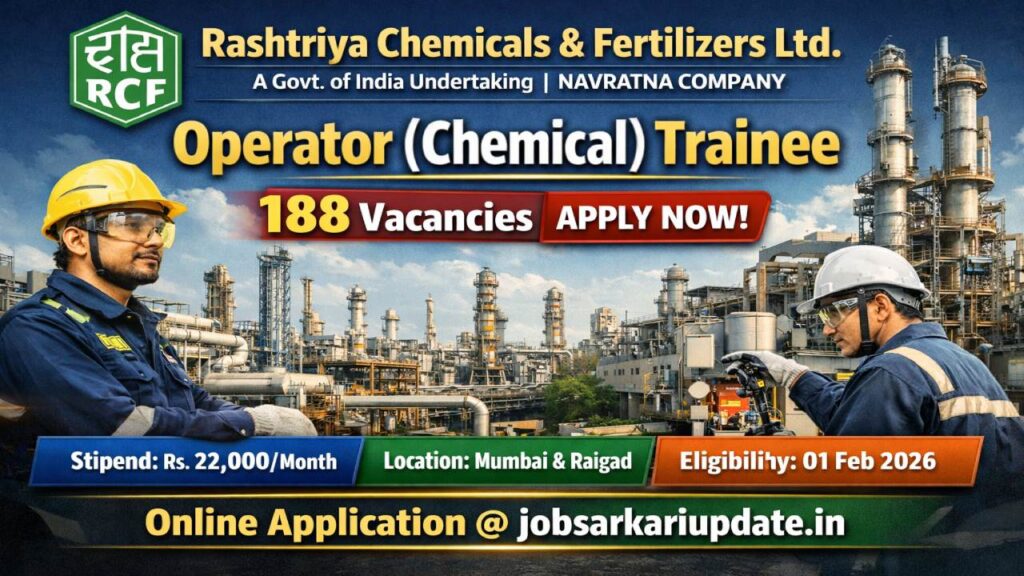
RCF Operator Chemical Trainee Recruitment 2026 – 188 Vacancies in Navratna PSU, Apply Online
The RCF Operator Chemical Trainee Recruitment 2026 has been officially announced by Rashtriya Chemicals and Fertilizers Limited (RCF Ltd), a profit-making Navratna company under the Government of India, through Advertisement No. 17022026. This notification invites online applications from eligible Indian citizens for 188 vacancies for the post of Operator (Chemical) Trainee in the Unionized Category. Applications opened on 11 April 2026 and the last date to apply is 27 April 2026 at 5:00 PM.
RCF Ltd is not an ordinary employer. As a Navratna Central Public Sector Undertaking with revenues of around Rs.17,098 crore, the company operates two major manufacturing units — one at Thal (Dist. Raigad, Maharashtra) and one at Trombay (Chembur, Mumbai) — producing fertilizers and industrial chemicals. A career at RCF offers PSU-grade job security, excellent salary, free medical care, company accommodation, and strong career growth — benefits that private sector chemical plant jobs rarely match.
The Operator (Chemical) Trainee position is a trainee-to-permanent conversion role. Selected candidates undergo a 6-month paid on-the-job training at Rs.22,000/month stipend, after which they are absorbed as Operator (Chemical) Grade-II in the A6 pay scale (Rs.22,000–60,000), with a gross monthly salary of approximately Rs.47,800. The role involves shift operations including night shifts, heavy physical work such as valve operations and equipment handling, and posting at either the Trombay or Thal plant. This is a hands-on, plant-floor chemical operations role — ideal for candidates with a B.Sc. (Chemistry) degree plus NCVT AO(CP) certification, or a Diploma in Chemical Engineering combined with BOAT training, or a Sandwich Diploma in Chemical Engineering.
With 188 vacancies across UR, SC, ST, OBC (NCL), and EWS categories, this is one of the largest PSU operator recruitments in the chemical sector in 2026. Competition will be high given RCF’s brand reputation. Candidates who apply early, prepare systematically, and document every qualification correctly will have the strongest chance of selection.
Recruitment Overview
RCF Ltd holds Navratna status — one of only a select group of central PSUs that have been granted this distinction for consistent financial performance and operational excellence. This status also means RCF has the autonomy to recruit independently and offer competitive compensation packages. The company’s dual-plant presence in Maharashtra ensures that selected Operator (Chemical) Trainees will gain exposure to world-class chemical plant operations, which itself is a significant career advantage. Candidates selected through this recruitment will be working alongside experienced chemical plant professionals in one of India’s most established fertilizer and chemicals companies.
| Detail | Information |
|---|---|
| Organisation Name | Rashtriya Chemicals and Fertilizers Limited (RCF Ltd) |
| Company Status | Navratna – Government of India Undertaking |
| Post Name | Operator (Chemical) Trainee |
| Post Code | OPTR_CHEM/022026 |
| Advertisement No. | 17022026 |
| Total Vacancies | 188 (tentative) |
| Category | Unionized Category (Workmen / Group C equivalent) |
| Job Location | Trombay (Chembur, Mumbai) or Thal (Dist. Raigad, Maharashtra) — as decided by Management |
| Pay Scale (after absorption) | Rs.22,000 – Rs.60,000 (A6 Grade) |
| Training Stipend | Rs.22,000/month (during 6-month training period) |
| Eligibility Cut-off Date | 01 February 2026 |
| Application Mode | Online Only – rcfltd.com |
Important Dates
The application window for RCF Operator Chemical Trainee Recruitment 2026 is extremely short — just 17 days, from 11 April to 27 April 2026. This is significantly tighter than most government or PSU recruitment windows, and it is a deliberate design choice by RCF that catches unprepared candidates off guard every cycle. Do not wait for the last weekend. PSU application portals often experience peak traffic in the final 48 hours, leading to login failures and payment gateway errors. Experienced PSU job applicants aim to submit within the first 3–5 days of the window opening. Since the portal opened on 11 April 2026, the ideal submission window is 11–15 April 2026. All subsequent communications from RCF will be sent exclusively via registered email — there will be no postal communication, making your active email ID critical throughout this process.
| Event | Date / Time |
|---|---|
| Eligibility Cut-off Date | 01 February 2026 |
| Online Application Start Date | 11 April 2026 at 8:00 AM |
| Online Application Last Date | 27 April 2026 at 5:00 PM |
| Online Test Date | To be communicated via Admit Card (downloaded from rcfltd.com) |
| Skill Test Date | To be notified — check rcfltd.com |
| Pre-Employment Medical Exam | To be notified after Skill Test |
| Result / Final Selection | To be notified — check rcfltd.com |
Important Notice: All dates are subject to change. If no communication is received within 90 days from the publication of the advertisement, it may be presumed the candidate has not been shortlisted. Regularly check rcfltd.com under “HR → RECRUITMENT” for all updates. No postal communication will be sent.
Application Fee
The application fee for RCF Operator Chemical Trainee Recruitment 2026 is Rs.700 (non-refundable) plus applicable bank charges and GST for General, EWS, and OBC (NCL) category candidates. SC/ST category candidates, Female candidates of all categories, and Ex-Servicemen are fully exempt from the application fee. This fee structure is standard for Navratna PSU recruitments. The fee is non-refundable under any circumstances — verify your eligibility completely before making payment. A commonly overlooked mistake is paying the fee and then discovering a disqualifying factor (such as not meeting the percentage requirement, or the NCVT AO(CP) certification date not meeting the cut-off). Payment can be made through Debit Cards (RuPay/Visa/MasterCard/Maestro), Credit Cards, Internet Banking, IMPS, Cash Cards, or Mobile Wallets. After payment, always wait for the server confirmation — do not press back or refresh to avoid double charges.
| Category | Application Fee | Payment Mode |
|---|---|---|
| General (UR) / EWS / OBC (NCL) | Rs.700 + Bank Charges + GST | Online Only (Debit/Credit Card, Net Banking, IMPS, Mobile Wallet) |
| SC / ST | Nil (Exempt) | Not applicable |
| Female Candidates (All Categories) | Nil (Exempt) | Not applicable |
| Ex-Servicemen | Nil (Exempt) | Not applicable |
Critical Warning: Application fee once paid will NOT be refunded under any circumstances, even if your application is rejected at any stage of the process. Verify every eligibility condition — particularly the NCVT AO(CP) qualification order, minimum percentage, age, and cut-off date compliance — before submitting payment.
Age Limit
The age limit for RCF Operator Chemical Trainee Recruitment 2026 is calculated as of the cut-off date of 01 February 2026. For Unreserved (General/UR) category candidates, the upper age limit is 30 years. For OBC (NCL) candidates, the upper age limit is 33 years (3 years relaxation). For SC and ST candidates, the upper age limit is 35 years (5 years relaxation). An additional concession of 5 years in the upper age limit is available for Ex-Servicemen and for children/family members of victims of the 1984 riots — this can stack with category relaxation where applicable as per DPE guidelines. There is no minimum age mentioned in the notification. Age is verified from the SSC Passing Certificate, School Leaving Certificate, or Municipal Birth Certificate — no other document is acceptable for age proof.
| Category | Upper Age Limit (as on 01.02.2026) | Age Relaxation |
|---|---|---|
| Unreserved / General (UR) | 30 Years | Nil |
| OBC (Non-Creamy Layer) | 33 Years | +3 Years |
| SC / ST | 35 Years | +5 Years |
| Ex-Servicemen / 1984 Riot Victim Family Members | +5 Years (additional concession over category limit) | +5 Years additional |
| EWS | 30 Years (same as UR) | Nil (as per DPE guidelines) |
Eligibility Criteria – Three Qualification Pathways Explained
The eligibility criteria for RCF Operator Chemical Trainee Recruitment 2026 offer three distinct qualification pathways. This is one of the most nuanced eligibility structures in any PSU recruitment — and also the most commonly misunderstood. Many candidates assume that simply holding a B.Sc. (Chemistry) degree is sufficient, or that any diploma in chemical engineering qualifies them. Neither assumption is correct. Each pathway has specific sequencing requirements and percentage thresholds that must be met as of the cut-off date of 01 February 2026. Final-year students are explicitly NOT eligible. Read each pathway carefully and match your exact qualification against the conditions.
Pathway 1: B.Sc. (Chemistry) + NCVT AO(CP) Trade
Candidates must hold a full-time, regular B.Sc. (Chemistry) degree from a UGC/AICTE recognised university or institution, with Physics as one of the subjects studied during any year of the 3-year B.Sc. course. In addition, they must have passed the National Council of Vocational Training (NCVT) examination in the Attendant Operator (Chemical Plant) — commonly known as AO(CP) Trade. The sequence matters critically: the NCVT AO(CP) must be completed after passing the B.Sc. (Chemistry) degree. Completing NCVT before or alongside the degree will not qualify.
Minimum Percentage: 55% in the last year or average aggregate of the last two semesters of B.Sc. (Chemistry). For SC/ST candidates: 50%.
Pathway 2: Diploma in Chemical Engineering + BOAT Training
Two sub-options exist here. Sub-option (a): A full-time, regular 3-year Diploma in Chemical Engineering/Technology from a UGC/AICTE recognised institution, plus successful completion of 1-year BOAT (Board of Apprenticeship Training) training under the Apprentice Act, 1961 (Amendment 1973). Sub-option (b): Candidates with HSC (Science) who gained direct admission to the second year / 3rd Semester of the 3-year Diploma in Chemical Engineering/Technology and subsequently completed 1 year of BOAT training. In both cases, the BOAT training must be completed after passing the Diploma.
Minimum Percentage: 55% in the last year or average aggregate of the last two semesters of the Diploma (50% for SC/ST candidates).
Pathway 3: Sandwich Diploma in Chemical Engineering
Candidates who completed a 4-year (8 Semesters) or 3.5-year (7 Semesters) full-time, regular Diploma in Chemical Engineering/Technology under the Sandwich pattern from a UGC/AICTE recognised institution are eligible — including those who entered via HSC (Science) direct admission to the second year. The Sandwich pattern must include 1-year or 6-month industrial training embedded in the course. No separate BOAT training is required for this pathway.
Minimum Percentage: 55% in the last year or average aggregate of the last two semesters of the Sandwich Diploma (50% for SC/ST candidates).
| Pathway | Primary Qualification | Additional Requirement | Sequence Rule | Min. Percentage (UR/OBC/EWS) | Min. Percentage (SC/ST) |
|---|---|---|---|---|---|
| 1 | Full-time B.Sc. (Chemistry) with Physics — UGC/AICTE recognised | NCVT Exam in AO(CP) Trade | NCVT must be completed AFTER B.Sc. degree | 55% | 50% |
| 2a | Full-time 3-Year Diploma in Chemical Engg./Tech. — UGC/AICTE recognised | 1-Year BOAT Training (Apprentice Act 1961) | BOAT must be completed AFTER Diploma | 55% | 50% |
| 2b | HSC (Science) + Direct admission to 2nd Year/3rd Sem of 3-Year Diploma in Chemical Engg./Tech. | 1-Year BOAT Training (Apprentice Act 1961) | BOAT must be completed AFTER Diploma | 55% | 50% |
| 3 | 4-Year (8 Sem) or 3.5-Year (7 Sem) Sandwich Diploma in Chemical Engg./Tech. — UGC/AICTE recognised (incl. HSC direct entry) | None (1-year/6-month industrial training embedded in course) | Not applicable | 55% | 50% |
Most Common Eligibility Mistake: Completing NCVT AO(CP) trade or BOAT training simultaneously with or before the B.Sc./Diploma degree. RCF’s notification explicitly states these must be completed after the degree/diploma is passed. Candidates with reversed sequencing will be disqualified at document verification, even if they cleared the online test. Also note: allied diploma streams (e.g., “Automation and Robotics Engineering”, “Power and Energy Engineering”) where “Chemical” does not appear as the primary word in the certificate name are NOT acceptable.
Vacancy Details
The total notified vacancy is 188 posts of Operator (Chemical) Trainee. The category-wise breakdown places 85 posts in the Unreserved (UR) category — the largest single category, reflecting the standard central government reservation formula. OBC (NCL) has 50 vacancies, which is the second-highest, making this a strong opportunity for eligible OBC candidates who can produce a valid Non-Creamy Layer certificate issued on or after 1st April 2025. SC has 18 vacancies and ST has 17 vacancies. EWS has 18 vacancies — candidates applying under EWS must ensure their Income and Assets Certificate is issued on or after 1st April 2025 and is in the prescribed Central Government format. It is important to note that vacancies are tentative and may be revised upward or downward based on project requirements and presidential directives on reservation, at the sole discretion of RCF Ltd.
| Post Name | UR | SC | ST | OBC (NCL) | EWS | Total |
|---|---|---|---|---|---|---|
| Operator (Chemical) Trainee | 85 | 18 | 17 | 50 | 18 | 188 |
Additionally, a panel of candidates will also be prepared for unforeseen vacancies — including those caused by the cessation of service of selected candidates — arising within one year from the date of empanelment. This means even candidates who narrowly miss the final merit list may have a chance at absorption through the panel.
Selection Process
The selection process for RCF Operator Chemical Trainee Recruitment 2026 consists of two stages: an Online Test and a Skill Test. There is no personal interview for this workmen category (Group C equivalent) recruitment. The final merit list is prepared exclusively on the basis of the Online Test score — the Skill Test is qualifying in nature only. This means your Online Test performance is the sole determinant of your rank in the final merit list. Every mark in the online test counts.
Stage 1: Online Test (Computer-Based Objective Type)
The online test is a computer-based objective/MCQ examination of 90 minutes duration, conducted at centres in Mumbai and Nagpur. The medium of test is Marathi, Hindi (Rajbhasha), and English. The test has 100 questions for 200 total marks. 80 questions (160 marks) come from discipline-specific course curriculum — covering the subject matter of your qualifying degree or diploma in Chemical Engineering/Chemistry. The remaining 20 questions (40 marks) are from General English, Quantitative Aptitude, Reasoning, and General Knowledge/Awareness. There is negative marking for wrong answers. Candidates scoring Nil marks or Negative marks in the online test are ineligible for document verification and Skill Test. Shortlisting for Skill Test is done in the ratio of 1:7 (7 candidates per vacancy, category-wise) from the online test merit list.
Stage 2: Document Scrutiny
Provisionally shortlisted candidates (ratio 1:7 from online test merit) undergo document scrutiny where all uploaded certificates are verified against the eligibility criteria. Failure to submit any required document at this stage results in immediate disqualification — no second chance will be given, and no further communication will be sent to rejected candidates. Upload every document at the application stage itself to prevent issues at this stage.
Stage 3: Skill Test (Qualifying)
The Skill Test is conducted after the online test for provisionally shortlisted candidates. It consists of two components: Practical Job Knowledge and Handling of Technical Equipment (80 marks) and Safety Awareness and Computer Knowledge (20 marks), for a total of 100 marks. The qualifying threshold is 60 marks for General/OBC/EWS candidates and 55 marks for SC/ST candidates. Passing the Skill Test is mandatory — failing it disqualifies the candidate regardless of their online test score. However, Skill Test marks are NOT added to the final merit — the merit list is based solely on online test performance.
Stage 4: Pre-Employment Medical Examination
Candidates who clear the Skill Test are called for a comprehensive pre-employment medical examination at an RCF-designated facility. This includes physical examination, audiometry, ECG, vision tests, blood and urine pathology, chest X-ray, lung function test, BMI measurement, and any other tests as recommended by RCF’s Medical Officer. Being called for a medical exam does not constitute final selection — the candidate must be declared medically fit. The job involves rotating shifts including night shifts and heavy physical work, so RCF’s medical standards are appropriately rigorous.
Exam Syllabus & Pattern
The online test for RCF Operator Chemical Trainee Recruitment 2026 is a computer-based objective examination of 90 minutes. It has 100 questions carrying a total of 200 marks — each question is worth 2 marks. There is negative marking for wrong answers (quantum not specified in the notification but standard PSU negative marking is typically 0.5 marks per wrong answer). The test is divided into two parts: discipline-specific (80 questions) and aptitude/general (20 questions).
Exam Pattern
| Part | Subject | Questions | Marks | Duration | Negative Marking |
|---|---|---|---|---|---|
| Part A | Discipline-related: Course curriculum of qualifying degree/diploma in Chemical Engineering/Chemistry | 80 | 160 | 90 Minutes | Yes (quantum per wrong answer — check admit card) |
| Part B | General English, Quantitative Aptitude, Reasoning, General Knowledge and Awareness | 20 | 40 | ||
| Total | 100 | 200 | |||
Skill Test Pattern
| Component | Marks | Qualifying Marks (General/OBC/EWS) | Qualifying Marks (SC/ST) |
|---|---|---|---|
| Practical Job Knowledge and Handling of Technical Equipment | 80 | 60 out of 100 | 55 out of 100 |
| Safety Awareness and Computer Knowledge | 20 | ||
| Total | 100 | Qualifying in nature — marks NOT added to final merit | |
Important Note on Marks Calculation: For the online test, only Theory subject marks and In-plant Training marks from your degree/diploma will be considered. Marks shown in Games/Sessional/Discipline subjects in your marksheet will NOT be considered when verifying the minimum percentage requirement. This is to maintain parity across different institutes and universities.
Preparation Tips for the Online Test
- Part A – Discipline (80 questions / 160 marks): This section tests the course curriculum of your qualifying degree or diploma. For B.Sc. (Chemistry) candidates, focus on Physical Chemistry, Organic Chemistry, Inorganic Chemistry, and Chemical Analysis. For Diploma in Chemical Engineering candidates, focus on Chemical Process Principles, Unit Operations, Heat Transfer, Mass Transfer, Fluid Mechanics, Chemical Reaction Engineering, and Instrumentation. Revise your NCVT AO(CP) or BOAT training material specifically for chemical plant process operations, safety, and equipment handling — this is directly relevant to Part A.
- Part B – Aptitude/GK (20 questions / 40 marks): Cover basic English grammar and comprehension, quantitative aptitude (percentages, ratios, averages, basic algebra), logical reasoning (series, analogies, coding-decoding), and current affairs with a focus on chemical/fertilizer industry news, government schemes, and science/technology updates.
- Tiebreaker awareness: If two candidates score the same in the online test, RCF uses (a) highest SSC percentage, (b) earlier date of birth, and (c) earlier application number as tiebreakers — in that order. This makes your SSC percentage relevant even at the online test stage.
Salary, Stipend & Benefits
The compensation structure for RCF Operator Chemical Trainee Recruitment 2026 is one of the most attractive in the PSU chemical sector for a workmen category role. The training period offers Rs.22,000/month stipend plus free hostel accommodation (shared basis), medical facility for self at RCF Hospital, and access to the RCF Sports Complex — all at no cost during training. After successful completion of the 6-month training period, the trainee is absorbed as Operator (Chemical) Grade-II in the A6 pay scale.
| Parameter | Training Period (6 Months) | After Absorption (A6 Grade) |
|---|---|---|
| Monthly Compensation | Rs.22,000/month (stipend) | Rs.22,000 (Basic Pay) + VDA (53.4%) + Perks (34%) + HRA (30% for Class A cities) |
| Gross Monthly Salary | Rs.22,000 | Approximately Rs.47,800/month (Class A city rate) |
| Pay Scale | Not applicable (stipend basis) | Rs.22,000 – Rs.60,000 (A6 Grade) |
| Accommodation | Free hostel/quarter (shared basis) | Company accommodation subject to availability (in lieu of HRA) |
| Medical Coverage | Self (at RCF Hospital) | Self and dependents (free medical facility) |
| Other Benefits | RCF Sports Complex access | Performance Related Pay (PRP), Gratuity, Contributory Provident Fund (CPF), Accident Insurance, Social Security Schemes |
To put the post-absorption salary in perspective: a gross salary of approximately Rs.47,800/month at the entry level of a Navratna PSU — with free medical coverage for self and family, PF contributions, gratuity, accident insurance, and the potential for company accommodation — represents a total compensation package that far exceeds what most private chemical plant operators earn at equivalent qualification levels. Career growth within RCF proceeds through the pay scale increments and departmental grade progression, with long-service employees reaching significantly higher compensation levels.
How to Apply Online – Step by Step
Pre-Application Checklist
- Valid personal email ID (keep active for at least 1 year — all communications will be sent here)
- Valid mobile number (keep active throughout the recruitment process)
- Recent passport-size colour photograph (4.5cm × 3.5cm, white background, 200×230 pixels, 20–50 KB, JPG/JPEG)
- Signature on white paper with black ink (140×60 pixels, 10–20 KB, JPG/JPEG)
- Left thumb impression on white paper with black or blue ink (240×240 pixels / 3cm×3cm, 200 DPI, 20–50 KB, JPG/JPEG)
- Handwritten declaration in English on white paper with black ink: “I, [Name], hereby declare that all the information submitted by me in the application form is correct, true and valid. I will present the supporting documents as and when required.” (800×400 pixels, 50–100 KB, JPG/JPEG)
- B.Sc. (Chemistry) Degree Certificate and Marksheets OR Diploma Certificate and Marksheets (as applicable to your pathway)
- NCVT AO(CP) Trade Certificate (if Pathway 1) OR BOAT Training Certificate (if Pathway 2)
- SSC (Class 10) Passing Certificate / School Leaving Certificate / Municipal Birth Certificate (for age proof)
- Caste Certificate in Central Government prescribed proforma (SC/ST/OBC NCL candidates)
- OBC NCL Certificate issued on or after 01 April 2025 (for OBC NCL candidates)
- Income and Assets Certificate issued on or after 01 April 2025 (for EWS candidates)
- Disability Certificate from designated authority (if PwBD)
- NOC from current employer (if employed in Central/State Govt./PSU/Autonomous Body)
- Credit/Debit Card, Net Banking, or Mobile Wallet for Rs.700 fee payment (if applicable)
- Visit the Official RCF Portal: Go to rcfltd.com and navigate to “HR → RECRUITMENT.” Click on “APPLY ONLINE” for Advertisement No. 17022026.
- New Registration: Click “Click here for New Registration.” Enter your name, contact details, and email ID. Note your Provisional Registration Number and Password — they will also be sent via email and SMS.
- Fill the Application Form: Enter personal details, qualification details (pathway, institution, percentage, year of passing, NCVT/BOAT/Sandwich details), category, and all other required fields. Use “SAVE AND NEXT” to save progress. Do not click “COMPLETE REGISTRATION” until you have reviewed everything — no changes are possible after this.
- Upload Photo, Signature, Thumb Impression, and Declaration: Upload each item in the specified format and file size. Also capture a live photograph via webcam or mobile scan (QR code option) as required by the portal. Verify each uploaded image for clarity before proceeding.
- Upload All Required Documents in PDF: Combine documents for each tab into a single PDF file (max 500 KB per file). Upload as per the list in Annexure IV of the advertisement. Submit your declaration: “I hereby declare that I have uploaded all documents as per the eligibility criteria…”
- Pay Application Fee: Click the “Payment” tab. Pay Rs.700 (plus bank charges and GST) via Debit Card, Credit Card, Net Banking, IMPS, or Mobile Wallet. Wait for the server confirmation before closing the page. Save the e-Receipt printout — do not refresh or press back during payment processing.
- Final Submit and Printout: Click “Submit” after confirming all details and successful payment. Print your system-generated application form and e-Receipt. Retain both — they may be required at the Skill Test or other stages.
3 Most Common Application Mistakes:
- Uploading the NCVT/BOAT/Diploma certificate without verifying the sequence rule — the additional qualification must be completed AFTER the primary degree/diploma, not before or alongside
- Uploading a handwritten declaration written in any language other than English, or in capital letters — this invalidates the application
- Not taking a printout of the e-Receipt and application form — candidates who cannot produce these at later stages face verification issues
Important Instructions for Candidates
- Only Indian citizens are eligible to apply. Final-year students of Graduation or Post-Graduation are NOT eligible.
- The category (SC/ST/OBC/EWS) once submitted in the application will NOT be changed under any circumstances, and no benefit of a different category will be admissible later.
- OBC (NCL) candidates must produce their latest Non-Creamy Layer Certificate in the Central Government prescribed proforma, issued on or after 01 April 2025. OBC candidates falling in the Creamy Layer are NOT entitled to OBC reservation.
- EWS Income and Assets Certificate must be issued on or after 01 April 2025, in the prescribed format for Central Government appointments.
- Candidates employed in Central/State Government, PSUs, or Autonomous Bodies must submit an NOC from their employer at the time of the Skill Test. Without an NOC, candidature will be rejected — no exception applies.
- The name entered in the application must exactly match the name on your SSC certificate and photo identity proof. Any mismatch will result in disqualification from the examination hall.
- Candidates who have changed their name (e.g., post-marriage) must carry their original Gazette notification, original marriage certificate, or original affidavit at the time of exam.
- Details submitted in the online application form are final — no changes will be entertained including change in category, exam centre city, email, or mobile number.
- Do NOT carry mobile phones, calculators, or any electronic devices into the examination hall. Violation leads to disqualification and possible debarring from all future RCF recruitments.
- Canvassing in any form at any stage is a disqualification for employment.
- This content is for informational purposes only. Always rely on the official notification on rcfltd.com for all recruitment-related decisions.
Expert Tips to Crack RCF Operator Chemical Trainee Recruitment 2026
Apply in the First Week
The application window closes on 27 April 2026 at 5:00 PM — and it opened only on 11 April. This gives you just 17 days total, which is extremely short for a PSU recruitment of this scale and documentation complexity. The RCF portal typically sees a heavy surge in the last 3–4 days as candidates scramble to gather documents at the last minute. Apply between 11–15 April 2026. This not only protects you from technical failures but also gives you a lower application number — which can matter as a tiebreaker if you and another candidate score identically in the online test.
Read the Full Notification Before Filling the Form
This is a 20-page notification with one of the most complex eligibility structures in any PSU recruitment — three qualification pathways, specific sequencing rules for NCVT/BOAT, detailed percentage calculation instructions, strict document upload requirements, and multiple certificate validity conditions. Many candidates have paid the non-refundable Rs.700 fee before discovering they did not meet the NCVT completion sequence requirement, or that their OBC NCL certificate predates April 2025. Read the notification cover-to-cover before starting the application form. Pay special attention to Section II (Date of Reckoning Eligibility) and the Annexure IV document list.
Prepare All Documents Before Starting the Application
This recruitment requires uploading four biometric/personal items (photograph, signature, left thumb impression, handwritten declaration) and all supporting qualification documents in PDF, all at the time of application itself. Gathering and scanning everything in advance is not optional — it is essential. Prepare your handwritten declaration in English, on white paper, with black ink, in your own handwriting (not printed or typed). Ensure your NCVT or BOAT training certificate clearly shows the date of issue and the name of the trade, and that this date is after your degree/diploma passing date.
Focus Online Test Preparation on Chemical Engineering Fundamentals
With 80 out of 100 questions in the online test coming from discipline-specific course curriculum, your preparation must be grounded in the actual subject matter of your qualifying degree or diploma. For B.Sc. (Chemistry) candidates, key focus areas are reaction kinetics, thermodynamics, analytical chemistry, and chemical plant operations (covered in NCVT AO(CP) material). For Diploma in Chemical Engineering candidates, core topics include unit operations, chemical processes, fluid mechanics, heat and mass transfer, plant safety, and instrumentation. Revise your institute notes, NCVT/BOAT training manuals, and solve previous RCF online test papers (available on major PSU preparation platforms). The remaining 20 questions on aptitude and GK should be covered through any standard PSU aptitude preparation guide.
Clear the Skill Test Qualifying Threshold
The Skill Test requires 60 marks out of 100 for General/OBC/EWS candidates and 55 marks for SC/ST candidates. While this is a qualifying stage (marks don’t count toward final merit), failing it ends your candidacy after you’ve already cleared the much harder online test. The Skill Test covers Practical Job Knowledge and Handling of Technical Equipment (80 marks) plus Safety Awareness and Computer Knowledge (20 marks). Prepare for this stage by reviewing your NCVT AO(CP) or BOAT practical training material, industrial safety protocols (including HAZOP, PPE use, valve operations, and process shutdowns), and basic computer skills.
Stay Updated on Admit Card, Skill Test, and Result Dates
All communications from RCF — including admit card availability, online test date, Skill Test call letters, and final selection — are communicated exclusively via your registered email and on rcfltd.com under “HR → RECRUITMENT.” RCF has explicitly stated it will not be responsible for emails not received due to invalid IDs. Keep your registered email inbox active for at least one year from the application date. Check the official website at least twice a week after submission. If you receive no communication within 90 days of the advertisement date, you may presume you have not been shortlisted.
Frequently Asked Questions (FAQs)
- 1. How many vacancies are available in RCF Operator Chemical Trainee Recruitment 2026?
- There are 188 tentative vacancies — 85 UR, 18 SC, 17 ST, 50 OBC (NCL), and 18 EWS. The number may change based on project requirements and presidential directives at the time of appointment.
- 2. What is the eligibility qualification for this recruitment?
- There are three pathways: (1) B.Sc. Chemistry with NCVT AO(CP) Trade completed after the degree; (2) 3-year Diploma in Chemical Engineering/Technology with 1-year BOAT training completed after the diploma (including HSC direct entry path); (3) 4-year or 3.5-year Sandwich Diploma in Chemical Engineering/Technology. All pathways require minimum 55% marks (50% for SC/ST), from UGC/AICTE recognised institutions, as of the cut-off date 01 February 2026.
- 3. Can final-year students apply for this recruitment?
- No. The notification explicitly states that candidates in the final year of Graduation or Post-Graduation are NOT eligible to apply. All qualifications must be fully completed as of the cut-off date of 01 February 2026.
- 4. What is the age limit for RCF Operator Chemical Trainee Recruitment 2026?
- Upper age limit as of 01 February 2026: 30 years for General/UR/EWS, 33 years for OBC (NCL), and 35 years for SC/ST. An additional 5-year relaxation applies for Ex-Servicemen and children/family members of 1984 riot victims, as per DPE guidelines.
- 5. What is the application fee?
- Rs.700 plus bank charges and GST for General/EWS/OBC (NCL) candidates. SC/ST candidates, Female candidates of all categories, and Ex-Servicemen are fully exempt. The fee is non-refundable under any circumstances.
- 6. What is the last date to apply for RCF Operator Chemical Trainee 2026?
- The online application window closes on 27 April 2026 at 5:00 PM. Applications opened on 11 April 2026 at 8:00 AM. No extensions are typically granted — apply well before the deadline.
- 7. What is the selection process for this recruitment?
- Selection consists of an Online Test (computer-based, 100 MCQ questions, 200 marks, 90 minutes) followed by a Skill Test (qualifying, 100 marks). The final merit is based 100% on the Online Test score. There is no personal interview.
- 8. Is there negative marking in the online test?
- Yes, there is negative marking for wrong answers in the online test. The specific deduction per wrong answer will be communicated in the admit card. Candidates scoring Nil or Negative total marks will be ineligible for further stages.
- 9. What is the salary for Operator (Chemical) Trainee at RCF?
- During the 6-month training period, trainees receive Rs.22,000/month stipend plus free accommodation, medical care, and sports facility access. After absorption into Grade A6, the gross monthly salary is approximately Rs.47,800 (Basic Pay + VDA 53.4% + Perks 34% + HRA 30% for Class A cities). Additional benefits include PRP, free medical for self and family, gratuity, CPF, and accident insurance.
- 10. What is the NCVT AO(CP) trade and why is its sequence important?
- NCVT AO(CP) stands for National Council of Vocational Training examination in the Attendant Operator (Chemical Plant) trade. It is a vocational certification for chemical plant operations. The sequence matters because RCF’s notification requires this to be completed AFTER the B.Sc. (Chemistry) degree is passed — completing it before or simultaneously with the degree disqualifies the candidate.
- 11. Where will the online test be conducted?
- The online test will be conducted at centres in Mumbai and Nagpur only. The exact venue is communicated through the admit card. Requests for change of exam centre, venue, date, or session after final submission of the online application form will not be entertained.
- 12. What documents are needed for the application?
- All documents must be uploaded in PDF format at the time of online application itself. Key documents include: degree/diploma certificate and marksheets, NCVT AO(CP) or BOAT training certificate, SSC certificate (for age proof), caste certificate (if applicable), OBC NCL certificate (issued after 01 April 2025), EWS Income and Assets certificate (issued after 01 April 2025), and NOC from current employer (if employed in government/PSU). The complete list is in Annexure IV of the official notification.
Important Links
| Apply Online | Apply Now |
| Download Notification | Click Here |
| Official Website | Click Here |
Recent Jobs
Check out our latest job postings
800 Jobs Available
URSC Apprentice 2026 - Quick Summary: ISRO's URSC has released notification for 410 Graduate, Technician & Commercial Practice Apprentice vacancies....
Read Full Details
JSSC Excise Constable Result 2026 - Quick Summary: JSSC has declared the JECCE 2023 result on July 28, 2026 for...
Read Full Details
Bank of Baroda Office Assistant Result 2026 - Quick Summary: Bank of Baroda has declared the final result for Office...
Read Full Details
UP TGT Result 2026 - Quick Summary: UPESSC has declared the final result for TGT Recruitment 2026 for 2,982 posts...
Read Full Details
AAI Apprenticeship 2026 - Quick Summary: Airports Authority of India Eastern Region has released notification for 140 Apprenticeship vacancies (Graduate:...
Read Full Details