





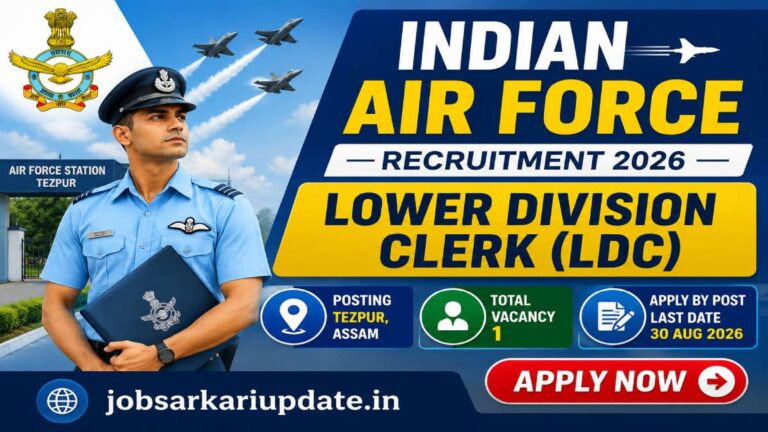
IAF LDC 2026 - Quick Summary: Indian Air Force has released notification for 1 Lower Division Clerk (LDC) vacancy at...
Read Full DetailsSSC Selection Post Phase 14 Recruitment 2026 – Apply Online
SSC Selection Post Phase 14 Recruitment 2026 – Complete Guide for All Eligible Candidates
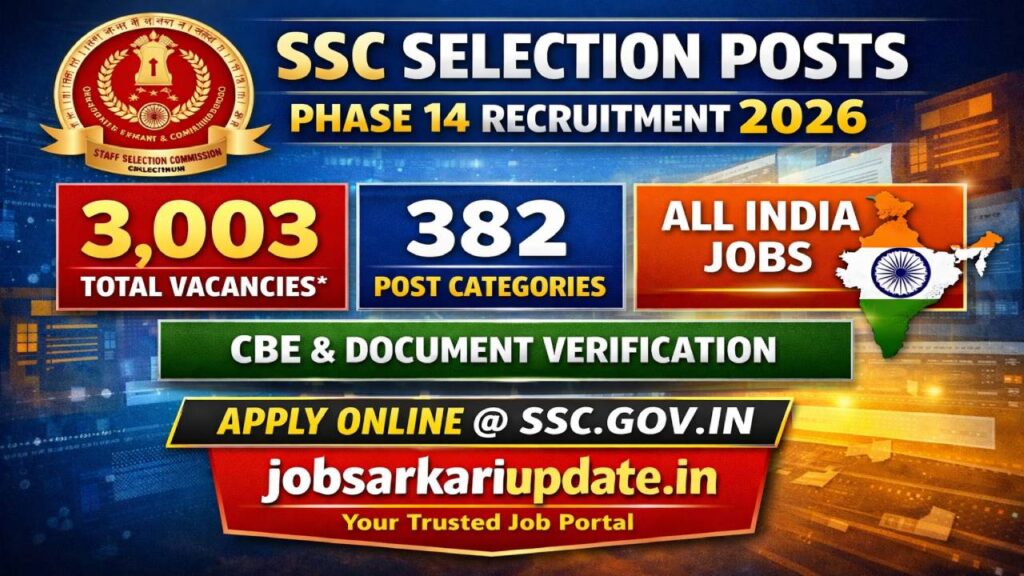
The SSC Selection Post Phase 14 Recruitment 2026 has been officially released by the Staff Selection Commission (SSC) under Advertisement No. Phase-XIV/2026/Selection Posts on 13 April 2026. This is one of the most anticipated annual recruitment drives by SSC, offering a total of 3,003 vacancies spread across 382 post categories from various Central Government Ministries, Departments, and Organizations across India. Posts are available at three educational qualification levels: Matriculation (10th), Higher Secondary (10+2), and Graduation & above.
This recruitment is unique because it consolidates hundreds of different government post categories — from Laboratory Attendants and Store Clerks to Scientific Assistants and Junior Engineers — under a single examination process. Whether you have passed Class 10, Class 12, or hold a graduation degree, there are posts open at your level. The wide range of departments — spanning Defence, Health, Agriculture, Mines, Environment, Finance, and many more — means candidates across streams and disciplines will find relevant posts.
The online application window opened on 13 April 2026 and the last date to apply is 04 May 2026 (up to 2300 Hrs.). The Computer Based Examination (CBE) is tentatively scheduled for June 2026. With 3,003 vacancies and lakhs of applicants expected across the country, this is both a high-opportunity and high-competition recruitment. Understanding the eligibility, exam pattern, cut-off rules, and selection process in detail is the most important preparation you can do right now.
The government has also emphasized gender balance in this recruitment — women candidates are especially encouraged to apply. With the application correction window (11–13 May 2026) and Aadhaar-based authentication option making the process more candidate-friendly, Phase 14 is one of the most accessible SSC recruitment cycles in recent years.
Recruitment Overview
The Staff Selection Commission is one of India’s most credible and high-volume recruitment bodies, operating under the Ministry of Personnel, Public Grievances & Pensions, Department of Personnel & Training. SSC Selection Posts are permanent Central Government positions — not contractual or temporary — and carry full government service benefits including pension (NPS), medical facilities, provident fund, and promotion prospects. Phase-wise Selection Post examinations are conducted annually, and Phase 14 for 2026 is the current edition. Candidates should note that they must apply separately for each post category they wish to be considered for, and fee must also be paid separately per category.
| Detail | Information |
|---|---|
| Organization Name | Staff Selection Commission (SSC) |
| Advertisement No. | Phase-XIV/2026/Selection Posts |
| Total Vacancies | 3,003 (Tentative) |
| Total Post Categories | 382 |
| Job Location | All India (All India Service Liability) |
| Job Type | Central Government — Permanent Posts |
| Application Mode | Online (ssc.gov.in / mySSC App) |
| Selection Mode | Computer Based Examination (CBE) + Document Verification |
| Exam Language | Hindi and English only |
| File No. | HQ-RHQS015/1/2026/C-4 |
Important Dates
The application window for SSC Phase 14 2026 is 22 days — a relatively tight period. Candidates must also note that a correction window is available from 11 to 13 May 2026, but it carries a fee: ₹200 for the first correction and ₹500 for the second. Avoiding mistakes during initial submission is far cheaper than correcting them later. SSC strongly advises candidates to apply well before the closing date of 04 May 2026, as heavy traffic on the SSC website near the deadline often causes disconnection issues. The crucial date for age calculation is 01 January 2026 (not the closing date), while the crucial date for Essential Qualifications and category certificates is the closing date: 04 May 2026.
| Event | Date / Deadline |
|---|---|
| Notification Upload Date | 13 April 2026 |
| Online Application Start Date | 13 April 2026 |
| Last Date for Online Application | 04 May 2026 (Up to 2300 Hrs.) |
| Last Date for Online Fee Payment | 05 May 2026 (Up to 2300 Hrs.) |
| Application Correction Window | 11 May 2026 to 13 May 2026 (Up to 2300 Hrs.) |
| Age Cut-off Date | 01 January 2026 |
| Essential Qualification (EQ) Cut-off Date | 04 May 2026 (Closing Date) |
| OBC/EWS Crucial Date | 04 May 2026 |
| Computer Based Examination (CBE) | June 2026 (Tentative) |
| Admit Card / Hall Ticket | Available on SSC website ~10 days before exam |
| Result Date | Not mentioned in official notification |
Notice: All dates are based on the official SSC Phase-XIV/2026 notification published on 13 April 2026. Dates are subject to change. Candidates are advised to monitor the official SSC website (ssc.gov.in) and their respective Regional Office website regularly for updates.
Application Fee
The application fee for SSC Selection Post Phase 14 is ₹100 per post category. Since candidates must apply and pay separately for each category of post they wish to be considered for, the total cost depends on the number of applications submitted. Fee can only be paid online — no offline/cash payment is accepted. Women candidates and candidates from SC, ST, PwBD, and ESM (Ex-Servicemen) categories eligible for reservation are fully exempted from payment. One critical mistake many candidates make: if your fee payment fails or remains incomplete, your application status will show as “Incomplete” and will be summarily rejected. Always verify your payment status through the “Payment Status” link in your candidate login after submitting the fee.
| Category | Application Fee | Payment Mode |
|---|---|---|
| General / UR / OBC / EWS (Male) | ₹100 per post category | BHIM UPI / Net Banking / Visa / MasterCard / Maestro / RuPay |
| Women (All Categories) | Exempted (₹0) | Not applicable |
| SC / ST | Exempted (₹0) | Not applicable |
| PwBD (Persons with Benchmark Disabilities) | Exempted (₹0) | Not applicable |
| Ex-Servicemen (ESM) | Exempted (₹0) | Not applicable |
| Application Correction Charge (1st time) | ₹200 | Online modes only |
| Application Correction Charge (2nd time) | ₹500 | Online modes only |
Important: Fee once paid is non-refundable and cannot be adjusted against any other SSC examination. In the event of cancellation of a post, fee paid for that post will also not be refunded. Pay the fee separately for each post category you apply for.
Age Limit
The age limit for SSC Phase 14 2026 varies by post category and is calculated as on 01 January 2026. Different posts carry different minimum and maximum age brackets — ranging from 18–25 years at the lower end to 23–28 years for senior technical roles. To calculate your eligibility: if the age limit for your post is 18–27 years, you must have been born on or after 02 January 1999 (not earlier) and on or before 01 January 2008 (not later). Your Matriculation/Secondary Examination certificate date of birth is the only accepted proof — no subsequent request for change of date of birth will be entertained.
| Age Bracket | Born Not Earlier Than | Born Not Later Than |
|---|---|---|
| 18–25 years | 02 January 2001 | 01 January 2008 |
| 18–27 years | 02 January 1999 | 01 January 2008 |
| 18–28 years | 02 January 1998 | 01 January 2008 |
| 18–30 years | 02 January 1996 | 01 January 2008 |
| 18–35 years | 02 January 1991 | 01 January 2008 |
| 20–25 years | 02 January 2001 | 01 January 2006 |
| 20–30 years | 02 January 1996 | 01 January 2006 |
| 21–27 years | 02 January 1999 | 01 January 2005 |
| 21–28 years | 02 January 1998 | 01 January 2005 |
| 22–28 years | 02 January 1998 | 01 January 2004 |
| 23–28 years | 02 January 1998 | 01 January 2003 |
Age Relaxation
| Category Code | Category | Age Relaxation |
|---|---|---|
| 01 | SC / ST | 5 years |
| 02 | OBC | 3 years |
| 03 | PwBD (General) | 10 years |
| 04 | PwBD (OBC) | 13 years |
| 05 | PwBD (SC/ST) | 15 years |
| 06 | Ex-Servicemen (ESM) | 3 years (after deducting military service from actual age) |
| 08 | Defence Personnel — disabled in operations (General) | 3 years |
| 09 | Defence Personnel — disabled in operations (SC/ST) | 8 years |
| 10 | Central Govt. Civilian Employees (CGCE) — Group C only, 3+ years service | Up to 40 years of age |
| 11 | CGCE (SC/ST) — Group C only, 3+ years service | Up to 45 years of age |
| 12 | Widows / Divorced Women / Women judicially separated (not remarried) | Up to 35 years of age |
| 13 | Widows / Divorced Women / Women judicially separated (SC/ST, not remarried) | Up to 40 years of age |
Age relaxation applies only when the candidate is applying against reserved vacancies of the respective category. Candidates from reserved categories applying against unreserved (UR) vacancies will get age relaxation only to the extent available for UR candidates. CGCE age relaxation is not applicable for Group ‘B’ posts.
Eligibility Criteria
Educational qualifications for SSC Selection Post Phase 14 are post-specific and fall into three broad levels. The most important eligibility rule: the Commission does NOT verify eligibility at the application stage. Applications are accepted provisionally, and scrutiny of documents is done by the User Department after the CBE result. This means a candidate who applies without meeting the EQ and clears the exam can still be rejected at the document verification stage — wasting both time and effort. The most common eligibility mistake is applying for a post without confirming whether your specific degree, stream, or experience matches the post’s Essential Qualifications (EQs) as listed in Annexure-III. Equivalence of qualifications is not permitted unless explicitly stated in the post’s EQ.
| EQ Level | Minimum Qualification Required | Exam Type | Example Post Types |
|---|---|---|---|
| Matriculation Level | 10th / Matriculation Pass | Separate CBE (Matric level paper) | MTS, Lab Attendant, Driver, Mechanic, Store Attendant |
| Higher Secondary Level | 12th / Higher Secondary (10+2) Pass | Separate CBE (10+2 level paper) | Stenographer, Store Clerk, Pharmacist-cum-Clerk, Stockman, Marine Electrician |
| Graduation & Above Level | Bachelor’s Degree (B.E./B.Tech/B.Sc/B.Com/B.A./BBA or equivalent) | Separate CBE (Graduation level paper) | Scientific Assistant, Technical Assistant, Junior Chemist, Junior Engineer, Accountant, Research Assistant |
Each post in Annexure-III has specific Essential Qualifications. Candidates must check post-wise EQ details at the SSC website (Annexure-III section) for the exact qualification, stream, subject, and experience requirements before applying. Experience gained during internship, training, or as part of an educational programme is NOT counted as work experience even if acquired after the qualifying degree.
Category-wise and Level-wise Vacancy Details
A grand total of 3,003 vacancies across 382 post categories have been advertised through 9 regional offices of SSC. The category-wise breakup shows 1,534 UR seats (51%), 667 OBC seats (22%), 346 SC seats (11.5%), 271 EWS seats (9%), and 185 ST seats (6.2%). Additionally, 101 seats are reserved for Ex-Servicemen (ESM), 40 for Orthopedically Handicapped (OH), 40 for Hearing Handicapped (HH), 24 for Visually Handicapped (VH), and 15 for other PwBD categories. The OBC category is numerically the second-largest reserved group — candidates with OBC (NCL) certificates should note the crucial date of 04 May 2026 and ensure their certificate is valid for FY 2026-27.
| Category | Vacancies | % Share |
|---|---|---|
| UR (Unreserved) | 1,534 | ~51% |
| OBC (Non-Creamy Layer) | 667 | ~22% |
| SC | 346 | ~11.5% |
| EWS | 271 | ~9% |
| ST | 185 | ~6.2% |
| Total (Vertical) | 3,003 | — |
| ESM (Horizontal) | 101 | Within total |
| OH — Orthopedic (Horizontal) | 40 | Within total |
| HH — Hearing (Horizontal) | 40 | Within total |
| VH — Visual (Horizontal) | 24 | Within total |
| Other PwBD (Horizontal) | 15 | Within total |
Vacancies are tentative. SSC reserves the right to alter, cancel, withdraw, or merge any vacancy at any time. Post-wise vacancy details for all 382 categories are available in Annexure-III of the official notification and on the SSC website under Phase-XIV/2026/Selection Posts.
Selection Process
The selection process for SSC Phase 14 2026 is multi-stage and strictly merit-driven. Understanding each stage gives candidates a significant edge in preparation and reduces the risk of rejection at later stages. There are no interviews for these posts — selection is entirely based on CBE score, document scrutiny, and skill tests where applicable.
Stage 1: Computer Based Examination (CBE)
All provisionally eligible candidates will be issued admission certificates and called to appear in the CBE scheduled tentatively for June 2026. Three separate CBEs are conducted simultaneously — one each for Matriculation, Higher Secondary (10+2), and Graduation & above levels. Candidates who have applied for posts of multiple EQ levels will appear in separate exams for each level. A candidate must not appear twice in the CBE for the same EQ level — doing so results in cancellation of candidature. The exam carries negative marking of 0.50 marks per wrong answer, and a sectional timer of 15 minutes applies to each part (20 minutes per part for scribe-eligible candidates).
Minimum qualifying cut-off marks to proceed to the next stage: UR — 30%, OBC/EWS — 25%, Other reserved categories — 20%. Candidates below these thresholds will not be considered regardless of vacancy availability.
Stage 2: Shortlisting for Document Scrutiny
Based on CBE scores, candidates are shortlisted in the following ratio for document scrutiny: 1:30 for posts with up to 5 vacancies in a category, and 1:15 (minimum 150 candidates) for posts with more than 5 vacancies. Shortlisted candidates must upload self-attested copies of all supporting documents — EQ certificates, experience proof, category certificate, age proof, etc. — on the SSC portal. Missing or incorrect documents at this stage leads to direct rejection.
Stage 3: Skill Test (Where Applicable)
For post categories where a Typing Test, Data Entry Skill Test, or Computer Proficiency Test is prescribed as an EQ, such tests will be conducted among candidates who are found eligible after document scrutiny. These tests are qualifying in nature unless specified otherwise in the post details. Begin practising typing or data entry alongside CBE preparation if your target post requires it.
Stage 4: Document Verification by User Department
Candidates who clear the scrutiny stage are called for Document Verification (DV) by the User Department to which the post belongs. The DV venue and date are communicated by the User Department — not SSC directly. Candidates must produce all original documents at DV. Failure to produce originals results in immediate disqualification. Call letters for DV will be issued on the User Department’s website or via SMS/email/post.
Stage 5: Final Select List
After DV, User Departments prepare and forward final select lists to SSC. In the event of a tie in CBE scores, the following tie-breaking order is applied: (a) Total normalized marks in CBE, (b) Marks in Part-A, (c) Part-B, (d) Part-C, (e) Date of birth (older candidate ranked higher), (f) Alphabetical order of name. Clearing all stages is mandatory — success in the CBE alone does not confer any right of appointment.
Exam Pattern and Syllabus
The CBE for SSC Selection Post Phase 14 2026 follows the same structure across all three levels, with 100 questions for 200 marks in 60 minutes. Each correct answer carries 2 marks and each wrong answer incurs a penalty of 0.50 marks. The exam is available in Hindi and English only — candidates must select their medium at the application stage and cannot change it later.
Exam Pattern (All Three Levels)
| Part | Subject | Questions | Maximum Marks | Duration |
|---|---|---|---|---|
| A | General Intelligence | 25 | 50 | 60 minutes (15 min sectional timer per part) 80 minutes for scribe-eligible candidates |
| B | General Awareness | 25 | 50 | |
| C | Quantitative Aptitude (Basic Arithmetic Skill) | 25 | 50 | |
| D | English Language (Basic Knowledge) | 25 | 50 | |
| Total | 100 | 200 | — | |
Negative Marking: 0.50 marks deducted per wrong answer. Each part has a sectional timer of 15 minutes — you cannot go back to a previous section after time expires for that section.
Syllabus — Matriculation Level
| Subject | Key Topics |
|---|---|
| General Intelligence | Non-verbal type questions; similarities/differences, space visualization, problem solving, analysis, judgment, visual memory, figure classification, arithmetical number series, abstract ideas and symbols |
| General Awareness | General awareness of environment; current affairs; India & neighbouring countries — History, Culture, Geography, Sports, Economy, Indian Constitution, Scientific Research |
| Quantitative Aptitude | Number systems, whole numbers, decimals, fractions, fundamental arithmetic operations, percentages, ratio & proportion, averages, interest, profit & loss, discount, tables & graphs, mensuration, time & distance, time & work |
| English Language | Basic English vocabulary, grammar, sentence structure, synonyms, antonyms, correct usage and writing ability |
Syllabus — Higher Secondary (10+2) Level
| Subject | Key Topics |
|---|---|
| General Intelligence | Verbal & non-verbal: Semantic/Symbolic Analogy, Venn Diagrams, Space Orientation, Figural Classification, Drawing Inferences, Number Series, Figural Patterns, Critical Thinking, Coding-Decoding, Emotional & Social Intelligence |
| General Awareness | Current affairs; India & neighbouring countries — History, Culture, Geography, Economic Scene, General Polity, Scientific Research |
| Quantitative Aptitude | Arithmetic (Number Systems, Percentage, Ratio, Profit/Loss, SI/CI, Mixture, Time & Work, Time & Distance); Algebra (Basic identities, Linear equations); Geometry (Triangles, Circles, Congruence); Mensuration; Trigonometry; Statistical Charts (Histogram, Bar, Pie) |
| English Language | Spot the Error, Fill in the blanks, Synonyms/Homonyms, Antonyms, Spellings, Idioms & Phrases, One-word substitution, Sentence Improvement, Active/Passive Voice, Direct/Indirect Narration, Cloze Passage, Comprehension Passage |
Syllabus — Graduation & Above Level
| Subject | Key Topics |
|---|---|
| General Intelligence | Verbal & non-verbal: Analogies, Space Visualization, Problem Solving, Syllogistic Reasoning, Statement-Conclusion, Coding-Decoding, Figural Series, Number Series, Venn Diagrams, Critical/Emotional/Social Intelligence |
| General Awareness | Current events; India & neighbouring countries — History, Culture, Geography, Economic Scene, General Polity & Scientific Research (higher standard than 10+2) |
| Quantitative Aptitude | Whole numbers, percentages, square roots, profit & loss, discount, interest, time & work, Algebra basics, Geometry (Triangles, Circles), Mensuration, Trigonometry, Data Interpretation; Note: Part-C questions are of 10th standard level |
| English Language | Correct English comprehension, basic understanding, writing ability; higher standard commensurate with graduation-level qualification |
Preparation Tips Based on the Official Syllabus
- Sectional timers are non-negotiable — practice solving each section (25 questions) in exactly 15 minutes during mock tests to build speed and avoid time pressure on exam day.
- Prioritize General Awareness for guaranteed marks — it requires no calculation and can be scored faster than Quant; read daily current affairs from the past 6 months.
- Negative marking discipline: At 0.50 per wrong answer, attempting uncertain questions can cost more than skipping them. Practice with strict negative marking rules in mock tests.
- Part-C (Quantitative Aptitude) is at 10th standard level even for Graduation-level exam — focus on speed over depth; standard NCERT Class 9-10 maths is sufficient for this section.
- English for Graduation-level candidates requires comprehension-level reading ability — practice reading passages and answering inference-based questions under time constraints.
Salary and Pay Scale
The posts in SSC Phase 14 2026 span Pay Levels 1 through 7 under the 7th Pay Commission Matrix, depending on the post category. Most posts fall in Pay Level 6 (basic pay ₹35,400/month), which is the most common level in this phase — a large volume of posts from Defence, Health, Agriculture, and Environment departments fall here. Pay Level 1 posts (basic ₹18,000) are fewer in number and primarily entry-level attendant or MTS-type roles. In addition to basic pay, all government employees receive DA (Dearness Allowance — currently around 55% of basic), HRA (House Rent Allowance based on city classification — 27%/18%/9% of basic), and Transport Allowance. This makes the in-hand salary significantly higher than basic pay alone.
| Pay Level | Basic Pay (Starting) | Approximate Gross Salary | Typical Post Types |
|---|---|---|---|
| Level 1 | ₹18,000/month | ₹25,000 – ₹30,000/month | Lab Attendant, Library Attendant, MTS, Mechanic (entry) |
| Level 2 | ₹19,900/month | ₹28,000 – ₹34,000/month | Store Clerk, Stockman, Junior Technician, Driver, Instructor (Matric trade) |
| Level 4 | ₹25,500/month | ₹36,000 – ₹44,000/month | Stenographer Gr-II (some), Store Keeper, Drilling Assistant, Lab Assistant Gr-II |
| Level 5 | ₹29,200/month | ₹41,000 – ₹50,000/month | Pharmacist-cum-Clerk, Lab Assistant, Junior Chemist (some) |
| Level 6 | ₹35,400/month | ₹50,000 – ₹62,000/month | Scientific Assistant, Technical Assistant, Stenographer (higher), Research Assistant, Junior Engineer |
| Level 7 | ₹44,900/month | ₹63,000 – ₹75,000/month | Senior technical roles (select categories) |
Salary figures above are approximate, based on 7th Pay Commission pay matrix and current DA rates. Actual in-hand salary varies by posting city (HRA classification), applicable allowances, NPS deduction, and other factors. The post-specific pay level is listed in Annexure-III of the official notification against each post category.
All these posts carry all-India service liability — selected candidates may be posted anywhere in India. Career growth follows the standard Central Government promotion ladder for the respective pay level. Compared to similarly-educated private sector roles, government posts at Pay Level 6 offer superior long-term value through NPS pension, medical benefits, job security, and annual increment of 3% of basic pay.
How to Apply Online – Step-by-Step Guide
Applications for SSC Phase 14 2026 must be submitted only online — either through the official SSC website (ssc.gov.in) or the mySSC mobile application available on Google Play Store. Candidates must apply and pay the fee separately for each category of post they wish to apply for. The application module captures a live real-time photograph — no pre-existing photograph upload is permitted (unless you use Aadhaar-based authentication). Here is a complete step-by-step guide:
Pre-Application Checklist
- Check Annexure-III to identify the specific post(s) you are eligible for — verify EQ, age, and category requirements
- Keep your Aadhaar card, Matriculation certificate (for DoB proof), EQ certificates, caste/category certificate (if applicable), and EWS/ESM certificate (if applicable) accessible
- Prepare a scanned signature in JPEG/JPG format (10–20 KB, 6.0 cm × 2.0 cm)
- Have a working email ID and mobile number — OTR registration requires these
- If opting for Aadhaar-based authentication, ensure Aadhaar is linked to your mobile number for OTP
- Decide on your preferred exam centre city (3 preferences, anywhere in India — this choice gets frozen after first application)
- Complete One-Time Registration (OTR): Visit ssc.gov.in and generate your OTR on the new website. Previous OTR from the old SSC website (ssc.nic.in) is NOT valid. Once generated, the new OTR remains valid for all future SSC exams on the new portal.
- Log In and Fill the Application Form: Log in with your OTR credentials and begin filling the application for your chosen post category. The module will prompt you to capture a live photograph — ensure good lighting, plain background, no cap or glasses, and full frontal face view.
- Upload Signature: Upload your scanned signature (JPEG, 10–20 KB, 6.0 cm × 2.0 cm). Blurred or miniature signatures will result in rejection (except for Aadhaar-authenticated candidates).
- Select Exam Centre Preferences: Select 3 exam centre cities in order of preference. This choice is frozen after your first application and applies to all subsequent applications across regions. Choose carefully.
- Fill Category and Age Relaxation Code: Select your applicable category (UR/OBC/SC/ST/EWS/PwBD/ESM) and appropriate age relaxation code as per the table in the notification. Incorrect category selection is a common and costly mistake.
- Preview and Submit: Use the Preview option to verify every detail — name, date of birth, category, EQ, photograph, signature, and centre preference. Keep a hard copy of the submitted application.
- Pay the Application Fee: Pay ₹100 per post category online (fee-exempted categories skip this step). Last date for fee payment is 05 May 2026 (up to 2300 Hrs.). Verify payment status in your candidate login before the deadline.
Most Common Application Mistakes to Avoid:
- Not verifying fee payment status — if fee is not received, application status shows “Incomplete” and will be summarily rejected
- Capturing a photograph of a pre-existing photograph instead of a live photo — all such applications are rejected (except Aadhaar-authenticated candidates)
- Applying for a post without checking the specific EQ in Annexure-III — eligibility is not verified at application stage; rejection happens at DV after you’ve already cleared the CBE
Important Instructions for Candidates
- Apply separately for each post category and pay fee separately — a single application does not cover multiple post categories
- The candidature is purely provisional at all stages — qualifying the CBE does not guarantee appointment; document scrutiny and DV by User Department determines final selection
- Do NOT appear in CBE twice for the same EQ level — doing so will result in cancellation of your entire candidature for that level
- Mobile phones, Bluetooth devices, spy cameras, or any electronic gadgets are strictly prohibited in examination halls — possession leads to 3–5 years debarment
- Exam centre preference is frozen after the first application and applies to all subsequent applications; choose wisely
- OBC candidates must ensure their certificate is valid and that they do not fall under the creamy layer as of 04 May 2026 — the crucial date for OBC status
- All dates and vacancies are subject to change — monitor the official SSC website regularly
- This content is for informational and guidance purposes only. The official SSC notification is the only authoritative source
Expert Tips to Crack SSC Selection Post Phase 14 Recruitment 2026
1. Apply in the First Week — Especially if Applying for Multiple Posts
SSC website traffic spikes dramatically in the final 3–4 days of the application window, often causing timeouts, payment failures, and login errors. Since each post category requires a separate application and fee payment, candidates applying for multiple posts are at greater risk of last-minute technical failures. Apply for your highest-priority posts first, in the first week of the window (by 20 April 2026), to ensure smooth processing. A smooth application also gives you time to use the correction window (11–13 May) if any error is spotted.
2. Read Annexure-III Before Filling Any Application
This is the single most important step and the one most candidates skip. Annexure-III contains the full details of all 382 post categories — including the exact EQ, experience requirement, age limit, pay level, post location, and PwBD suitability for each. Matching your exact qualification against a post’s EQ prevents the worst-case scenario: clearing the CBE after months of preparation, only to be rejected at document verification because your degree stream didn’t match. Study the post details at ssc.gov.in before submitting any application.
3. Master the Sectional Timer — It Is Your Biggest Exam Challenge
The CBE has a 15-minute sectional timer for each part — once the time for a section expires, you cannot return to it or go back. This is different from most competitive exams where you can move freely between sections. Practise with strict sectional time limits during mock tests. The ideal strategy is to solve 20 questions confidently within 12 minutes and use the remaining 3 minutes for review — leaving 5+ questions unattempted is better than attempting uncertain questions and losing 0.50 marks each.
4. Target the Minimum Cut-off Strategically for Reserved Category Candidates
The minimum qualifying cut-offs are UR: 30%, OBC/EWS: 25%, and Other categories: 20% of total marks (200 marks). This means SC/ST/PwBD candidates need only 40 marks out of 200 to qualify — but merit competition within the category still applies for shortlisting in the 1:15 or 1:30 ratio. The strategic approach: aim for at least 130–150 marks regardless of category, as the competition among candidates shortlisted for document scrutiny is intense across all categories.
5. Prepare Your Document File Before the Exam — Not After
Post-CBE, shortlisted candidates must upload self-attested copies of all documents on the SSC portal within a limited time window. Candidates who scramble to collect certificates after the result — especially experience certificates, EWS certificates valid for FY 2026-27, or OBC NCL certificates — often miss the upload deadline and lose their candidature. Start assembling your document file now: Matriculation certificate, EQ certificates with all year/semester mark sheets, category certificate, experience certificate (if required), photo ID, Aadhaar. One missing document at this stage can undo months of preparation.
6. Track the CBE Date, Admit Card, and Result Through SSC Website Only
SSC does not send admit cards by post or email — they are available only on the SSC website approximately 2–3 days before the exam. Monitor ssc.gov.in regularly after May 2026. For Document Verification, the User Department (not SSC) issues the call letter — candidates must also check the concerned User Department’s website and watch for SMS/email communication. After qualification, result and select list for each post category are declared separately by the respective Regional Office. Staying updated through the official website is the only reliable information channel.
Frequently Asked Questions (FAQs)
- 1. How many total vacancies are there in SSC Selection Post Phase 14 2026?
- A total of 3,003 vacancies across 382 post categories have been notified through 9 Regional Offices of SSC. The vacancies are tentative and may change. UR category has the highest share with 1,534 seats.
- 2. What is the educational qualification required for SSC Phase 14 2026?
- Posts are available at three levels: Matriculation (10th pass), Higher Secondary (10+2 pass), and Graduation & above. The exact EQ for each post category is given in Annexure-III of the official notification. Candidates must check post-specific requirements before applying.
- 3. What is the last date to apply for SSC Phase 14 2026?
- The last date for online application submission is 04 May 2026 (up to 2300 Hrs.). Fee payment last date is 05 May 2026 (up to 2300 Hrs.). The application correction window is available from 11 to 13 May 2026.
- 4. What is the application fee for SSC Selection Post Phase 14?
- The fee is ₹100 per post category for General/OBC/EWS male candidates. Women, SC, ST, PwBD, and ESM candidates are fully exempted. Fee must be paid separately for each post category applied for and is non-refundable.
- 5. What is the age limit and crucial date for SSC Phase 14 2026?
- The age limit varies by post — common brackets include 18–25, 18–27, 18–30, and 20–30 years. The crucial date for age calculation is 01 January 2026. Age relaxation applies for SC, ST, OBC, PwBD, ESM, CGCE, and other categories as per GoI rules.
- 6. What is the exam pattern for SSC Phase 14 CBE?
- The exam has 4 parts: General Intelligence (25Q/50M), General Awareness (25Q/50M), Quantitative Aptitude (25Q/50M), and English Language (25Q/50M) — totalling 100 questions for 200 marks in 60 minutes. There is a 15-minute sectional timer per part and negative marking of 0.50 marks per wrong answer.
- 7. Is there negative marking in SSC Selection Post Phase 14?
- Yes. 0.50 marks are deducted for each wrong answer. There are 100 questions for 200 marks (2 marks each). Unanswered questions carry no penalty — it is advisable to skip questions you are very uncertain about.
- 8. What are the minimum qualifying marks (cut-off) for SSC Phase 14 CBE?
- The minimum qualifying cut-offs are: UR — 30% (60 marks), OBC/EWS — 25% (50 marks), Other reserved categories (SC/ST/PwBD/ESM) — 20% (40 marks) of total 200 marks. Candidates below these thresholds will not be considered for shortlisting.
- 9. Can I apply for multiple post categories in SSC Phase 14?
- Yes. You can apply for multiple post categories, but each application must be submitted and fee paid separately. For posts of the same EQ level in the same exam, you will appear only once — your marks will be used for all applicable post categories in that level.
- 10. What documents do I need for Document Verification in SSC Phase 14?
- You need: Matriculation/Secondary Certificate, EQ certificate (all year/semester mark sheets), experience certificate (if required), caste/category certificate, EWS/PwBD/ESM certificate as applicable, Aadhaar or other valid photo ID, and two passport-size photographs. All documents must be produced in original along with self-attested photocopies.
- 11. Where will the SSC Phase 14 exam be conducted?
- The CBE is conducted across exam centres in all 9 Regional Offices covering all states and UTs of India. Candidates can select 3 preferred exam cities from the available list. The centre preference is frozen after the first application and applies to all subsequent applications.
- 12. Does SSC guarantee a job after clearing the Phase 14 exam?
- No. Clearing the CBE is only the first stage. Candidates must also qualify in document scrutiny, any prescribed skill test, and final Document Verification by the User Department. Success in the examination does not confer any right of appointment — the government verifies suitability through all stages before finalizing the select list.
Important Links
| Apply Online | Apply Now |
| Download Notification | Click Here |
| Official Website | Click Here |
Recent Jobs
Check out our latest job postings
800 Jobs Available
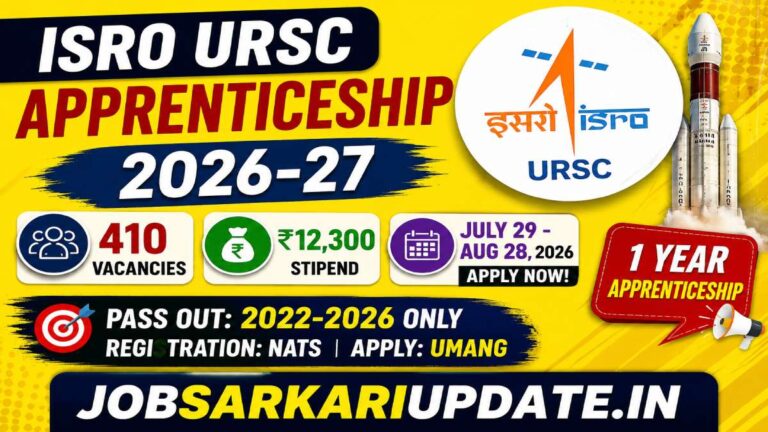
URSC Apprentice 2026 - Quick Summary: ISRO's URSC has released notification for 410 Graduate, Technician & Commercial Practice Apprentice vacancies....
Read Full Details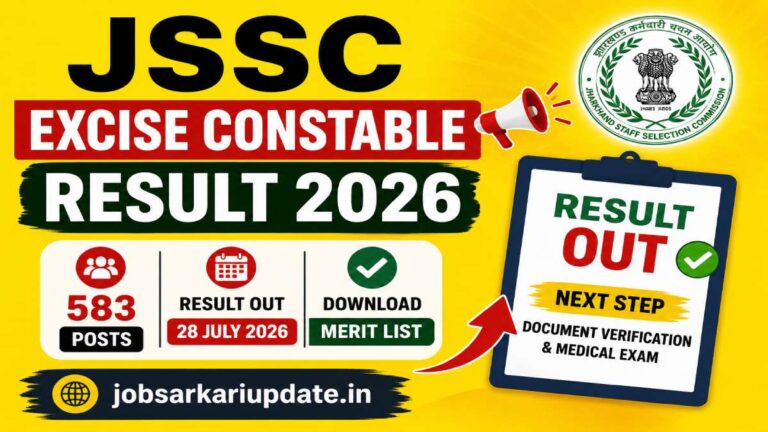
JSSC Excise Constable Result 2026 - Quick Summary: JSSC has declared the JECCE 2023 result on July 28, 2026 for...
Read Full Details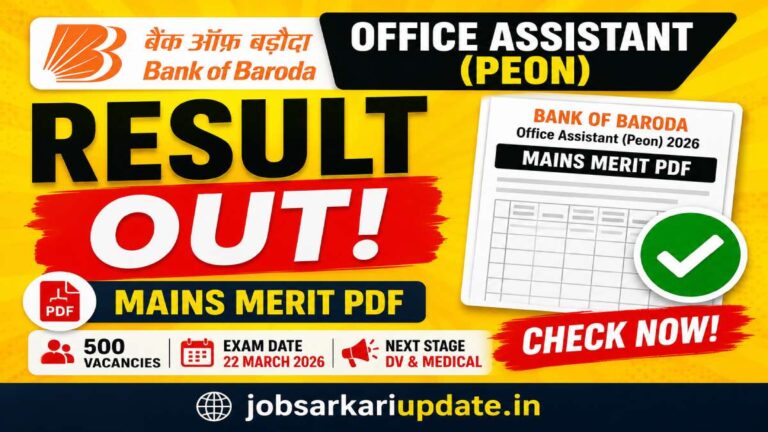
Bank of Baroda Office Assistant Result 2026 - Quick Summary: Bank of Baroda has declared the final result for Office...
Read Full Details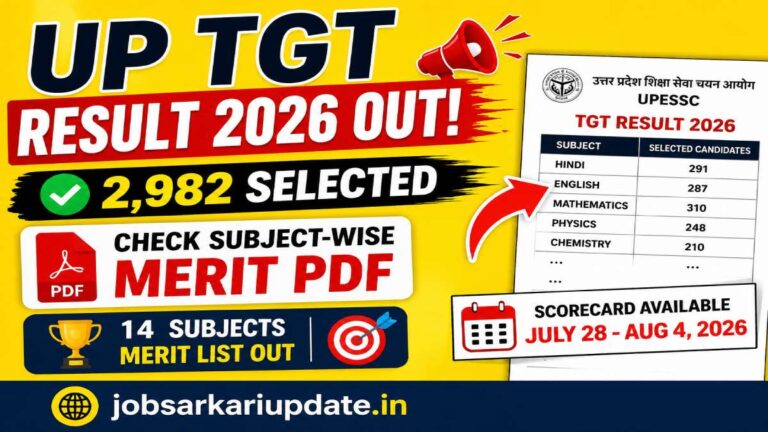
UP TGT Result 2026 - Quick Summary: UPESSC has declared the final result for TGT Recruitment 2026 for 2,982 posts...
Read Full Details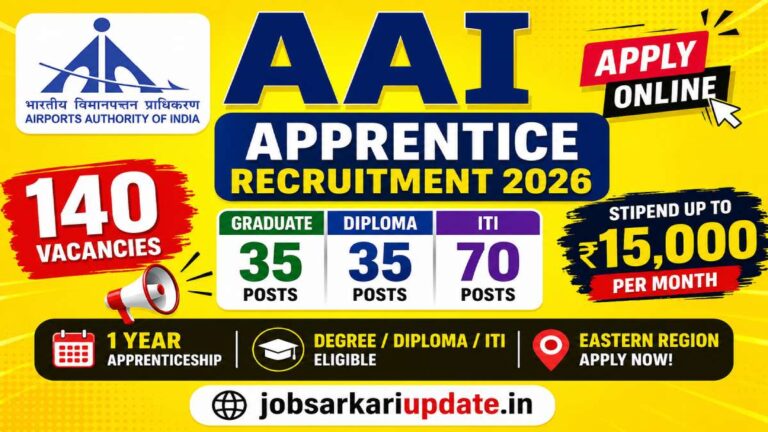
AAI Apprenticeship 2026 - Quick Summary: Airports Authority of India Eastern Region has released notification for 140 Apprenticeship vacancies (Graduate:...
Read Full Details