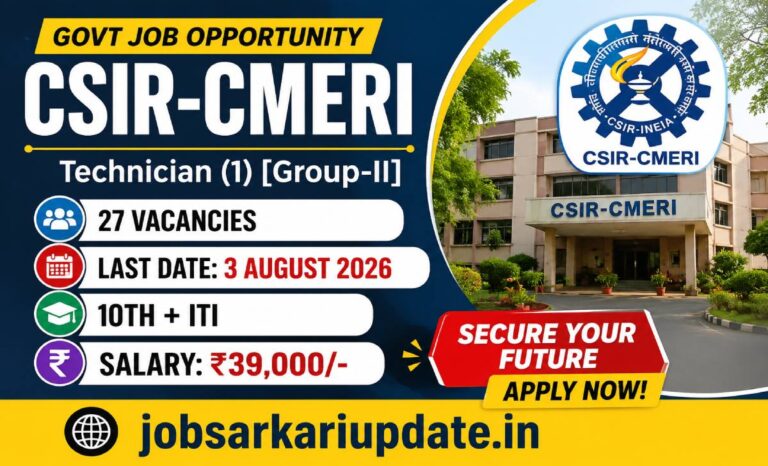
CSIR CMERI Technician 2026 - Quick Summary: CSIR-CMERI has released 27 Technician (Group-II) vacancies at Durgapur and Ludhiana. Approximate total...
Read Full DetailsNEET UG 2026: Complete Application Guide | Admit Card Download
NEET UG 2026 – National Eligibility cum Entrance Test Overview
The National Testing Agency (NTA) has announced the NEET UG 2026 examination for admission to undergraduate medical courses including MBBS, BDS, BAMS, BUMS, BSMS, and BHMS across India. This is a golden opportunity for aspiring medical students to secure seats in top government and private medical colleges nationwide. The exam is conducted as per the National Medical Commission Act 2019 and offers a transparent, merit-based admission process.
NEET UG 2026 is designed for candidates who have completed or are appearing in Class 12 with Physics, Chemistry, and Biology. This examination opens doors to prestigious institutions including AIIMS, JIPMER, and central universities. With proper preparation and timely application, candidates can achieve their dream of becoming healthcare professionals.
This comprehensive guide on jobsarkariupdate covers everything from eligibility criteria to application process, ensuring you don’t miss any crucial detail for NEET UG 2026.
Organization & Recruitment Details
| Particulars | Details |
|---|---|
| Conducting Authority | National Testing Agency (NTA) |
| Examination Name | National Eligibility cum Entrance Test (NEET UG) 2026 |
| Courses Covered | MBBS, BDS, BAMS, BUMS, BSMS, BHMS, B.Sc Nursing |
| Exam Mode | Pen & Paper Based (Offline) |
| Exam Duration | 180 Minutes (3 Hours) |
| Total Questions | 180 Questions (All Compulsory) |
| Total Marks | 720 Marks |
| Question Type | Multiple Choice Questions (MCQs) |
The National Testing Agency has been conducting NEET UG since 2019 with approval from the Ministry of Health and Family Welfare. The examination ensures a uniform admission standard across all medical institutions in India, replacing multiple state-level entrance tests.
Important Dates – NEET UG 2026
| Event | Date |
|---|---|
| Online Application Starts | 08 February 2026 |
| Last Date to Apply | 11 March 2026 (Till 9:00 PM) |
| Last Date for Fee Payment | 11 March 2026 (Till 11:50 PM) |
| Correction Window | 12 March 2026 to 14 March 2026 |
| Admit Card Download | 27 April 2026 |
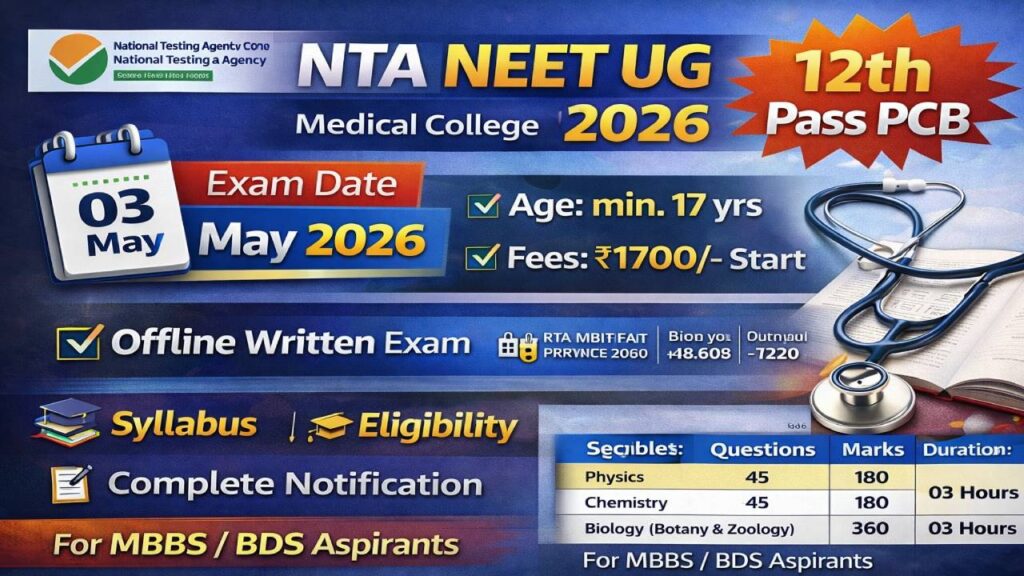
| Examination Date | 03 May 2026 (Sunday) |
| Exam Timing | 02:00 PM to 05:00 PM (IST) |
| Result Declaration | To be announced later |
Expert Advice: Don’t wait for the last date to submit your application. Technical issues and server load can cause problems. Apply at least 3-5 days before the deadline to avoid last-minute hassles. Keep all documents ready in advance for smooth submission.
Application Fee – NEET UG 2026
| Category | Fee for India Centers | Fee for Outside India Centers |
|---|---|---|
| General / OBC | ₹1700 | ₹9500 |
| General-EWS / OBC-NCL | ₹1600 | ₹9500 |
| SC / ST / PwBD / Third Gender | ₹1000 | ₹9500 |
Payment Mode & Process
Candidates can pay the application fee through the following online modes:
- Credit Card – Domestic and International cards accepted
- Debit Card – All major banks supported
- Net Banking – Available for multiple banks
- UPI – Quick payment through UPI apps
Important: Processing charges and GST (18%) will be applicable and must be borne by the candidate. Mere deduction of fee from your account doesn’t confirm payment. Ensure you receive the confirmation page after successful payment. The fee once paid is non-refundable and non-transferable.
Common Mistake to Avoid: Many candidates close the payment window before the transaction completes. Wait for the confirmation page to generate. If the page doesn’t appear, contact the payment gateway helpline before attempting another payment to avoid duplicate charges.
Age Limit – NEET UG 2026
| Particulars | Age Criteria |
|---|---|
| Minimum Age (All Categories) | 17 years as on 31 December 2009 |
| Date of Birth Criteria | Born on or before 31 December 2009 |
| Maximum Age Limit | No Upper Age Limit |
Age Calculation Explained
According to the Graduate Medical Education Regulation-2023 Amendment dated 16 June 2023, candidates must have completed 17 years of age on or before 31 December of the examination year. This means:
- For NEET UG 2026, you should be born on or before 31 December 2009
- There is no maximum age limit as per NMC notification dated 09 March 2022
- This applies to all categories – General, EWS, OBC-NCL, SC, ST, and PwBD
How to verify: Check your Class 10 certificate or birth certificate for accurate date of birth. The same DOB will be used throughout the admission process, so ensure consistency across all documents.
Eligibility Criteria – NEET UG 2026
| Criteria | Requirements |
|---|---|
| Nationality | Indian Nationals, NRI, OCI, Foreign Nationals |
| Educational Qualification | 10+2 or equivalent with Physics, Chemistry, Biology/Biotechnology & English |
| Minimum Percentage | Not specified (but qualifying marks required in NEET) |
| Appearing Candidates | Class 12 appearing in 2026 can also apply |
| Qualifying Code | Code 01 for appearing students; Code 02-07 for passed candidates |
Subject Requirements
| Compulsory Subjects | Details |
|---|---|
| Physics | Mandatory with practicals |
| Chemistry | Mandatory with practicals |
| Biology/Biotechnology | Mandatory with practicals (Botany & Zoology) |
| English | Core subject at Class 12 level |
Important Notes for Eligibility:
- Candidates who studied Physics, Chemistry, Biology as additional subjects after passing Class 12 from recognized boards are now eligible as per NMC Public Notice dated 22 November 2023
- For BUMS course: Must have studied Urdu/Arabic/Persian in Class 10 or clear equivalent test
- For BSMS course: Must have studied Tamil in Class 10 or Higher Secondary or during First Professional year
- Foreign board candidates must ensure their qualification matches Indian 10+2 standard
Common Eligibility Mistakes: Many candidates assume that passing Class 12 is enough. You must have studied the required subjects (PCB/Biotechnology + English) with practical exams. Also, if you’re appearing in Class 12 in 2026, you can apply, but admission will only be granted after passing the qualifying exam before the first counseling round.
Vacancy Details – Seat Distribution
NEET UG 2026 is conducted for admission to approximately 1,08,000+ MBBS seats and 27,000+ BDS seats across India in government and private medical/dental colleges. The exact vacancy details vary each year and are announced by respective counseling authorities.
| Course Type | Approximate Seats | Counseling Authority |
|---|---|---|
| MBBS (15% AIQ) | ~15,000 seats | MCC-DGHS |
| MBBS (85% State Quota) | ~93,000 seats | State Counseling Authorities |
| BDS (15% AIQ) | ~4,000 seats | MCC-DGHS |
| BDS (85% State Quota) | ~23,000 seats | State Counseling Authorities |
| AIIMS Institutes | ~1,200 seats | MCC-DGHS |
| JIPMER | ~200 seats | MCC-DGHS |
| AYUSH Courses (AIQ) | ~10,000 seats | AACCC |
Reservation Policy
| Category | Reservation Percentage (AIQ) |
|---|---|
| SC (Scheduled Caste) | 15% |
| ST (Scheduled Tribe) | 7.5% |
| OBC-NCL (Other Backward Classes) | 27% |
| EWS (Economically Weaker Section) | 10% |
| PwBD (Persons with Benchmark Disability) | 5% (Horizontal Reservation) |
Competition Insight: With over 20 lakh candidates appearing for NEET UG annually and limited seats available, the competition is extremely intense. Securing a government medical seat typically requires scoring above 600+ marks (for General category). State quotas have separate cutoffs based on domicile and category.
Selection Process – NEET UG 2026
The selection for MBBS/BDS and other undergraduate medical courses through NEET UG 2026 follows a multi-stage process:
Stage 1: Written Examination
The NEET UG 2026 examination is a pen-paper based objective test conducted offline on 03 May 2026. The exam consists of:
| Subject | Questions | Marks | Duration |
|---|---|---|---|
| Physics | 45 | 180 | 180 minutes (3 hours) |
| Chemistry | 45 | 180 | |
| Biology (Botany + Zoology) | 90 (45+45) | 360 (180+180) | |
| Total | 180 | 720 | 3 hours |
Marking Scheme
- Correct Answer: +4 marks
- Incorrect Answer: -1 mark (Negative marking)
- Unanswered: 0 marks
Stage 2: Qualifying Criteria
| Category | Minimum Qualifying Percentile |
|---|---|
| General / EWS | 50th Percentile |
| OBC-NCL | 40th Percentile |
| SC / ST | 40th Percentile |
| PwBD (General/EWS) | 45th Percentile |
| PwBD (OBC/SC/ST) | 40th Percentile |
Stage 3: All India Rank (AIR) Declaration
NTA prepares the All India Merit List based on NEET UG 2026 scores. In case of tie-breaking, the following criteria are applied sequentially:
- Higher marks in Biology (Botany + Zoology)
- Higher marks in Chemistry
- Higher marks in Physics
- Lower ratio of incorrect to correct answers (all subjects)
- Lower ratio of incorrect to correct answers in Biology
- Lower ratio of incorrect to correct answers in Chemistry
- Lower ratio of incorrect to correct answers in Physics
- If still tied, random process with expert committee guidance
Stage 4: Counseling & Document Verification
Counseling is conducted separately by:
- MCC (Medical Counseling Committee): For 15% All India Quota, AIIMS, JIPMER, central universities, deemed universities
- State Counseling Authorities: For 85% state quota seats
- AACCC: For AYUSH courses (BAMS, BUMS, BSMS, BHMS)
During counseling, candidates must submit original documents for verification including mark sheets, category certificates, domicile proof, and identity proof.
Preparation Tips for Selection: Focus on NCERT textbooks for Class 11 and 12. Biology carries the highest weightage (360 marks), so prioritize it. Practice previous year papers and take regular mock tests. Time management is crucial – aim to complete the paper in 2.5 hours, leaving 30 minutes for revision.
Salary / Pay Scale – After MBBS/BDS
While NEET UG is an entrance examination and not a recruitment process, understanding potential career earnings helps candidates make informed decisions:
Starting Salary for MBBS Graduates
| Job Profile | Starting Salary Range | After Experience (5+ years) |
|---|---|---|
| Medical Officer (Government) | ₹60,000 – ₹80,000/month | ₹1,00,000 – ₹1,50,000/month |
| Junior Resident (PG pursuing) | ₹70,000 – ₹90,000/month | ₹1,20,000 – ₹2,00,000/month (as specialist) |
| Private Hospital Doctor | ₹40,000 – ₹70,000/month | ₹1,50,000 – ₹5,00,000/month |
| Own Clinic/Practice | ₹50,000 – ₹1,00,000/month | ₹2,00,000 – ₹10,00,000+/month |
Government Medical Officer Pay Scale
| Component | Amount/Details |
|---|---|
| Pay Level | Level 10 (Central/State Pay Matrix) |
| Basic Pay | ₹56,100 – ₹1,77,500 |
| Dearness Allowance (DA) | Currently ~50% of Basic |
| House Rent Allowance (HRA) | 8-24% based on city classification |
| Transport Allowance | ₹3,600 – ₹7,200/month |
| Other Allowances | Medical, Children Education, etc. |
| In-hand Salary (Approx) | ₹75,000 – ₹95,000/month (starting) |
BDS Graduate Salary
| Job Profile | Starting Salary |
|---|---|
| Dental Surgeon (Government) | ₹50,000 – ₹70,000/month |
| Private Dental Clinic | ₹30,000 – ₹60,000/month |
| Own Dental Practice | ₹1,00,000 – ₹5,00,000+/month (after establishment) |
Career Growth: After MBBS, candidates can pursue MD/MS specialization which significantly increases earning potential. Specialists in fields like Cardiology, Neurology, Orthopedics earn ₹2-10 lakhs per month. Government doctors also enjoy benefits like pension, medical facilities, and job security.
How to Apply – NEET UG 2026 Step-by-Step Guide
The application process for NEET UG 2026 is completely online. Follow these steps carefully to ensure successful submission:
Step 1: Registration
- Visit the official NEET UG website (check NTA website for link)
- Click on “New Registration” for NEET UG 2026
- Enter your basic details:
- Name (as per Class 10 certificate)
- Date of Birth
- Mobile Number (your own or parent’s – will receive OTP)
- Email ID (your own or parent’s – will receive OTP)
- Create a strong password (8-13 characters with uppercase, lowercase, number, and special character)
- Choose a security question and answer
- Verify mobile number and email ID through OTP
- Note down the Application Number generated – this is crucial for all future logins
Step 2: Login & Fill Personal Details
- Login using your Application Number and Password
- Fill in complete personal information:
- Full name, Father’s name, Mother’s name
- Gender, Category (Gen/EWS/OBC/SC/ST)
- Nationality (Indian/NRI/OCI/Foreign)
- PwBD status (if applicable)
- Complete address (present and permanent)
Step 3: Identity Verification
Choose ONE mode of identity verification:
- Aadhaar Card (Recommended): Enter 12-digit Aadhaar number
- DigiLocker: Link your DigiLocker account
- Other IDs: PAN Card, Passport, Voter ID, etc. (requires additional document upload)
Note: Using Aadhaar is recommended as it avoids the need for additional document attestation.
Step 4: Disability Details (If Applicable)
- If you have benchmark disability (PwBD), enter UDID Card details
- Upload disability certificate
- Specify if you need a scribe
- Provide scribe details if using your own scribe
Step 5: Choose Exam Centers & Question Paper Medium
- Select 3 exam city choices in order of preference (based on your permanent/present address state)
- Choose question paper medium (13 options available):
- English only
- English + Hindi
- English + Regional language (Assamese, Bengali, Gujarati, Kannada, Malayalam, Marathi, Odia, Punjabi, Tamil, Telugu, Urdu)
Important: Medium and exam city choices CANNOT be changed later (except during correction window).
Step 6: Educational Qualification Details
- Enter Class 10 details:
- Board name
- Roll number
- Passing year
- Marks/percentage
- Enter Class 12 details:
- Board name
- Select qualifying code (01 if appearing in 2026; 02-07 if passed)
- Roll number
- Passing year
- Subjects studied
- Marks/percentage
Step 7: Upload Documents
Upload scanned copies in specified format (JPG/JPEG/PDF):
| Document | Format | Size |
|---|---|---|
| Passport size photograph | JPG/JPEG | 10 KB – 200 KB |
| Signature | JPG/JPEG | 10 KB – 100 KB |
| Left & Right thumb impression | JPG/JPEG | 10 KB – 200 KB |
| Class 10 certificate | 50 KB – 300 KB | |
| Class 10 marksheet | 50 KB – 300 KB | |
| Category certificate (if applicable) | 50 KB – 300 KB | |
| PwBD certificate (if applicable) | 50 KB – 300 KB |
Step 8: Capture Live Photograph
- Enable webcam/camera on your device
- Ensure good lighting and white background
- Face should be 80% visible including ears
- Remove mask and spectacles (unless medically required)
- Click and upload live photo
Step 9: Review & Preview
- Carefully review all entered information
- Check uploaded documents
- Preview the complete application form
- Make corrections if needed before proceeding to payment
Step 10: Fee Payment
- Select your payment mode (Credit/Debit Card/Net Banking/UPI)
- Enter payment details
- Verify OTP received on registered email
- Complete the transaction
- Wait for confirmation page to generate
Step 11: Download Confirmation Page
- After successful payment, Confirmation Page will be generated automatically
- Download and save multiple copies
- Take printouts for your records
- This confirms your application is successfully submitted
Application Checklist:
- ✓ Valid email ID and mobile number
- ✓ Aadhaar card for identity verification
- ✓ Class 10 and 12 certificates/marksheets
- ✓ Recent passport size photo (taken after 01 Jan 2026)
- ✓ Signature sample
- ✓ Category certificate (if applicable)
- ✓ Debit/credit card or net banking for fee payment
- ✓ Stable internet connection
Common Application Errors to Avoid:
- ❌ Using someone else’s mobile/email (use only your own or parent’s)
- ❌ Uploading old photographs (must be taken after 01 Jan 2026)
- ❌ Wrong date of birth (cross-verify with Class 10 certificate)
- ❌ Incorrect category selection
- ❌ Poor quality document scans (must be clearly legible)
- ❌ Closing payment window before confirmation page generates
- ❌ Not saving confirmation page after submission
- ❌ Submitting multiple applications (strictly prohibited)
Important Instructions for Candidates
⚠️ Critical Points to Remember:
- Single Application Only: Candidates can submit only ONE application. Multiple applications will lead to cancellation of candidature.
- Correct Information: Ensure all details entered are accurate. Information filled once cannot be changed except during the correction window (10-12 March 2026).
- Original Documents: Keep all original documents safe. They will be required during counseling and admission.
- Admit Card: Download admit card when available. No admit card will be sent by post. Candidates must carry the printed admit card to the exam center.
- Exam Day Requirements: Bring admit card, valid photo ID proof, and passport size photographs. No electronic devices, calculators, or study materials allowed.
- Reporting Time: Report to exam center by 11:00 AM. Last entry is 01:30 PM. Late candidates will NOT be allowed entry.
- Dress Code: Wear light-colored clothes without heavy accessories. Avoid items with metallic components as metal detectors will be used.
- Exam Center Allocation: Centers are allotted by system. No change requests will be entertained.
- Results & Counseling: NTA conducts exam and declares results. Counseling is conducted separately by MCC-DGHS, state authorities, and AACCC. Regularly check respective websites.
- Validity: NEET UG 2026 score is valid only for admission to 2026-27 academic session.
- Unfair Means: Any malpractice or unfair means will result in immediate cancellation and debarment up to 3 years from NTA exams plus criminal action.
Disclaimer: This information is compiled from official NEET UG 2026 Information Bulletin. Candidates must verify all details and updates from the official NTA NEET website. Dates and rules may change – stay updated through official notifications.
NEET UG 2026 – Expert Tips & Success Strategies
Success in NEET requires strategic preparation beyond just hard work. Here are expert-backed tips to maximize your chances:
1. Start Application Process Early
Don’t wait until the last week to apply. Technical glitches, payment issues, and server overload are common near the deadline. Apply within the first 10 days after registration opens. This gives you buffer time to resolve any issues and also allows you to utilize the correction window if needed.
2. Document Preparation Before Application
Before starting your application, gather and verify all documents:
- Take fresh passport-size photographs with white background (after 01 Jan 2026)
- Scan all certificates in required format and size
- Keep Aadhaar details, Class 10 & 12 certificates ready
- Verify your date of birth across all documents for consistency
- If claiming category/PwBD benefits, ensure certificates are valid and from competent authority
3. Choose Exam Centers Wisely
Select exam cities strategically:
- First preference: Your home city or nearest city
- Second preference: Well-connected city within your state
- Third preference: Another accessible city in your state
- Visit potential exam centers beforehand if possible
- Check travel time, accommodation options, and accessibility
4. Medium Selection Strategy
Choose your question paper medium carefully:
- If comfortable with English, choose English only – it avoids translation ambiguities
- If you studied in regional language medium, choose bilingual option
- Practice previous papers in your chosen medium
- Remember: English version is final in case of translation discrepancies
5. Avoid Common Application Mistakes
These errors can cost you admission:
- Wrong category selection: OBC-NCL means Central List only, not state list
- Incorrect qualifying code: Use Code 01 if appearing in 2026; Code 02-07 if already passed
- Poor quality uploads: Blurry documents lead to rejection
- Different name spellings: Name should match exactly across all documents
- Using someone else’s credentials: Mobile/email should be yours or parents’ only
6. Smart Study Plan for NEET UG
| Subject | Recommended Daily Hours | Priority Topics |
|---|---|---|
| Biology | 4-5 hours | Human Physiology, Genetics, Ecology (Zoology); Plant Physiology, Reproduction, Diversity (Botany) |
| Physics | 3-4 hours | Mechanics, Optics, Modern Physics, Current Electricity |
| Chemistry | 3-4 hours | Organic Chemistry (reactions), Inorganic Chemistry (coordination compounds), Physical Chemistry (equilibrium, thermodynamics) |
| Revision | 2-3 hours | Previous topics, weak areas, formula revision |
7. Exam Day Success Tactics
- Time management: Allocate 90 minutes for Biology, 45 minutes each for Physics and Chemistry, keep 30 minutes for revision
- Attempt sequence: Start with Biology (highest marks), then your stronger subject between Physics/Chemistry
- Accuracy over speed: Due to negative marking (-1), avoid blind guessing. Attempt only when 80% sure
- Two-pass strategy: First pass – attempt questions you’re confident about; Second pass – tackle difficult questions
- OMR marking: Darken bubbles completely, avoid overwriting, maintain cleanliness
8. Resource Recommendations
Best Study Materials:
- NCERT Textbooks (Class 11 & 12) – Most important, read thoroughly 3+ times
- Previous 10 years NEET question papers
- Standard reference books: HC Verma (Physics), OP Tandon (Chemistry), Trueman’s Biology
- Quality test series for regular practice
- Avoid too many books – master limited quality resources
9. Stay Updated Throughout the Process
Create a tracking system:
- Bookmark official NTA NEET website and check weekly
- Subscribe to official updates (if available)
- Join reliable NEET preparation groups (verify information from official sources)
- Set reminders for important dates: application deadline, correction window, admit card release
- After results, track counseling websites regularly (MCC for AIQ, respective state counseling sites)
10. Mental Health & Motivation
- Take regular breaks – study in 50-minute blocks with 10-minute breaks
- Maintain healthy sleep schedule (7-8 hours)
- Practice meditation or yoga for stress management
- Stay connected with family and mentors
- Maintain realistic expectations – have backup plans ready
- Remember: NEET can be attempted multiple times with no upper age limit
Final Success Mantra: NEET UG requires consistent effort over 12-18 months. Focus on NCERT thoroughly, practice extensively, manage time wisely during exam, and maintain accuracy over speed. The key is not just hard work, but smart, strategic preparation combined with timely application submission. Good luck!
Frequently Asked Questions (FAQs) – NEET UG 2026
1. What is the last date to apply for NEET UG 2026?
The last date to submit online application is 08 March 2026 till 9:00 PM. However, fee payment is accepted till 11:50 PM on the same day. It’s recommended to apply at least 3-5 days before the deadline to avoid last-minute issues.
2. Can I apply for NEET UG 2026 if I’m appearing in Class 12 in 2026?
Yes, candidates appearing in Class 12 qualifying examination in 2026 are eligible to apply. You must select qualifying code 01 in the application form. However, admission will only be granted after you pass the qualifying examination before the first counseling round.
3. Is there any age limit for NEET UG 2026?
The minimum age requirement is 17 years as on 31 December 2009 (must be born on or before this date). There is no upper age limit as per NMC notification dated 09 March 2022. This applies to all categories.
4. What is the application fee for NEET UG 2026?
The fee varies by category: General/OBC – ₹1700; EWS/OBC-NCL – ₹1600; SC/ST/PwBD/Third Gender – ₹1000. For exam centers outside India, all categories pay ₹9500. Additional processing charges and 18% GST apply.
5. How many times can I attempt NEET UG?
There is no limit on the number of attempts for NEET UG. Since there’s no upper age limit, you can appear for the exam as many times as you wish until you qualify or secure admission.
6. What subjects are required for NEET UG 2026 eligibility?
You must have studied Physics, Chemistry, Biology/Biotechnology (with practicals) and English in your 10+2 or equivalent examination. As per recent NMC guidelines, these subjects can also be studied as additional subjects after passing Class 12.
7. Can I change my exam center or question paper medium after submitting the application?
No, exam center cities and question paper medium cannot be changed once the application is submitted, except during the correction window (10-12 March 2026). Even during the correction window, only limited fields are editable, so choose carefully while filling the form.
8. What is the exam pattern for NEET UG 2026?
NEET UG 2026 is a pen-paper based offline exam with 180 compulsory MCQs for 720 marks. Subjects: Physics (45 questions, 180 marks), Chemistry (45 questions, 180 marks), Biology (90 questions, 360 marks). Duration: 3 hours. Marking: +4 for correct, -1 for incorrect.
9. What documents are required for NEET UG 2026 application?
Essential documents: Recent passport-size photograph (taken after 01 Jan 2026), signature, thumb impressions, Class 10 certificate and marksheet, Class 12 certificate (if passed), Aadhaar card or other valid ID proof, category certificate (if applicable), PwBD certificate (if applicable).
10. What is the qualifying percentile for NEET UG 2026?
Qualifying percentiles: General/EWS – 50th percentile; OBC/SC/ST – 40th percentile; PwBD (Gen/EWS) – 45th percentile; PwBD (OBC/SC/ST) – 40th percentile. Actual qualifying marks vary each year based on difficulty level.
11. Who conducts counseling for NEET UG 2026?
Counseling is conducted by multiple authorities: MCC-DGHS for 15% All India Quota, AIIMS, JIPMER, central universities, and deemed universities; State Counseling Authorities for 85% state quota seats; AACCC for AYUSH courses (BAMS, BUMS, BSMS, BHMS).
12. Can NRI/OCI/Foreign nationals apply for NEET UG 2026?
Yes, NRI, OCI cardholders, and foreign nationals are eligible to apply. They must pay ₹9500 application fee and provide valid documentary proof (passport, OCI card, embassy certificate). However, their eligibility for specific seats depends on respective state/institution rules.
13. Is negative marking applicable in NEET UG 2026?
Yes, there is negative marking. Each correct answer gives +4 marks, while each incorrect answer results in -1 mark. Unanswered questions get zero marks. Therefore, avoid random guessing and attempt only when reasonably confident.
14. What is the syllabus for NEET UG 2026?
The syllabus is based on Class 11 and 12 NCERT curriculum covering Physics, Chemistry, and Biology (Botany + Zoology). NMC has notified the detailed syllabus which is available on the official NEET website and NMC website. There is no change in syllabus compared to previous years.
15. When will NEET UG 2026 admit card be released?
The admit card release date will be announced later on the official NTA NEET website. Typically, admit cards are released 2-3 weeks before the exam date. Candidates can download it from the website using their application number and password. No admit card will be sent by post.
16. Can I submit more than one application for NEET UG 2026?
No, submitting multiple applications is strictly prohibited and will lead to cancellation of candidature. Each candidate can submit only ONE application. This is considered an unfair means practice and may result in debarment from NTA exams.
17. What happens if I make a mistake in my application form?
NTA provides a correction window (10-12 March 2026) where you can edit certain fields in your application. However, not all fields are editable. Fields like photograph, signature, and some critical details cannot be changed. Therefore, fill the form very carefully and verify all information before final submission.
18. Is there any reservation in NEET UG 2026?
Yes, for 15% All India Quota and central institutions, reservation policy is: SC – 15%, ST – 7.5%, OBC-NCL – 27%, EWS – 10%, and PwBD – 5% horizontal reservation. State quota seats follow respective state government reservation policies.
19. What is the expected salary after MBBS through NEET?
Starting salary for MBBS graduates in government service ranges from ₹60,000 to ₹80,000 per month with allowances. After specialization (MD/MS), salaries increase significantly to ₹1.5-5 lakhs per month depending on specialization and experience. Private practice can earn even higher income.
20. How can I check my NEET UG 2026 result?
Results will be declared on the official NTA NEET website. You can download your scorecard using your application number and password. The scorecard will contain your marks, percentile, All India Rank (AIR), and qualifying status. Save multiple copies for future counseling processes.
Important Links
| Apply Online | Apply Now |
| Download Notification | Click Here |
| Official Website | Click Here |
| Admit Card | Click Here |
| Download Syllabus | Click Here |
| Correction Form | Click Here |
Recent Jobs
Check out our latest job postings
668 Jobs Available
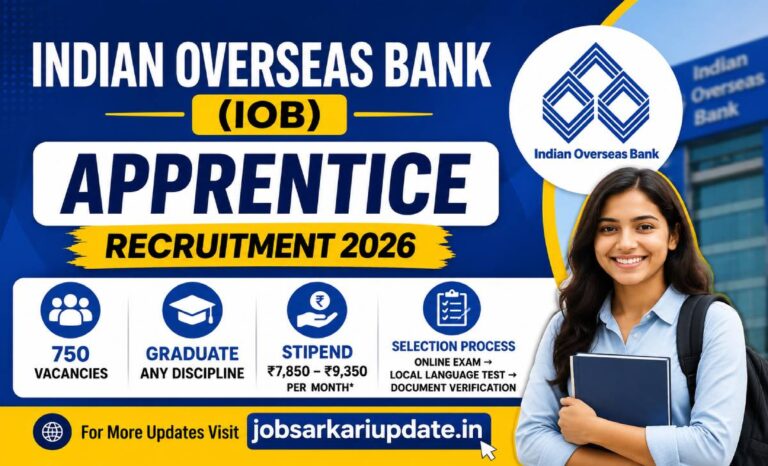
IOB Apprentice 2026 - Quick Summary: Indian Overseas Bank has released 750 Apprentice vacancies for FY 2026-27. Approximate in-hand stipend...
Read Full Details
JKSSB Works Supervisor 2026 - Quick Summary: JKSSB has released 357 vacancies for Works Supervisor posts under the J&K Public...
Read Full Details
Warder Recruitment 2026 - Quick Summary: JKSSB has released 288 vacancies for Warder posts under the J&K Home Department. Approximate...
Read Full Details
CCI Recruitment 2026 - Quick Summary: Cotton Corporation of India Ltd. (CCI) has released recruitment notification for 148 vacancies across...
Read Full Details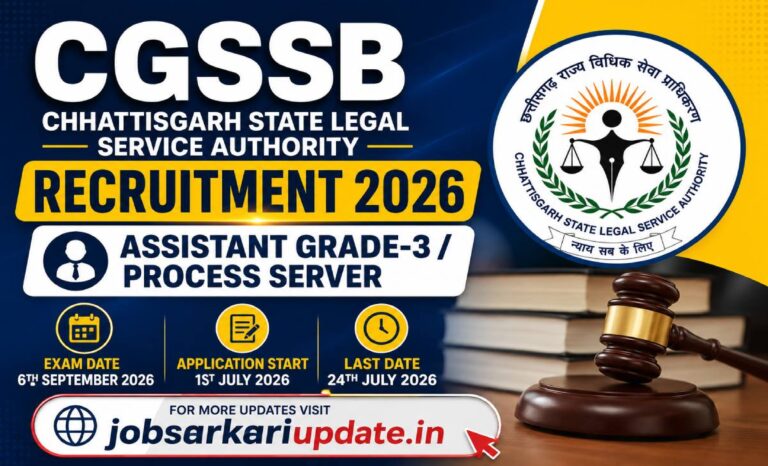
CG Legal Assistant Grade-3 Recruitment 2026 - Quick Summary: Chhattisgarh State Legal Service Authority (CGSSB) invites applications for Assistant Grade-3/Process...
Read Full Details