






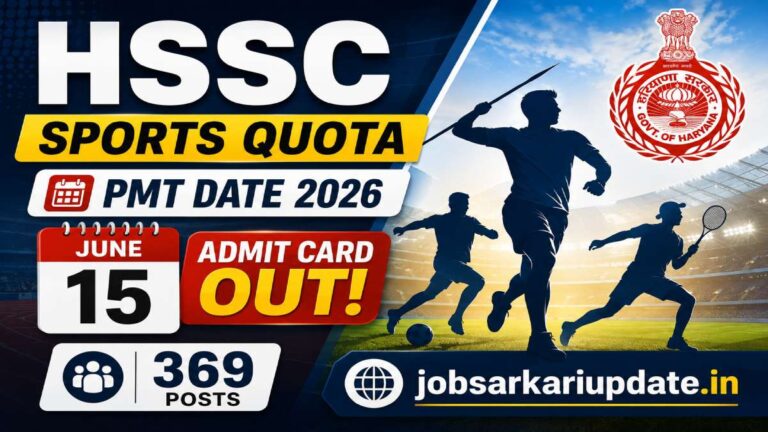
HSSC Sports Quota PMT Date 2026 - Quick Summary: HSSC has released PMT/PST schedule for Advt 13/2024 Sports Quota Group...
Read Full DetailsUPSC CMS Recruitment 2026 – Medical Officer Vacancy & Apply
UPSC CMS Medical Officer Recruitment 2026 – Everything You Need to Know
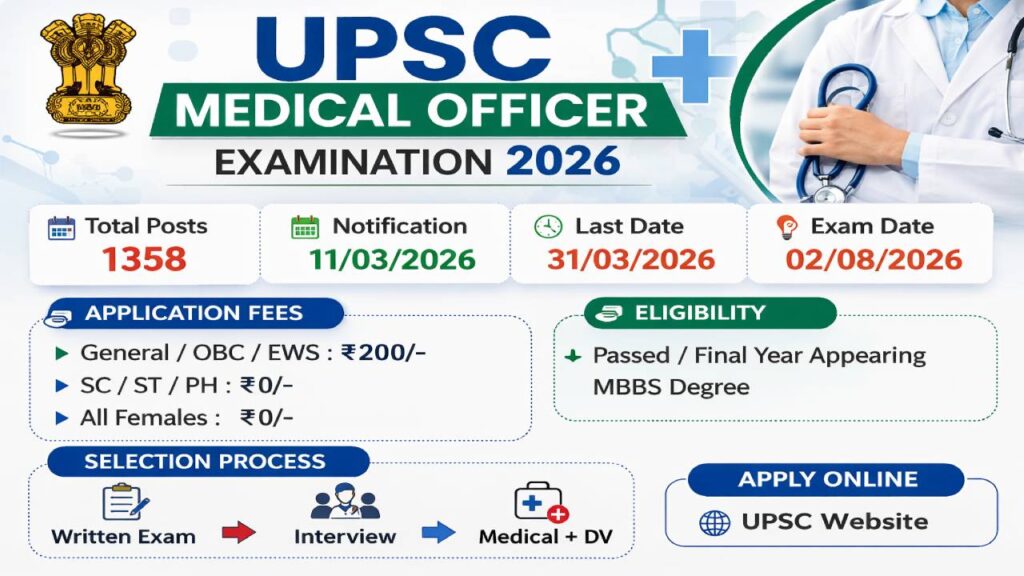
The UPSC CMS Medical Officer Recruitment 2026 is one of the most anticipated central government job notifications for medical graduates in India. Released on 11th March 2026 by the Union Public Service Commission (UPSC), this examination offers a combined pathway to four prestigious medical services under the Central Government — spanning Railways, the Central Health Service, the New Delhi Municipal Council, and the Municipal Corporation of Delhi. With a total of 1,358 tentative vacancies spread across multiple posts, this is a significant opportunity for MBBS graduates seeking a stable, well-paying government career.
If you hold a final MBBS degree — or are even in your final year awaiting results — this recruitment is tailor-made for you. A career through UPSC CMS brings with it Pay Matrix Level-10 pay, Non-Practising Allowance (NPA), pension under the Contributory Pension System, and the professional prestige of serving under Central Government institutions. The examination is scheduled for 2nd August 2026, giving candidates roughly five months to prepare. Given that UPSC conducts this examination annually and attracts hundreds of thousands of applications from across India, competition will be intense — making early preparation and a correctly submitted application absolutely critical.
Recruitment Overview
The Union Public Service Commission is one of India’s most credible constitutional bodies, established under Article 315 of the Indian Constitution. It has been conducting competitive examinations for over seven decades and its processes are universally respected for transparency, rigor, and fairness. A selection through UPSC carries enormous professional weight, and candidates placed through this examination are considered among the best public health officers in the country. Employers — both public and private — recognize a UPSC-recommended appointment as a mark of exceptional competence.
| Field | Details |
|---|---|
| Organization Name | Union Public Service Commission (UPSC) |
| Examination Name | Combined Medical Services Examination (CMS) 2026 |
| Advertisement No. | Examination Notice No. 9/2026-CMS |
| Total Tentative Vacancies | 1,358 |
| Job Location | All India (48 examination centres) |
| Job Type | Central Government (Group A) |
| Application Mode | Online only via upsconline.nic.in |
| Notification Release Date | 11th March 2026 |
Important Dates
Timing your application strategically is not just good advice — it is essential for UPSC CMS 2026. Examination centres are allotted on a first-apply-first-allot basis (except Chennai, Delhi, Dispur, Kolkata, and Nagpur), which means popular centres like Delhi and Mumbai fill up quickly. Candidates who wait until the final week risk being assigned to a distant centre, adding unnecessary travel burden on exam day. As a rule of thumb, submit your application within the first three to five days of the portal opening. This gives you the best shot at your preferred centre and also leaves room to correct any technical issues before the deadline.
| Event | Date |
|---|---|
| Application Start Date | 11th March 2026 |
| Last Date to Apply | 31st March 2026 (till 6:00 PM) |
| Application Fee Last Date | 31st March 2026 (till 6:00 PM) |
| Date of Examination | 2nd August 2026 |
| e-Admit Card Release | Last working day of the preceding week of exam date |
| Result Date | To be notified by UPSC |
| Personality Test Date | To be notified after written exam result |
Note: All dates are subject to change at the discretion of the Commission. Always verify from the official notification before taking any action.
Application Fee
The application fee for UPSC CMS 2026 is kept modest at just Rs. 200, reflecting the Commission’s intent to encourage participation from all eligible medical graduates. A significant and candidate-friendly feature of this notification is the complete fee exemption for Female candidates, SC/ST candidates, and Persons with Benchmark Disability (PwBD). OBC and EWS candidates, however, are required to pay the full fee of Rs. 200. Payment can be made through Net Banking, Visa/Master/RuPay Credit or Debit Card, or UPI. One common mistake candidates make is attempting to pay after the portal deadline — the payment link closes simultaneously with the application form, so never leave the fee for the last hour.
| Category | Fee Amount | Payment Mode |
|---|---|---|
| General / OBC / EWS (Male) | Rs. 200/- | Net Banking / Visa / Master / RuPay / UPI / Credit / Debit Card |
| Female (All Categories) | Exempted | No payment required |
| SC / ST | Exempted | No payment required |
| Persons with Benchmark Disability (PwBD) | Exempted | No payment required |
Age Limit
The age calculation for UPSC CMS 2026 is done as on 1st August 2026 — not the application date. For most posts, the upper age limit is 32 years, meaning candidates must have been born on or after 2nd August 1994. However, for the Medical Officers Grade in the General Duty Medical Officers Sub-cadre of Central Health Service, the upper age limit is relaxed to 35 years as on 1st August 2026. To illustrate with a simple example: if you were born on 3rd August 1994, you are eligible for CHS posts (under 35) but not for the 32-year posts. Always verify using the exact date of birth recorded in your Matriculation certificate — no other document is accepted by the Commission for age proof.
| Category | Upper Age Limit | Age Relaxation |
|---|---|---|
| General / EWS (ADMO, NDMC, MCD posts) | 32 years | Nil |
| General / EWS (CHS Medical Officer) | 35 years | Nil (separate upper limit) |
| SC / ST | 32 / 35 years | +5 years |
| OBC (Non-Creamy Layer) | 32 / 35 years | +3 years |
| Defence Personnel (Disabled in Operations) | 32 / 35 years | +3 years |
| Ex-Servicemen (5+ years Military service) | 32 / 35 years | +5 years |
| ECOs/SSCOs (extended assignment beyond 5 years) | 32 / 35 years | +5 years |
| Persons with Benchmark Disability (PwBD) | 32 / 35 years | +10 years |
Eligibility Criteria
The educational eligibility for UPSC CMS 2026 is clearly defined and applies uniformly across all four posts: a candidate must have passed the written and practical parts of the final MBBS examination. This is a non-negotiable requirement — no other medical qualification, diploma, or degree will substitute. The most common eligibility mistake candidates make is assuming that completion of internship is mandatory before applying. It is not. A candidate who is yet to complete the compulsory rotating internship is educationally eligible to sit the examination and can even be selected — however, actual appointment will only be made after internship completion. Similarly, candidates who have appeared in their final MBBS examination but have not yet received results may apply provisionally.
| Post Name | Educational Qualification | Internship Required for Appointment? | Final Year Appearing? |
|---|---|---|---|
| Medical Officers Grade – CHS (General Duty) | Final MBBS (written + practical) passed | Yes (appointment after internship completion) | Yes (provisional admission) |
| Assistant Divisional Medical Officer (Railways) | Final MBBS (written + practical) passed | Yes | Yes (provisional admission) |
| General Duty Medical Officer – NDMC | Final MBBS (written + practical) passed | Yes | Yes (provisional admission) |
| General Duty Medical Officer Grade-II – MCD | Final MBBS (written + practical) passed | Yes | Yes (provisional admission) |
Vacancy Details
The total tentative vacancy count for UPSC CMS 2026 stands at 1,358 posts. The largest share belongs to Medical Officers in the General Duty Sub-cadre of the Central Health Service at 864 posts — making it the most competitive and most sought-after post in this examination. Assistant Divisional Medical Officers in Railways account for 450 posts, followed by 30 posts in the Municipal Corporation of Delhi and 14 posts in the New Delhi Municipal Council. A careful reading of the PwBD reservations shows that 34 vacancies in CHS and 18 in Railways are specifically reserved for candidates with benchmark disabilities, while MCD has 2 reserved PwBD posts. These numbers are tentative and subject to revision — a norm with UPSC examinations. Category-wise distribution (UR/OBC/SC/ST/EWS) has not been individually specified in the notification and will follow Central Government reservation norms.
| Post Name | Category | Total Vacancies | PwBD Reserved |
|---|---|---|---|
| Medical Officers Grade – General Duty (CHS) | Category I | 864 | 34 (17 Locomotor + 17 SLD/MD) |
| Assistant Divisional Medical Officer (Railways) | Category II (i) | 450 | 18 (Locomotor Disability) |
| General Duty Medical Officer – NDMC | Category II (ii) | 14 | NIL |
| General Duty Medical Officer Grade-II – MCD | Category II (iii) | 30 | 2 (SLD: 1 + MD: 1) |
| Total | 1,358 | 54 | |
Selection Process
The UPSC CMS 2026 selection process is structured, transparent, and merit-based. It consists of two main stages — a Written Examination worth 500 marks, followed by a Personality Test (Interview) worth 100 marks. Together, the total marks considered for final merit ranking are 600. There is no physical fitness test or skill test, but all finally selected candidates must satisfy medical and physical fitness standards as prescribed by the respective cadre controlling authorities. Understanding each stage clearly and preparing with focus is the surest path to success.
Stage 1: Written Examination (500 Marks)
The written examination consists of two objective-type papers, each carrying 250 marks and each of two hours duration. Both papers are set in English only. Paper I covers General Medicine and Paediatrics (120 questions: 96 from Medicine + 24 from Paediatrics). Paper II covers Surgery, Gynaecology & Obstetrics, and Preventive & Social Medicine (120 questions: 40 from each subject). There is negative marking — one-third of the allocated marks are deducted for each wrong answer. A blank answer carries no penalty. Candidates should develop a disciplined strategy of attempting only those questions they are confident about.
Preparation Tip: Use standard MBBS textbooks for each subject covered. For Paper I, prioritise cardiology, neurology, and communicable diseases — these topics appear consistently. For Paper II, surgical emergencies, obstetric complications, and community medicine epidemiology deserve special attention.
Stage 2: Personality Test / Interview (100 Marks)
Candidates who qualify the written examination are called for a Personality Test conducted by the Commission. This is not merely a knowledge interview — it assesses intellectual curiosity, critical thinking, judgment, social cohesion, integrity, and leadership potential. The test board looks at how you think and respond under pressure, not just what you know.
Preparation Tip: Read newspapers regularly, stay updated on national health programmes and public health policy, and practice speaking about your clinical experience and motivations for joining government service clearly and confidently.
Stage 3: Document Verification
The Commission verifies eligibility conditions with reference to original documents only after the candidate qualifies the written examination. Candidates must upload updated documents during the 15-day window provided post-written result. Missing this window results in disqualification from further stages.
Stage 4: Medical Examination
All finally recommended candidates must satisfy the physical and medical fitness standards prescribed for the service they are allocated to, as detailed in Appendix III of the examination rules. No relaxation in medical standards is available to PwBD candidates beyond what is specifically identified in the official PwBD functional classification tables.
Remember: Clearing the written examination and Personality Test does not automatically guarantee appointment. Final appointment is subject to character verification, medical fitness, and satisfactory internship completion. Approach each stage with complete preparation and integrity.
Exam Syllabus & Pattern
The syllabus for UPSC CMS 2026 is officially provided in the examination notification. Both papers are of MBBS standard, objective (multiple-choice) type, and set in English only. The following details are extracted directly from the official notification.
Exam Pattern
| Paper | Subjects | Total Questions | Maximum Marks | Duration | Negative Marking |
|---|---|---|---|---|---|
| Paper I (Code 1) | General Medicine (96 Qs) + Paediatrics (24 Qs) | 120 | 250 | 2 Hours | 1/3 mark per wrong answer |
| Paper II (Code 2) | Surgery (40 Qs) + Gynaecology & Obstetrics (40 Qs) + Preventive & Social Medicine (40 Qs) | 120 | 250 | 2 Hours | 1/3 mark per wrong answer |
| Personality Test | Interview / Personality Assessment | — | 100 | As per board | Not applicable |
| Total | 600 | — | — | ||
Subject-wise Syllabus
Paper I — General Medicine
- Cardiology
- Respiratory Diseases
- Gastro-intestinal
- Genito-Urinary
- Neurology
- Hematology
- Endocrinology
- Metabolic Disorders
- Infections / Communicable Diseases (Virus, Bacterial, Spirochetal, Protozoan, Metazoan, Fungus, Rickets)
- Nutrition / Growth
- Dermatology (Diseases of the Skin)
- Musculoskeletal System
- Psychiatry (Depression, Psychosis, Anxiety, Bipolar, Schizophrenia)
- Emergency Medicine
- Common Poisoning & Snake Bite
- Tropical Medicine
- Critical Care Medicine
- Medical Procedures (Emphasis)
- Pathophysiological Basis of Diseases
- Vaccine Preventable and Non-Vaccine Preventable Diseases
- Vitamin Deficiency Diseases
Paper I — Paediatrics
- Common Childhood Emergencies
- Basic Newborn Care
- Normal Developmental Milestones
- Accidents and Poisonings in Children
- Birth Defects and Counselling including Autism
- Immunization in Children
- Recognizing Children with Special Needs and Management
- National Programmes Related to Child Health
Paper II — Surgery (including ENT, Ophthalmology, Traumatology, Orthopaedics)
- General Surgery: Wounds, Infections, Tumours, Lymphatic, Blood Vessels, Cysts/Sinuses, Head & Neck, Breast, Alimentary Tract, Liver/Bile/Pancreas, Spleen, Peritoneum, Abdominal Wall, Abdominal Injuries
- Urological Surgery
- Neuro Surgery
- Otorhinolaryngology (ENT)
- Thoracic Surgery
- Orthopaedic Surgery
- Ophthalmology
- Anaesthesiology
- Traumatology
- Diagnosis and Management of Common Surgical Ailments
- Pre-operative and Post-operative Care
- Medicolegal and Ethical Issues of Surgery
- Wound Healing
- Fluid and Electrolyte Management in Surgery
- Shock — Pathophysiology and Management
Paper II — Gynaecology & Obstetrics
- Obstetrics: Ante-natal, Intra-natal, Post-natal conditions; Management of Normal and Complicated Labour
- Gynaecology: Applied Anatomy, Applied Physiology, Infections in Genital Tract, Neoplasms, Displacement of Uterus, Normal and Safe Delivery, High Risk Pregnancy, Abortions, IUGR, Medicolegal Examination
- Family Planning: Conventional Contraceptives, IUD and Oral Pills, Operative Sterilization, MTP
Paper II — Preventive & Social Medicine (Community Medicine)
- Social and Community Medicine
- Concept of Health, Disease and Preventive Medicine
- Health Administration and Planning
- General Epidemiology
- Demography and Health Statistics
- Communicable Diseases
- Environmental Health
- Nutrition and Health
- Non-communicable Diseases
- Occupational Health
- Genetics and Health
- International Health
- Medical Sociology and Health Education
- Maternal and Child Health
- National Programmes
- Management of Common Health Problems
- Monitoring National Health Programmes
- Maternal and Child Wellness
- Community Health Problems including Malnutrition and Emergencies
Preparation Tips
Since both papers are at MBBS standard and entirely objective, accuracy matters more than speed. Build conceptual clarity from standard references such as Harrison’s Principles of Internal Medicine for Paper I and Bailey & Love for Surgery. For community medicine, Park’s Textbook remains the gold standard. Practice previous year UPSC CMS papers to understand question framing and regularly time yourself under exam conditions to sharpen your negative-marking strategy.
Salary & Pay Scale
All four posts recruited through UPSC CMS 2026 fall under Pay Matrix Level-10, which starts at Rs. 56,100 and goes up to Rs. 1,77,500 under the 7th Pay Commission. In addition to basic pay, all posts carry a Non-Practising Allowance (NPA), which compensates doctors for the prohibition on private practice. With House Rent Allowance (HRA), Dearness Allowance (DA at current rates), Transport Allowance (TA), and NPA, the gross monthly salary at the entry level is estimated in the range of Rs. 95,000 to Rs. 1,10,000 per month depending on the city of posting. In-hand salary after NPS (National Pension System) deduction and other statutory deductions typically falls in the Rs. 80,000–90,000 range for a metro posting. This is significantly higher than most private hospital junior doctor salaries at the same stage of career.
| Post Name | Pay Level | Basic Pay (Entry) | NPA | Gross Salary (Approx.) |
|---|---|---|---|---|
| Medical Officers Grade – CHS | Level-10 | Rs. 56,100/- | As per Govt. orders | Rs. 95,000–1,10,000/- (approx.) |
| ADMO – Indian Railway Health Service | Level-10 | Rs. 56,100/- | As per Govt. orders | Rs. 95,000–1,10,000/- (approx.) |
| GDMO – NDMC | Level-10 | Rs. 56,100/- | Restricted NPA | Rs. 90,000–1,05,000/- (approx.) |
| GDMO Grade-II – MCD | Level-10 | Rs. 56,100/- | As per Govt. orders | Rs. 90,000–1,05,000/- (approx.) |
Career growth is well-structured. For NDMC, the promotional path moves from General Duty Medical Officer (Level-10) → Senior Medical Officer (Level-11, Rs. 67,700–2,08,700) → Chief Medical Officer (Level-12, Rs. 78,800–2,09,200) → Chief Medical Officer Non-Functional Selection Grade (Level-13) → Senior Administrative Grade (Level-14, Rs. 1,44,200–2,18,200). Railways ADMOs similarly progress through the Indian Railway Medical Service grades. Compared to a similar-level Group A central service (such as Indian Revenue Service at entry level), UPSC CMS posts offer a competitive salary advantage due to NPA, making it one of the most financially rewarding Group A entry-level postings in the Central Government.
How to Apply Online – Step by Step
Pre-Application Checklist
Before opening the application portal, keep the following ready: scanned photograph (JPG, 20 KB–200 KB), scanned signature (3 signatures one below the other on white paper in black ink, JPG, 20 KB–100 KB), a valid Photo ID (Aadhaar / Voter ID / PAN / Passport / Driving Licence), MBBS degree or provisional certificate / final year marksheet, category certificate (SC/ST/OBC/EWS/PwBD) if applicable, and net banking / UPI / card payment method (for General/OBC/EWS male candidates).
- Visit the official portal: Go to the UPSC Online Application Portal and navigate to the Combined Medical Services Examination, 2026 section.
- Create Account / URN Registration: If you are a first-time UPSC applicant, complete the Account Creation and Universal Registration Number (URN) Profile. The URN is a one-time lifetime registration and common across all UPSC examinations.
- Fill the Common Application Form (CAF): Enter your personal details, educational qualifications, category, date of birth, and photo ID details. Upload your photograph and capture a live photo as required. Upload your signature (three times, one below the other).
- Fill the Examination-Specific Module: Select Combined Medical Services Examination 2026, choose your preferred examination centre, indicate service preferences, and fill in any other examination-specific fields.
- Pay the Application Fee: If you fall in the fee-paying category, pay Rs. 200 via Net Banking, UPI, or Visa/Master/RuPay credit or debit card. Fee is non-refundable once paid.
- Review and Final Submit: Carefully review every field — name, date of birth, category, post preferences — before clicking the final submit button. No corrections are allowed after submission.
- Save the Confirmation: Download and save your application confirmation page and Application Number. Keep your URN and Application Number together — both are needed for future correspondence with UPSC.
Common Application Mistakes to Avoid
- Entering a date of birth that differs from the Matriculation certificate — this leads to disqualification at the document verification stage.
- Uploading a signature that does not meet the format requirement (must be three signatures, one below the other, on white paper in black ink) — blurry or non-compliant signatures lead to form rejection.
- Not selecting service preferences in the Exam-Specific Module — without expressing preferences, UPSC will not consider you for service allocation, even if you clear the examination.
Important Instructions for Candidates
Please read carefully before applying:
✔ Verify every detail — name, date of birth, category — before final submission. No corrections are allowed after the form is submitted.
✔ Keep all scanned documents (photograph, signature, ID proof, category certificates) ready before opening the form to ensure a smooth experience.
✔ All dates mentioned in this notification are subject to revision by the Commission. Always cross-check against the official notification before taking any action.
✔ Use only your own valid email ID and active mobile number. UPSC communicates through electronic mode — missed emails can result in missed admit cards or important updates.
✔ This content is provided for informational purposes only. Candidates are advised to refer to the official UPSC notification for all final decisions regarding eligibility and application.
Expert Tips to Crack UPSC CMS 2026
Apply in the First Week
Examination centres for UPSC CMS fill up on a first-come, first-served basis. If you wait until the last few days before the March 31, 2026 deadline, you may find your preferred city no longer available. A centre mismatch means added travel stress on exam day — and stress never helps performance. Apply between March 11 and March 17, 2026. Applying early also gives you a buffer to resolve any technical issues with payment or document uploads before the portal closes.
Read the Full Notification Before Filling the Form
Many candidates skim through the notification and miss critical details — like the OBC Non-Creamy Layer certificate date requirement (income of FY 2022-23, 2023-24, and 2024-25, issued after 1st April 2025) or the EWS certificate validity requirement (FY 2024-25, issued after 1st April 2025). Getting the wrong certificate invalidates your reserved category claim entirely. Spend 30–45 minutes reading the full official notice, page by page, before touching the application form.
Prepare All Documents Before Starting the Application
The UPSC Online Application Portal does not allow you to save a partial form and return to it later in a meaningful way. Once you begin the Exam-Specific Module, you should ideally complete the entire process in one sitting. Have your photograph file (20–200 KB, JPG), signature file (20–100 KB, JPG), Aadhaar or other photo ID, degree certificate or marksheet, and category certificates all scanned and saved on your device before you start filling the form. This prevents last-minute panics and errors.
Begin Exam Preparation from Day One
With the examination scheduled for 2nd August 2026, candidates applying today have approximately 140 days to prepare — a substantial but not unlimited window. Both papers test MBBS-level knowledge in a clinically applied manner. Start by mapping the syllabus against your existing MBBS preparation, identify weaker subjects (for most candidates this is Community Medicine and Gynaecology), and allocate proportionally more revision time to those. Solve at least 50 questions every single day to build the MCQ temperament needed for UPSC-level objective papers.
Avoid the Most Common Rejection Reasons
UPSC is strict about application integrity. The most common reasons for application rejection or candidature cancellation include: submitting an incorrect date of birth that does not match the Matriculation certificate; uploading an unclear or non-compliant photograph or signature; failing to submit required category certificates or submitting outdated ones; and not informing the Head of Office in writing if already in government service. Each of these can be avoided with a careful, unhurried approach to the application process. Never rush, never guess — verify every field from the source document.
Stay Updated on Admit Card, Result, and Cut-off Dates
UPSC does not send admit cards by post or email — you must download the e-Admit Card from the Commission’s website during the specified window (the last working day of the preceding week of the examination date). Set reminders on your phone for the probable admit card release period (late July 2026). Similarly, keep tracking the Commission’s website for result declaration and the 15-day post-result window for document upload. Missing any of these time-sensitive steps can disqualify you despite clearing the written examination.
Frequently Asked Questions (FAQs)
- 1. How many total vacancies are available in UPSC CMS 2026?
- The total tentative vacancy count is 1,358 posts across four services — CHS General Duty Medical Officers (864), Railways ADMO (450), NDMC GDMO (14), and MCD GDMO Grade-II (30). These numbers are tentative and subject to alteration by the government.
- 2. What is the educational qualification required for UPSC CMS 2026?
- Candidates must have passed the written and practical parts of the final MBBS examination. Candidates who have appeared in or are yet to appear in the final MBBS examination may also apply provisionally. No other medical degree or diploma is accepted as an equivalent qualification.
- 3. What is the age limit for UPSC CMS 2026?
- For most posts (ADMO Railways, NDMC GDMO, MCD GDMO), the upper age limit is 32 years as on 1st August 2026. For Medical Officers Grade in CHS, the upper age limit is 35 years. Age relaxation applies to SC/ST (+5 years), OBC (+3 years), PwBD (+10 years), and Ex-Servicemen (+5 years).
- 4. What is the application fee for UPSC CMS 2026?
- The fee is Rs. 200 for General, OBC, and EWS male candidates. Female candidates, SC/ST candidates, and Persons with Benchmark Disability are fully exempted from payment of the application fee.
- 5. What is the last date to apply for UPSC CMS 2026?
- The last date to submit the online application is 31st March 2026 by 6:00 PM. No applications or corrections are accepted after this deadline under any circumstances.
- 6. What are the stages of the UPSC CMS 2026 selection process?
- The selection process consists of two stages: a Written Examination (Paper I and Paper II, 500 marks total) and a Personality Test or Interview (100 marks). Candidates who qualify the written examination are called for the Personality Test. Final merit is determined on the combined 600-mark score.
- 7. What is the salary for a UPSC CMS selected candidate?
- All posts are at Pay Matrix Level-10, with a basic pay starting at Rs. 56,100. With HRA, DA, NPA, and TA, the gross monthly salary is approximately Rs. 95,000 to Rs. 1,10,000 for a metro posting. Private practice of any kind is strictly prohibited.
- 8. Is there negative marking in the UPSC CMS written examination?
- Yes. One-third of the marks assigned to each question will be deducted for a wrong answer. If more than one answer is marked for a single question, it is treated as a wrong answer. Unattempted questions carry no penalty.
- 9. Can final-year MBBS students apply for UPSC CMS 2026?
- Yes, candidates who have appeared in or are yet to appear at the final MBBS examination may apply. Their admission is provisional and conditional on producing proof of passing the final MBBS within the time limit specified by UPSC after the written result is declared.
- 10. What documents are required for UPSC CMS 2026 application?
- At the application stage, you need a scanned photograph, scanned signature, and one valid government photo ID (Aadhaar, Voter ID, PAN, Passport, or Driving Licence). Category certificates (SC/ST/OBC/EWS/PwBD) and educational certificates are required to be uploaded after qualification for the Personality Test — not at the application stage.
- 11. What age relaxation is available for OBC candidates in UPSC CMS 2026?
- OBC (Non-Creamy Layer) candidates get an age relaxation of 3 years over the upper age limit. OBC candidates must possess a valid Non-Creamy Layer certificate based on income of FY 2022-23, 2023-24, and 2024-25, issued on or after 1st April 2025 but not later than 31st March 2026.
- 12. Where can I download the UPSC CMS 2026 admit card?
- The e-Admit Card will be made available on the UPSC Online Application portal for download on the last working day of the preceding week of the examination date. No admit card is sent by post or email. Candidates must download it themselves from the portal.
Important Links
| Apply Online | Apply Now |
| Download Notification | Click Here |
| Official Website | Click Here |
Recent Jobs
Check out our latest job postings
837 Jobs Available
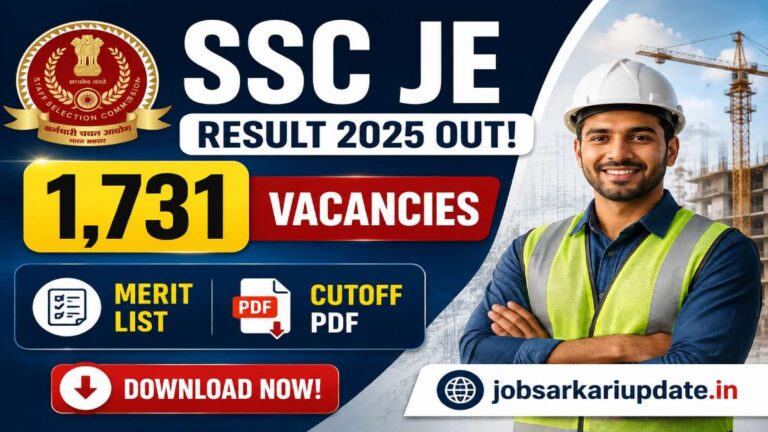
SSC JE Result 2025 - Quick Summary: SSC has declared the final result for Junior Engineer Examination 2025 on August...
Read Full Details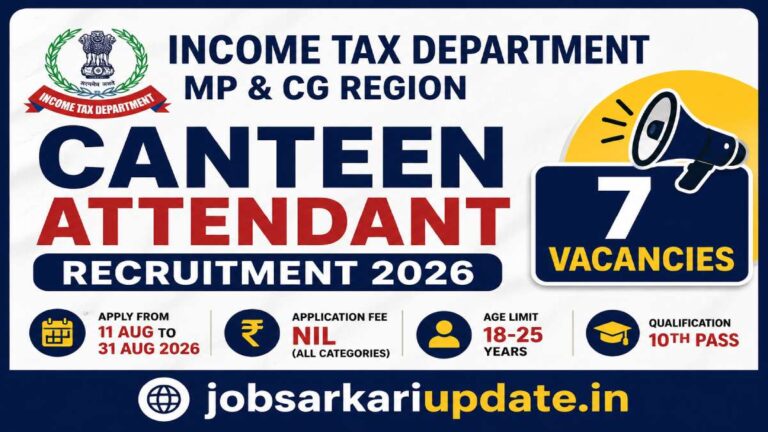
Income Tax Canteen Attendant 2026 - Quick Summary: Income Tax Department, MP & CG Region has released notification for 7...
Read Full Details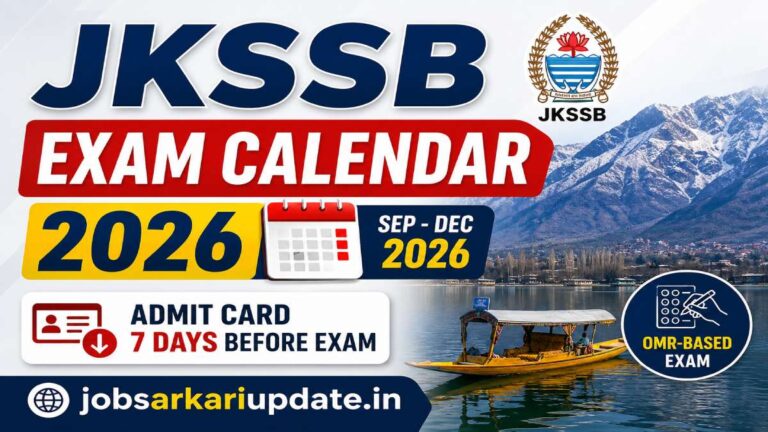
JKSSB Exam Calendar 2026 - Quick Summary: JKSSB has released the exam calendar for 2026 for Health & Medical Education,...
Read Full Details
UPSSSC Auditor Recruitment 2026 - Quick Summary: UPSSSC has released notification for 1,957 Auditor and Assistant Accountant vacancies across various...
Read Full Details
Agniveer Recruitment Rally Fatehgarh 2026 - Quick Summary: Rajput Regimental Centre Fatehgarh is conducting Agniveer Recruitment Rally (UHQ Quota) from...
Read Full Details