MPSC Group-B Combined Preliminary Examination 2026 – Complete Guide Maharashtra Public Service Commission (MPSC) has officially released the notification for...
Read Full DetailsJEE Advanced 2026 – Eligibility, Dates, Syllabus & Pattern
JEE Advanced 2026 – Complete Guide: Eligibility, Registration Dates, Exam Pattern, Syllabus & Rank List Criteria
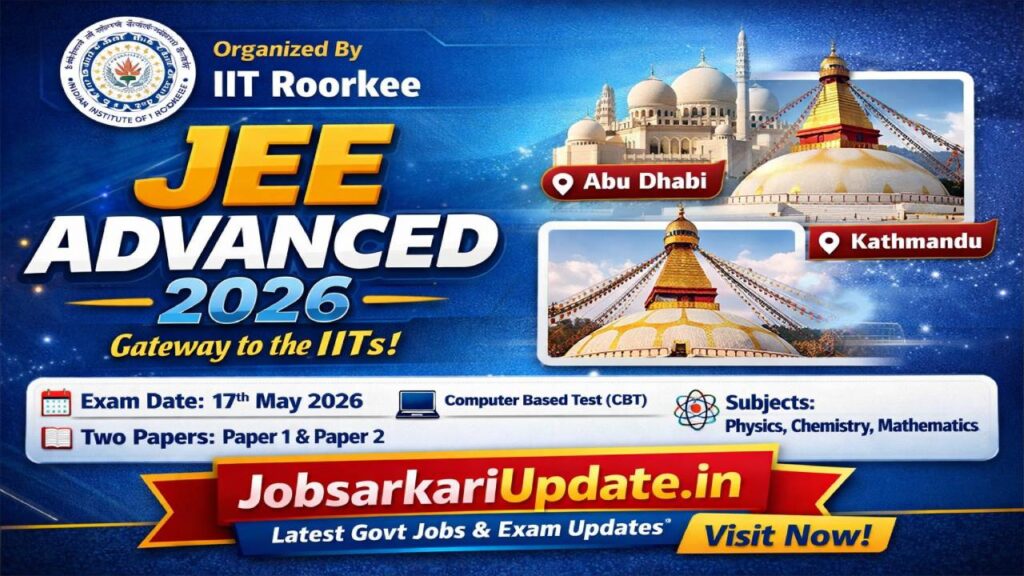
JEE Advanced 2026 is officially announced, with the Indian Institute of Technology Roorkee (IIT Roorkee) serving as the Organizing Institute this year. The examination is scheduled for May 17, 2026 (Sunday) and will be conducted in Computer Based Test (CBT) mode across hundreds of cities in India and two foreign centres. Online registration for JEE Main qualified candidates opens on April 23, 2026 and closes on May 2, 2026. This is the gateway examination for admission to undergraduate programmes at all 23 IITs — including B.Tech, B.S., B.Arch, Dual Degree, and Integrated M.Tech/M.S. programmes — for the academic year 2026-27.
JEE Advanced 2026 is conducted by the seven Zonal Coordinating IITs under the guidance of the Joint Admission Board 2026 (JAB 2026). Unlike JEE Main, which is a qualifying exam conducted by NTA, JEE Advanced is the final selection exam — performance in JEE Advanced directly determines your rank and your IIT seat. The top 2,50,000 candidates from JEE Main 2026 (across all categories, including horizontal reservations) are eligible to register for JEE Advanced. Of these, only candidates who also meet Class XII criteria and all other eligibility conditions will ultimately qualify for IIT admissions through JoSAA 2026.
This article explains everything you need — all five eligibility criteria, registration process and fee, exam pattern, marking scheme, rank list cutoffs, Class XII board performance requirements, and the complete subject-wise syllabus overview — so you do not have to wade through the 118-page official information brochure.
Key Dates at a Glance: Registration: April 23 – May 2, 2026 | Fee Payment Deadline: May 4, 2026 | Exam: May 17, 2026 | Results: June 1, 2026
JEE Advanced 2026 – Overview
The Indian Institutes of Technology (IITs) are institutions of national importance established through Acts of Parliament. At present, there are 23 IITs across India spanning six zones — East, Central, North-Central, North-East, North, South, and West — each offering a diverse range of undergraduate and dual-degree programmes. Admission to all these programmes is exclusively through JEE Advanced. This year, IIT Roorkee is the organizing institute and the examination is conducted as a Computer Based Test across selected cities and towns throughout India and two foreign centres (Abu Dhabi and Kathmandu).
| Detail | Information |
|---|---|
| Exam Name | Joint Entrance Examination (Advanced) 2026 — JEE (Advanced) 2026 |
| Organizing Institute | Indian Institute of Technology Roorkee (IIT Roorkee) |
| Conducted By | Seven Zonal Coordinating IITs under Joint Admission Board 2026 (JAB 2026) |
| Purpose | Admission to B.Tech, B.S., B.Arch, Dual Degree, Integrated M.Tech/M.S. at 23 IITs — Academic Year 2026-27 |
| Mode of Examination | Computer Based Test (CBT) only |
| Date of Examination | May 17, 2026 (Sunday) |
| Number of Papers | Two — Paper 1 (09:00–12:00 IST) and Paper 2 (14:30–17:30 IST) |
| Subjects | Physics, Chemistry, Mathematics (in both papers) |
| Language of Paper | English and Hindi (candidates can switch between languages during the exam) |
| Official Website | https://jeeadv.ac.in |
| Contact | orgjee@iitr.ac.in | IIT Roorkee, Roorkee – 247667 |
JEE Advanced 2026 – Important Dates
The JEE Advanced 2026 schedule is extremely tight — from registration opening to exam day is only 24 days, and from exam to results is just 15 days. Candidates who qualify JEE Main must register without delay during the April 23 – May 2 window. Missing the fee payment deadline of May 4 means your registration is cancelled — there is no grace period. Admit cards are available from May 11 onwards, and the exam is on May 17. All dates listed below are sourced directly from the official Information Brochure. Any changes will be notified only at https://jeeadv.ac.in.
| Event | Date / Time (IST) |
|---|---|
| Direct Registration for Foreign/OCI/PIO(F) Candidates Opens | April 06, 2026 (Monday, 10:00 IST) |
| JEE Main Qualified Candidates – Registration Opens | April 23, 2026 (Thursday, 10:00 IST) |
| Online Registration Closes (All Candidates) | May 02, 2026 (Saturday, 23:59 IST) |
| Last Date for Fee Payment | May 04, 2026 (Monday, 23:59 IST) |
| Admit Card Download Opens | May 11, 2026 (Monday, 17:00 IST) |
| Admit Card Download Closes | May 17, 2026 (Sunday, 14:30 IST) |
| Scribe Meeting for PwD Candidates | May 16, 2026 (Saturday) |
| JEE Advanced 2026 Examination | May 17, 2026 (Sunday) | Paper 1: 09:00–12:00 IST | Paper 2: 14:30–17:30 IST |
| Candidate Responses Available on Portal | May 21, 2026 (Thursday, 17:00 IST) |
| Provisional Answer Keys Released | May 25, 2026 (Monday, 10:00 IST) |
| Feedback on Provisional Answer Keys | May 25, 2026 (10:00 IST) – May 26, 2026 (Tuesday, 17:00 IST) |
| Final Answer Keys Released | June 01, 2026 (Monday, 10:00 IST) |
| JEE Advanced 2026 Results | June 01, 2026 (Monday) |
| AAT 2026 Registration | June 01, 2026 (10:00 IST) – June 02, 2026 (Tuesday, 17:00 IST) |
| Architecture Aptitude Test (AAT) 2026 | June 04, 2026 (Thursday) – 09:00 to 12:00 IST |
| AAT 2026 Results | June 07, 2026 (Sunday, 17:00 IST) |
Note: The exam date (May 17, 2026) will remain unchanged even if it is declared a public holiday. All date changes, if any, will be notified exclusively at https://jeeadv.ac.in. PwD candidates with ≥40% impairment get 1 hour extra per paper (Paper 1 ends at 13:00 IST, Paper 2 ends at 18:30 IST).
JEE Advanced 2026 – Registration Fee
The registration fee for JEE Advanced 2026 varies by category, gender, and examination centre location (India vs. foreign countries). Female candidates of all categories, and male candidates belonging to SC, ST, and PwD categories pay only Rs. 1,600 for exam centres in India. All other candidates (General/EWS/OBC-NCL males) pay Rs. 3,200. The fee is non-refundable and non-transferable under any circumstances. Payment is made online during registration and the final deadline for fee payment is May 4, 2026 at 23:59 IST — registrations without completed fee payment will be cancelled. Note that the fee shown does not include service charges or processing fees levied by payment gateways or banks.
| Candidate Type | Category | Fee – India Centres | Fee – Foreign Centres |
|---|---|---|---|
| Indian Nationals | Female Candidates (all categories) | Rs. 1,600 | USD 200 (or equiv. in INR) |
| SC, ST, and PwD Candidates (male) | Rs. 1,600 | USD 200 (or equiv. in INR) | |
| All Other Candidates (General/EWS/OBC-NCL male) | Rs. 3,200 | USD 200 (or equiv. in INR) | |
| OCI/PIO (I) Candidates | Female (GEN and GEN-PwD) | Rs. 1,600 | USD 200 (or equiv. in INR) |
| OPEN (GEN-PwD) | Rs. 1,600 | USD 200 (or equiv. in INR) | |
| OPEN (GEN) | Rs. 3,200 | USD 200 (or equiv. in INR) | |
| Foreign Nationals & OCI/PIO (F) | Candidates in SAARC Countries | USD 100 (or equiv. in INR) | USD 200 (or equiv. in INR) |
| Candidates in Non-SAARC Countries | USD 200 (or equiv. in INR) | USD 300 (or equiv. in INR) |
Age Limit (Criterion A2)
The age limit for JEE Advanced 2026 is straightforward but must be verified carefully. Candidates must have been born on or after October 1, 2001 to be eligible. This means any candidate born on or before September 30, 2001 does not qualify, regardless of their JEE Main rank. SC, ST, and PwD candidates receive a 5-year age relaxation — they must have been born on or after October 1, 1996. The age is determined from the date of birth as recorded in the Class X certificate, not as stated by the candidate. There is no maximum age limit stated beyond the birth date criteria — the qualification is purely birth-date based.
| Category | Date of Birth Eligibility (Must be born ON OR AFTER) |
|---|---|
| General / EWS / OBC-NCL | October 1, 2001 |
| SC / ST / PwD | October 1, 1996 (5-year relaxation) |
JEE Advanced 2026 – Complete Eligibility Criteria (All 5 Criteria for Indian Nationals)
Every Indian national (including OCI/PIO(I) candidates) must satisfy ALL FIVE eligibility criteria simultaneously to appear for JEE Advanced 2026. Failing even one criterion makes you ineligible, regardless of how well you meet the others. Read each criterion carefully — particularly Criterion A4 (Class XII first attempt rule) and Criterion A5 (prior IIT admission rule), which are the two most commonly misunderstood and cause unexpected disqualifications.
Criterion A1 – Performance in JEE Main 2026 (Top 2,50,000)
You must be among the top 2,50,000 successful candidates in the B.E./B.Tech. paper of JEE Main 2026 across all categories. The category-wise distribution of the 2,50,000 shortlisted candidates is fixed as follows — you must rank within your category’s allocated quota to be eligible.
| Sl. No. | Category | Number of Top Candidates | Group Total |
|---|---|---|---|
| 1 | OPEN | 96,187 | 1,01,250 |
| 2 | OPEN-PwD | 5,063 | |
| 3 | GEN-EWS | 23,750 | 25,000 |
| 4 | GEN-EWS-PwD | 1,250 | |
| 5 | OBC-NCL | 64,125 | 67,500 |
| 6 | OBC-NCL-PwD | 3,375 | |
| 7 | SC | 35,625 | 37,500 |
| 8 | SC-PwD | 1,875 | |
| 9 | ST | 17,812 | 18,750 |
| 10 | ST-PwD | 938 | |
| Total | ~2,50,000 (may be slightly more in case of tied scores) | ||
Criterion A2 – Age Limit
Born on or after October 1, 2001 (General/EWS/OBC-NCL). Born on or after October 1, 1996 (SC/ST/PwD — 5-year relaxation).
Criterion A3 – Number of Attempts (Maximum 2)
A candidate can attempt JEE Advanced a maximum of two times, and these two attempts must be in two consecutive years. For example, if you attempted JEE Advanced 2025, you can attempt JEE Advanced 2026 — but you cannot attempt JEE Advanced 2027. There are no exceptions to this rule.
Criterion A4 – Class XII First Appearance (2025 or 2026 Only)
You must have appeared for Class XII (or equivalent) for the FIRST TIME in either 2025 or 2026. Physics, Chemistry, and Mathematics must have been compulsory subjects. Candidates who first appeared for Class XII in 2024 or earlier are NOT eligible for JEE Advanced 2026, regardless of the subjects attempted. One important exception: if a Board declared the result of academic year 2023-24 on or after June 18, 2024, then candidates of that board who appeared in 2024 may also be eligible — verify your board’s result date carefully.
Criterion A5 – No Prior IIT Admission
You must NOT have been admitted to an IIT under any programme listed in JoSAA Business Rules of 2025 — even if you did not continue in the programme, or even if your admission was subsequently cancelled after joining. The following situations make you INELIGIBLE: (1) You accepted a seat at an IIT through JoSAA 2025 and reported online or at a reporting centre. (2) Your admission to an IIT was cancelled for any reason after you joined. The following situations keep you ELIGIBLE despite a JoSAA 2025 seat: (1) You were allocated a seat but did not report at all. (2) You withdrew before the last round of seat allotment. (3) Your seat was cancelled before the last round of allotment. Candidates admitted to a Preparatory Course at any IIT for the first time in 2025 are also eligible.
Critical Note for Repeaters: The category as entered in the JEE Main 2026 database will be final for JEE Advanced 2026. Requests to change category will NOT be entertained at any stage.
Seat Reservation at IITs
Seats at IITs are reserved as per Government of India norms. The reservation percentages are: GEN-EWS — 10% of seats in every course; OBC-NCL — 27% of seats; SC — 15% of seats; ST — 7.5% of seats; PwD — 5% of seats within each of the OPEN, GEN-EWS, OBC-NCL, SC, and ST categories (horizontal reservation). OBC candidates in the Creamy Layer are NOT entitled to OBC-NCL reservation and are treated as General (OPEN) category. Two preferential seats exist per institute for Defence Service (DS) candidates (children of defence/paramilitary personnel killed or permanently disabled in action). Supernumerary seats exist for female candidates to ensure at least 20% female enrolment in undergraduate programmes at each IIT. Foreign nationals get up to 10% supernumerary seats per programme per IIT.
| Category | Reservation Percentage | Applicable To |
|---|---|---|
| GEN-EWS | 10% of seats in every course | General category with income below Rs. 8 lakh/year (with no excluded assets) |
| OBC-NCL | 27% of seats in every course | OBC candidates in the Non-Creamy Layer as per Central List |
| SC | 15% of seats in every course | Scheduled Castes as per Central Government list |
| ST | 7.5% of seats in every course | Scheduled Tribes as per Central Government list |
| PwD (Horizontal) | 5% within each vertical category | Persons with Disability with at least 40% impairment |
| Defence Service (DS) | 2 seats per Institute (preferential) | Children of defence/paramilitary personnel killed or permanently disabled in action |
| Female (Supernumerary) | Enough to ensure ≥20% female enrolment | Female Indian nationals and OCI/PIO(I) who qualify JEE Advanced |
| Foreign Nationals (Supernumerary) | Up to 10% of total seats per programme per IIT | Non-Indian citizens and OCI/PIO(F) candidates |
JEE Advanced 2026 – Exam Pattern
JEE Advanced 2026 consists of two papers — Paper 1 and Paper 2 — each of exactly three hours duration. Appearing in BOTH papers is compulsory. Candidates who appear in only one paper will not have their responses evaluated and will not be ranked. Each paper has three sections: Physics, Chemistry, and Mathematics. The papers are designed to test comprehension, reasoning, and analytical ability — not just rote recall. Negative marking may apply to some question types (specific details are provided in the question paper instructions on exam day). PwD candidates with at least 40% impairment, and persons with less than 40% disability having writing difficulty, get one hour of compensatory time per paper.
| Detail | Paper 1 | Paper 2 |
|---|---|---|
| Timing (General) | 09:00 IST – 12:00 IST | 14:30 IST – 17:30 IST |
| Timing (PwD / Writing Difficulty) | 09:00 IST – 13:00 IST (+1 hr) | 14:30 IST – 18:30 IST (+1 hr) |
| Duration | 3 Hours (180 minutes) | 3 Hours (180 minutes) |
| Sections | Physics, Chemistry, Mathematics | Physics, Chemistry, Mathematics |
| Mode | Computer Based Test (CBT) | Computer Based Test (CBT) |
| Language | English and Hindi (switchable during exam; English version prevails in case of discrepancy) | |
| Negative Marking | May apply for some question types (exact marking scheme provided in question paper on exam day) | |
| Compulsory | YES — both papers must be attempted; only candidates appearing in BOTH are ranked | |
Important: If a question is dropped by the examiners (e.g., for error), full marks for that question are awarded to ALL candidates irrespective of whether negative marking applies to that question type. Mock tests in CBT mode are available under the “Resources” section on https://jeeadv.ac.in — all candidates are strongly advised to practice before the exam day.
JEE Advanced 2026 – Syllabus Overview
The complete detailed syllabus is provided in Annexure-I of the official Information Brochure at https://jeeadv.ac.in. The syllabus covers three subjects — Physics, Chemistry, and Mathematics — at the Class XI and XII level, with a strong emphasis on conceptual understanding and application rather than formula memorisation. Below is a chapter-level overview of the key topics in each subject. Candidates preparing for JEE Advanced must go deeper than JEE Main in each of these topics — particularly in areas like electrochemistry, nuclear physics, complex numbers, and coordinate geometry.
Chemistry Syllabus – Key Topics
| Area | Key Topics |
|---|---|
| Physical Chemistry | Mole concept, Stoichiometry, States of Matter (Gas Laws, van der Waals), Atomic Structure (Bohr model, quantum numbers), Chemical Bonding (VB, MO theory, VSEPR), Chemical Thermodynamics, Chemical & Ionic Equilibrium, Electrochemistry, Chemical Kinetics, Nuclear Chemistry, Surface Chemistry |
| Inorganic Chemistry | Periodic Table trends, s-block, p-block, d-block elements, Coordination Chemistry, Extractive Metallurgy, Qualitative Analysis |
| Organic Chemistry | Nomenclature, Isomerism, Reaction mechanisms (substitution, elimination, addition), Functional group chemistry (alcohols, ethers, aldehydes, ketones, carboxylic acids, amines), Biomolecules, Polymers, Practical Organic Chemistry |
Mathematics Syllabus – Key Topics
| Area | Key Topics |
|---|---|
| Algebra | Complex Numbers, Quadratic Equations, Sequences & Series, Permutations & Combinations, Binomial Theorem, Matrices & Determinants, Probability |
| Calculus | Limits, Continuity, Differentiability, Differentiation (including applications), Integration (definite and indefinite), Differential Equations |
| Coordinate Geometry | Straight Lines, Circles, Parabola, Ellipse, Hyperbola, 3D Geometry (lines, planes) |
| Trigonometry & Vectors | Trigonometric functions, identities, equations, Inverse Trigonometry, Properties of Triangles, Vectors (dot and cross product) |
Physics Syllabus – Key Topics
| Area | Key Topics |
|---|---|
| Mechanics | Kinematics, Laws of Motion, Work-Energy-Power, Circular Motion, Gravitation, Properties of Solids & Fluids, Simple Harmonic Motion, Waves & Sound |
| Thermal Physics | Thermal Expansion, Calorimetry, Thermodynamics (Laws, Carnot cycle), Kinetic Theory of Gases, Heat Transfer |
| Electricity & Magnetism | Electrostatics, Current Electricity (Kirchhoff’s laws, Wheatstone bridge), Capacitance, Magnetic Effects of Current, Electromagnetic Induction, Alternating Current |
| Modern Physics & Optics | Geometrical Optics (reflection, refraction, lenses, mirrors), Wave Optics (interference, diffraction), Photoelectric Effect, Bohr Model, Radioactivity, Nuclear Physics |
Note: The detailed topic-wise syllabus (including Architecture Aptitude Test syllabus) is published in Annexure-I of the official JEE Advanced 2026 Information Brochure at https://jeeadv.ac.in. Always refer to the official syllabus — never rely on third-party syllabus compilations.
JEE Advanced 2026 – Rank Lists & Minimum Qualifying Marks
Ranks in JEE Advanced 2026 are determined by aggregate marks across both papers. The aggregate is the sum of marks in Physics (Paper 1 + Paper 2), Chemistry (Paper 1 + Paper 2), and Mathematics (Paper 1 + Paper 2). Candidates must clear BOTH a subject-wise minimum percentage AND an aggregate minimum percentage to be included in any rank list. Failing to meet either threshold — even by a fraction — means you do not appear in the rank list and are not eligible for IIT admission. In case of a tie, the candidate with higher positive marks ranks higher. If still tied, the one with more marks in Mathematics, then Physics, gets the higher rank. If the tie persists, both candidates are given the same rank.
| Rank List | Minimum % Marks in Each Subject | Minimum % Aggregate Marks |
|---|---|---|
| Common Rank List (CRL) | 10.0% | 35.0% |
| GEN-EWS Rank List | 9.0% | 31.5% |
| OBC-NCL Rank List | 9.0% | 31.5% |
| SC Rank List | 5.0% | 17.5% |
| ST Rank List | 5.0% | 17.5% |
| Common-PwD (CRL-PwD) | 5.0% | 17.5% |
| GEN-EWS-PwD Rank List | 5.0% | 17.5% |
| OBC-NCL-PwD Rank List | 5.0% | 17.5% |
| SC-PwD Rank List | 5.0% | 17.5% |
| ST-PwD Rank List | 5.0% | 17.5% |
| Preparatory Course Rank Lists (SC/ST/PwD) | 2.5% | 8.75% |
Note: A candidate who qualifies in more than one category will be included in all the rank lists applicable to their category membership. The minimum aggregate percentage thresholds may be lowered if required, as per MHRD directives.
Class XII Board Performance Criteria for IIT Admission
Qualifying JEE Advanced alone is not enough for IIT admission. You must ALSO satisfy the Class XII board performance criteria. Candidates must meet AT LEAST ONE of the following two conditions, with Physics, Chemistry, and Mathematics as compulsory subjects in their Class XII board exam.
| Criterion | Requirement | Category-wise Marks |
|---|---|---|
| Option 1 — 75% Aggregate Marks | Passed Class XII (or equivalent) with minimum five subjects and secured at least 75% aggregate marks | General/OBC/EWS: 75% | SC/ST/PwD: 65% |
| Option 2 — Top 20 Percentile | Passed Class XII (or equivalent) with minimum five subjects and be within the category-wise top 20 percentile of successful candidates in the respective Board examination | Category-wise percentile cutoffs vary by Board |
The aggregate marks for Class XII are calculated across five specific subjects: Physics, Chemistry, Mathematics, one Language (higher marks if more than one language taken), and one other subject (highest marks). If your board uses grades instead of percentage marks, you must obtain a percentage conversion certificate from the board. A CGPA of 59.99% is treated as less than 60% — rounding up is not permitted.
How to Register for JEE Advanced 2026 – Step-by-Step
Pre-Registration Checklist
- JEE Main 2026 Application Number and login credentials
- Class X certificate (for date of birth verification)
- Class XII certificate/marksheet (if appeared in 2025; upload 2026 marksheet when available)
- Category certificate — SC/ST/OBC-NCL/GEN-EWS (issued on or after April 1, 2026 for EWS/OBC-NCL)
- PwD certificate (UDID or prescribed FORM-PwD, issued from Swavalamban portal for post-June 2021 certificates)
- DS certificate (FORM-DS from record office) if applicable
- Scanned photograph and signature
- Valid email ID and mobile number (must remain active throughout the process)
- Payment method for registration fee (Debit/Credit Card, Net Banking, UPI)
- Visit the Registration Portal: Go to https://jeeadv.ac.in. JEE Main qualified candidates can register from April 23, 2026 (10:00 IST) onwards.
- Login with JEE Main Credentials: Use your JEE Main 2026 application number and other credentials to access the JEE Advanced registration portal.
- Verify Eligibility: The portal will pre-fill some details from JEE Main. Verify all pre-filled information carefully — category, personal details, and exam-related data. Category once submitted cannot be changed.
- Upload Documents: Upload all required scanned documents — photograph, signature, and certificates as applicable to your category. Ensure documents are clear, correctly formatted, and within specified file size limits.
- Select Exam Centres: Choose 10 exam cities/towns in order of preference. You MUST choose 10 — no fewer. Requests for change after submission will NOT be entertained.
- Pay Registration Fee: Complete online payment of the applicable fee. You have until May 4, 2026 (23:59 IST) to pay — registrations without payment are cancelled automatically.
- Download Confirmation: After successful registration and payment, save your system-generated application printout and registration confirmation. Download your admit card from May 11, 2026 onwards from https://jeeadv.ac.in.
Critical Mistakes to Avoid:
- Selecting fewer than 10 exam cities — the portal requires exactly 10 choices; fewer may cause submission errors
- Missing the fee payment deadline of May 4, 2026 (23:59 IST) — your registration will be cancelled with no reinstatement option
- Uploading category certificates issued before April 1, 2026 for EWS or OBC-NCL — the notification explicitly requires these certificates to be issued on or after April 1, 2026
Expert Tips for JEE Advanced 2026 Aspirants
1. Register Immediately After JEE Main Results — Don’t Wait for April 23
Even though registration opens April 23, you should prepare all documents now — category certificate, Class X certificate, photograph, and payment details. On April 23 at 10:00 IST, login and complete registration in one sitting. The portal typically experiences high traffic in the first and last few hours of the registration window. Completing registration early gives you time to fix any upload errors before the May 2 deadline.
2. Confirm Your Class XII First-Attempt Year Before Applying
Criterion A4 trips up many students. If you first appeared for Class XII in 2023 or 2024 (and your board declared results before June 18, 2024), you are NOT eligible for JEE Advanced 2026 — regardless of your JEE Main rank. Students with board results from 2024 where the board declared results on or after June 18, 2024 may be eligible — check your specific board’s result declaration date for academic year 2023-24 before applying.
3. Understand the JoSAA Seat Acceptance Rule (Criterion A5)
If you were allocated an IIT seat through JoSAA 2025 and reported online or at a reporting centre — even if you subsequently declined or did not join — you are typically ineligible for JEE Advanced 2026. However, if you were allocated a seat but never reported at all, or withdrew before the last round, you ARE eligible. Read Criterion A5 precisely and cross-check with your JoSAA 2025 activity log before registering.
4. Attempt Both Paper 1 and Paper 2 — No Exceptions
Both papers are compulsory. If you appear for only one paper, your responses will not be evaluated and you will not be ranked — regardless of how well you performed in the paper you attended. Plan your exam day carefully: Paper 1 is 09:00–12:00 IST and Paper 2 is 14:30–17:30 IST. Reach the centre well before 09:00 IST as the main entrance closes at 09:00 IST for Paper 1 and at 14:30 IST for Paper 2.
5. Practice Mock Tests in CBT Mode on the Official Portal
JEE Advanced is a CBT exam with a specific interface — on-screen scribble pad, virtual keyboard, section navigation, and a question palette with status indicators. Many students lose time on exam day because they are unfamiliar with the interface. Free mock tests are available under the “Resources” section at https://jeeadv.ac.in. Practise at least 3–4 full-length mock tests in CBT mode before May 17.
6. Meet the Class XII 75% Criteria Alongside JEE Preparation
JEE Advanced 2026 rank alone does not guarantee IIT admission — you must also secure at least 75% aggregate marks in Class XII (65% for SC/ST/PwD), or be in the top 20 percentile of your board. For students appearing in Class XII in 2026, board exams and JEE preparation run in parallel. Do not neglect your board subjects in the final months — a poor board percentage can make your JEE Advanced rank irrelevant for IIT admission.
Frequently Asked Questions (FAQs)
- 1. What is the exam date for JEE Advanced 2026?
- JEE Advanced 2026 is scheduled for May 17, 2026 (Sunday). Paper 1 is from 09:00 to 12:00 IST and Paper 2 is from 14:30 to 17:30 IST. The date will not change even if declared a public holiday.
- 2. Who is the organizing institute for JEE Advanced 2026?
- Indian Institute of Technology Roorkee (IIT Roorkee) is the organizing institute for JEE Advanced 2026. The examination is conducted by seven Zonal Coordinating IITs under the guidance of the Joint Admission Board 2026 (JAB 2026).
- 3. What is the registration date for JEE Advanced 2026?
- For JEE Main 2026 qualified Indian nationals, online registration opens April 23, 2026 (10:00 IST) and closes May 2, 2026 (23:59 IST). The last date for fee payment is May 4, 2026 (23:59 IST). Foreign nationals and OCI/PIO(F) candidates can register from April 6, 2026.
- 4. How many candidates are eligible to appear for JEE Advanced 2026?
- The top 2,50,000 candidates from JEE Main 2026 (B.E./B.Tech paper) across all categories are eligible to register for JEE Advanced 2026. This includes horizontal reservations for PwD candidates within each vertical category.
- 5. What is the age limit for JEE Advanced 2026?
- General/EWS/OBC-NCL candidates must have been born on or after October 1, 2001. SC, ST, and PwD candidates get 5-year relaxation — they must have been born on or after October 1, 1996.
- 6. Can a student who appeared for Class XII in 2024 appear for JEE Advanced 2026?
- Generally, no — only candidates who first appeared for Class XII in 2025 or 2026 are eligible. However, if your board declared the result for academic year 2023-24 on or after June 18, 2024, you may be eligible. Check your specific board’s result declaration date carefully before applying.
- 7. What is the registration fee for JEE Advanced 2026?
- For exam centres in India: Female candidates (all categories), SC, ST, and PwD candidates pay Rs. 1,600. All other Indian nationals pay Rs. 3,200. Foreign candidates in SAARC countries pay USD 100; Non-SAARC countries pay USD 200. The fee is non-refundable and non-transferable.
- 8. Is negative marking present in JEE Advanced 2026?
- Negative marking may be awarded for incorrect answers for some question types. The exact marking scheme (including which question types carry negative marks and the amount of penalty) will be provided in the detailed instructions in the question paper on exam day.
- 9. What is the minimum marks required to qualify in JEE Advanced 2026?
- For the Common Rank List (CRL): 10% in each subject and 35% aggregate. For SC/ST/PwD: 5% in each subject and 17.5% aggregate. For GEN-EWS and OBC-NCL: 9% in each subject and 31.5% aggregate. Candidates must meet BOTH the subject-wise AND aggregate minimums.
- 10. What Class XII marks are needed for IIT admission after qualifying JEE Advanced?
- You must either score at least 75% aggregate marks in Class XII (65% for SC/ST/PwD), OR be in the top 20 percentile of your board. Both conditions require Physics, Chemistry, and Mathematics as compulsory subjects. Aggregate is calculated across five specific subjects including PCM, one language, and one additional subject.
- 11. Where can JEE Advanced 2026 be taken outside India?
- JEE Advanced 2026 has two foreign examination centres: Abu Dhabi (UAE) and Kathmandu (Nepal). Indian nationals and OCI/PIO(I) candidates appearing at foreign centres pay USD 200 registration fee.
- 12. What is the Architecture Aptitude Test (AAT) 2026?
- AAT 2026 is a separate test required for admission to B.Arch programmes, available at IIT (BHU) Varanasi, IIT Kharagpur, and IIT Roorkee. Only JEE Advanced 2026 qualifiers can register for AAT (June 1–2, 2026). The test is on June 4, 2026 (09:00–12:00 IST) and results are declared June 7, 2026. Candidates must pass AAT; there is no separate ranking — IIT seat allocation for B.Arch is based solely on JEE Advanced rank.
Important Links
| Apply Online | Click Here |
| Download Notification | Click Here |
| Official Website | Click Here |
Recent Jobs
Check out our latest job postings
309 Jobs Available

UPSSSC Fireman Recruitment 2026 – 170 Vacancies for Vidhan Bhavan Rakshak & Agnik/Agni Rakshak Posts The UPSSSC Fireman Recruitment 2026...
Read Full Details
GIMS Paramedical Staff Recruitment 2026 – Complete Guide The Government Institute of Medical Sciences (GIMS), Greater Noida has released the...
Read Full Details
Indian Army RVC SSC Recruitment 2026 – 95th Short Service Commission Course for Veterinary Graduates The Indian Army RVC SSC...
Read Full Details
UKMSSB Medical Officer Allopathic Recruitment 2026 – 47 ESI Vacancies for MBBS Doctors in Uttarakhand The UKMSSB Medical Officer Allopathic...
Read Full Details
Haryana RTE EWS Admission 2026-27 – Complete Guide for Parents The Government of Haryana, through the Directorate of Elementary Education,...
Read Full Details Follow WhatsApp Channel