
MP Police Constable Band Recruitment 2026 – 679 Vacancies, Apply Online by April 19 The MP Police Constable Band Recruitment...
Read Full DetailsBSNL SET Recruitment 2026 – Eligibility, Vacancy & Apply
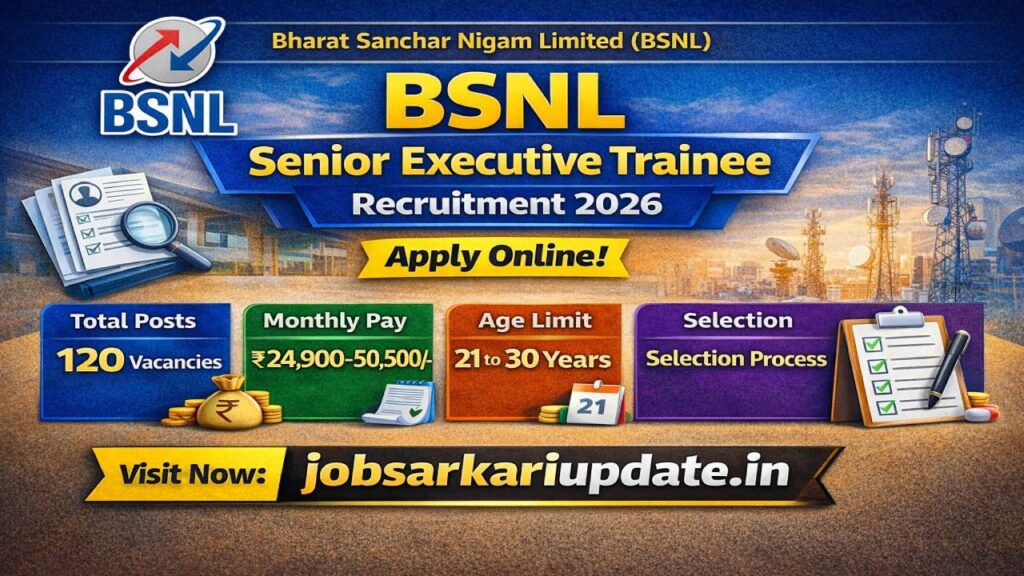
BSNL Senior Executive Trainee Recruitment 2026 – Complete Notification Details
The BSNL Senior Executive Trainee Recruitment 2026 is one of the most anticipated government sector openings of the year for engineering and finance professionals. Bharat Sanchar Nigam Limited (BSNL), a Government of India enterprise and one of the country’s largest telecom service providers, has officially released Advt. No. BSNLCO-11/12(11)/1/2025-RECTT-CO-Part (1) dated 29 January 2026, inviting applications from eligible external candidates for the post of Senior Executive Trainee (Direct Recruitment) in two streams — Telecom and Finance. A total of 120 vacancies are available across both streams, with 95 posts in the Telecom stream and 25 posts in the Finance stream.
This is a rare direct-recruitment opportunity from open market candidates into a Group-B executive-level post in a Central Government PSU. BSNL’s SET (DR) position offers the combined benefits of government job security, a structured IDA pay scale, a clear promotion path up to AGM level, pension under NPS, and the prestige of working for a national telecom infrastructure backbone. For B.Tech/BE graduates in Electronics, Telecom, Computer Science, IT, Electrical or Instrumentation — and for CA/CMA professionals — this notification is a genuine career-changing opportunity. Given BSNL’s track record of conducting transparent CBT-based selections and the relatively limited vacancy count of 120, competition is expected to be intense. Candidates are advised to act quickly, as the online registration window opened on 05 February 2026 and closes on 07 March 2026.
BSNL SET 2026 Recruitment Overview
| Detail | Information |
|---|---|
| Organization Name | Bharat Sanchar Nigam Limited (BSNL) |
| Post Name | Senior Executive Trainee – Direct Recruitment (Telecom & Finance) |
| Advertisement No. | BSNLCO-11/12(11)/1/2025-RECTT-CO-Part (1) |
| Total Vacancies | 120 (95 – Telecom | 25 – Finance) |
| Job Location | Anywhere in India (All BSNL Operational Areas) |
| Job Type | Central Government PSU (IDA Pay Scale) |
| Application Mode | Online Only |
| Notification Date | 29 January 2026 |
BSNL is a wholly owned Government of India enterprise operating under the Department of Telecommunications (DoT), Ministry of Communications. It is one of the few public sector telecom entities with a pan-India operational footprint, serving both urban and rural connectivity needs across all 29 states and union territories. BSNL’s direct recruitment process is transparent, merit-based, and conducted entirely online — from application to CBT examination — making it a highly trustworthy and credible recruitment exercise. The fact that this is a Direct Recruitment from the external/open market (not a departmental promotion) makes it accessible to all eligible candidates across India, adding significant value to this notification.
BSNL SET 2026 Important Dates
| Event | Date & Time |
|---|---|
| Application Start Date | 05 February 2026 | 10:00 AM |
| Last Date to Apply Online | 31 March 2026 | 10:00 AM (Extended) |
| Application Editing Window Opens | 01 April 2026 | 10:00 AM |
| Last Date for Application Editing | 8 April 2026 | 10:00 AM |
| CBT Exam Date (Tentative) | To be notified |
| Document Verification Date | To be notified |
| Result Date | To be notified |
Every experienced government job aspirant knows that applying in the first week is always the smarter strategy — and here is exactly why. In the early days of registration, BSNL’s portal tends to handle lower traffic, which means faster form submission, fewer server timeout errors, and a smoother document upload experience. More importantly, if you discover a mistake in your form — wrong category selected, incorrect photograph dimensions, or a mismatch in personal details — you have adequate time to use the editing window (08–15 March 2026) to correct it. Last-minute applicants often miss this safety net entirely and end up with an uncorrectable error on record.
Important Notice: All dates are subject to change. Always verify from the official notification before taking any action.
BSNL SET 2026 Application Fee
| Category | Fee Amount | Payment Mode |
|---|---|---|
| General / OBC (CL & NCL) / EWS | ₹2,500/- | Online Only (Net Banking / Credit Card / Debit Card) |
| SC / ST / PwBD | ₹1,250/- | Online Only (Net Banking / Credit Card / Debit Card) |
The examination fee must be paid exclusively through online modes — Internet Banking, Credit Card, or Debit Card — on the official BSNL examination portal. UPI-based payments are not explicitly mentioned in the notification, so candidates should rely on the officially listed methods only. One critical mistake that candidates frequently make is selecting the wrong fee category during payment. For example, an OBC (NCL) candidate paying at the SC/ST rate of ₹1,250/- instead of the applicable ₹2,500/- can lead to application rejection at the document verification stage. Always cross-verify your category before completing the fee transaction. Once paid, the fee is strictly non-refundable under any circumstances and cannot be carried forward to any future recruitment exercise.
BSNL SET 2026 Age Limit
| Category | Minimum Age | Maximum Age | Age Relaxation |
|---|---|---|---|
| Unreserved / EWS / OBC (CL) | 21 Years | 30 Years | NIL |
| OBC (NCL) | 21 Years | 33 Years | +3 Years |
| SC / ST | 21 Years | 35 Years | +5 Years |
| PwBD – General / EWS / OBC (CL) | 21 Years | 40 Years | +10 Years |
| PwBD – OBC (NCL) | 21 Years | 43 Years | +13 Years |
| PwBD – SC / ST | 21 Years | 45 Years | +15 Years |
Age is calculated as on the closing date of application receipt — 07 March 2026. Here is a practical example: if you belong to the General category and your date of birth is 08 March 1996, you would be exactly 30 years old on the closing date and remain eligible. However, if your date of birth is 06 March 1996, you would have already crossed 30 years by the cutoff date and would be ineligible for the unreserved category. This single-day difference is legally binding. The only accepted proof of date of birth is the Matriculation/Class 10th certificate; no alternative documents such as horoscopes, affidavits, or birth extracts from Municipal Corporations will be considered. Age relaxation follows standard Government of India rules unless stated otherwise.
BSNL SET 2026 Eligibility Criteria
| Post Name | Educational Qualification | Required Stream / Subject | Experience Required |
|---|---|---|---|
| SET (DR) – Telecom Stream | BE / B.Tech or equivalent engineering degree with minimum 60% marks on a regular full-time basis | Electronics & Telecom, Electronics, Computer Science, Information Technology, Electrical, Instrumentation, or combination of these disciplines as core with other associated emerging branches | Not mentioned in official notification. Candidates are advised to check the official notice for updates. |
| SET (DR) – Finance Stream | Chartered Accountant (CA) or Cost and Management Accountancy (CMA) – full qualification | CA / CMA (complete qualification from ICAI / ICMAI) | Not mentioned in official notification. Candidates are advised to check the official notice for updates. |
One of the most frequent eligibility mistakes in BSNL SET recruitment is applying for the Telecom stream with an engineering degree not listed in the notification — such as Civil, Mechanical, or a B.Sc. in Physics. These are not accepted equivalents. The notification specifies only BE/B.Tech (or equivalent engineering degree) in the listed disciplines with a minimum 60% aggregate, earned on a regular, full-time basis. Part-time, correspondence, or distance-mode engineering degrees are not accepted. For the Finance stream, only fully qualified CA or CMA professionals are eligible — CA Inter or CMA Inter alone does not qualify. Both qualifications must be completed on or before 07 March 2026. For CGPA-graded degrees, a percentage conversion certificate from your university is mandatory at document verification.
BSNL SET 2026 Vacancy Details – Category-Wise Breakup
| Post Name | UR/OBC(CL) | OBC (NCL) | SC | ST | EWS | PwBD-C | PwBD-D/E | Total |
|---|---|---|---|---|---|---|---|---|
| SET (DR) – Telecom | 40 | 25 | 14 | 7 | 9 | 2 | 2 | 95 |
| SET (DR) – Finance | 11 | 6 | 4 | 2 | 2 | 1 | – | 25 |
| TOTAL | 51 | 31 | 18 | 9 | 11 | 3 | 2 | 120 |
With 95 out of 120 total posts allocated to the Telecom stream, this is clearly where the larger opportunity lies — particularly for B.Tech graduates in Electronics, Telecom, and Computer Science. The UR/OBC (CL) category has the highest number of seats in Telecom at 40, followed by OBC (NCL) at 25. For the Finance stream, competition will be exceptionally fierce: just 25 total posts across all categories for CA and CMA professionals means the Finance CBT cut-off is expected to be very high. SC candidates collectively hold 18 seats across both streams, making it one of the more proportionate reserved categories by percentage. Compared to BSNL’s earlier limited DR exercises, 120 executive-level vacancies is a moderate opening — signaling selective expansion at the E-3 entry level. Candidates in OBC (NCL) and EWS categories have relatively better odds in the Telecom stream given the vacancy distribution.
BSNL SET 2026 Selection Process
The BSNL SET 2026 selection process is a structured multi-stage pipeline designed to assess aptitude, technical depth, and physical fitness. Here is a complete breakdown of each stage:
Stage 1: Computer Based Test (CBT)
All candidates must appear for a Computer Based Multiple Choice Objective Type Test of 180 minutes (3 hours) duration comprising Part-I (Common Aptitude — 40 questions, 40 marks) and Part-II (Core Technical — 160 questions, 160 marks), totalling 200 questions and 200 marks. Negative marking of -0.25 applies per wrong answer. General candidates must score at least 40% in each part individually and a combined minimum of 50% overall. SC/ST/OBC/PwBD/EWS candidates require 35% per part and 45% overall. Start practising with full-length 200-question mock tests under timed conditions — at just 54 seconds per question on average, speed and accuracy both matter equally.
Stage 2: Merit List Preparation
The final merit list is prepared strictly based on total marks obtained in Part-I and Part-II of the CBT, provided the candidate meets minimum qualifying marks in each section. If multiple exam sessions are conducted, normalization of marks will be applied. There is no interview, group discussion, or personality test at any stage. This entirely objective selection is a great equalizer — every mark you earn in the CBT directly determines your rank in the final list.
Stage 3: Document Verification
Candidates shortlisted from the merit list will be called for Document Verification (DV). All original documents — degree certificates, marksheets, caste/disability/EWS certificates, and Class 10th board certificate — must be produced. Government/PSU employees must also present a No Objection Certificate from their current employer. Organize your documents well in advance so that there are no last-minute surprises at this stage.
Stage 4: Medical Examination
Appointment of finally selected candidates is subject to passing BSNL’s Medical Examination as per company standards. Candidates currently employed elsewhere must not resign from their present jobs until they are officially declared medically fit by BSNL — this is a critical instruction that has caught many candidates off guard in previous recruitment cycles. Get a general health checkup done before this stage to avoid unexpected disqualification.
The BSNL SET 2026 selection process rewards consistent, focused preparation. With no interview in the picture, every mark you score in the CBT is a direct investment in your future with one of India’s most stable and respected public sector employers. Approach your preparation with a structured plan from Day 1, and you have every reason to be confident about your chances.
BSNL SET 2026 Exam Syllabus & Pattern
Exam Pattern
| Stream | Paper | Section | Questions | Marks | Duration | Negative Marking |
|---|---|---|---|---|---|---|
| Telecom | Part-I (Common) | Aptitude Test | 40 | 40 | 180 Minutes | -0.25 per wrong answer |
| Part-II (Core) | Technical – Telecom | 160 | 160 | |||
| Finance | Part-I (Common) | Aptitude Test | 40 | 40 | 180 Minutes | -0.25 per wrong answer |
| Part-II (Core) | Technical – Finance | 160 | 160 |
Part-I (Common) – Aptitude Syllabus (40 Questions / 40 Marks)
- Quantitative Ability and Data Sufficiency
- Reasoning – Analytical, Logical and Critical Reasoning
- Verbal Ability, Reading Comprehension and Analysis
Part-II (Core) – Technical Syllabus: Telecom Stream (160 Questions / 160 Marks)
1. Basic Telecommunications Concepts – 15%
- Signal Processing
- Modulation and Demodulation Technologies
- Multiplexing Techniques
- Spectrum Management
2. Wireless Telecommunications Technologies – 15%
- Wireless Communication Principles
- Mobile Antenna System (Basics, Azimuth, Tilt, VSWR)
- Fundamentals of GSM (2G/3G)
- Fundamentals of LTE
- Fundamentals of IP Multimedia Subsystem (IMS)
- Fundamentals of 5G and Industrial Applications (5G Use Cases, Captive Networks)
- KPIs of 2G/3G/4G/5G Mobile Networks for Voice & Data Quality
- Satellite Communications (LEO, MEO)
- Fundamentals of Telco-Cloud
- Mobile Radio Back Haul (M/W, UBR, E-Band)
- Fixed Wireless Access
- Fundamentals of USIM/ESIM/ISIM and Network Access Security
- Fundamentals of Network Management System (NMS)
- Standardization in Wireless Communication
- Fundamental of Signaling (SS7/SIGTRAN) & Protocols (SIP, Megaco, H.248, MGCP, RTP, RTCP)
- Disaster Management & Mitigation through ICT
3. Wireline Telecommunications Technologies – 15%
- NGN Switches, Soft Switches
- Telecommunication Call Routing and Switching Concepts
- Broadband Internet Technologies
- FTTx Technology
- Signaling in PSTN and SSTP
- C4 & C5 NGN Architecture and Call Flow
- NGN Protocols (SIP / H.248 / RTP / SIGTRAN)
- IMS Network Architecture
- ISDN (PRI/BRI), EPABX, SIP Services
- Wi-Fi Services and Encrypted Hotspot, Enterprise Hotspot Solutions
4. Telecom Transmission Infrastructure – 15%
- Fundamentals of Transmission Systems
- Optical Fiber Technology
- Optical Fiber Systems: DWDM, OTN, FTTH, GPON, EPON
5. IP / Data Networks – 15%
- Network Elements
- Routing Concepts and Protocols
- OSI and TCP/IP Model
- Caching and Peering
- Secured IP Network
- IPv4 Addressing, Sub-netting, Super-netting
- IPv6 Addressing: Scheme, Address Types, IPv6 Routing, Tunneling
- Fundamentals of MPLS
- Network Design for Next Generation IP Cloud Network
- IP Network QoS
- Proxy Services, DNS Services
- Cyber Security and Firewall
6. Emerging Technologies – 15%
- Fundamentals of Internet of Things (IoT) and M2M
- Block Chain
- Software Defined Networks (SDN)
- Cloud Computing and Data Centers
- Artificial Intelligence and Telecom Network
7. Project Management – 10%
- Introduction to Project Management and Project Selection
- Project Planning and Implementation
- Project Management Tools: Bar Chart, Gantt Chart, PERT, CPM
Part-II (Core) – Technical Syllabus: Finance Stream (160 Questions / 160 Marks)
1. Advanced Accounting – 15%
- Preparation of Financial Statements – Balance Sheet, P&L
- Financial Ratios, EBITDA
- Consolidation of Financial Statements – Branch Offices & Subsidiaries
2. Taxation Rules – 15%
- Indirect Tax: GST Laws, Computation of GST Liability, GST TDS
- Tax Invoice, Credit/Debit Notes, E-Way Bill, Input Tax Credit, GST Returns
- Levy & Collection of CGST and IGST
- Exemption from Tax, Composition Levy
- Direct Tax: Computation of Income, Aggregation, Set Off, Carry Forward of Losses
- Advance Tax, Self Assessment, TDS and TCS
3. Cost Accounting – 15%
- Cost Elements, Preparation of Cost Sheets
- Cost Accounting System: Material / Employee / Overheads / ABC Analysis
- Break Even Analysis
- Process / Operation Costing
- Costing of Service Sector
- Cost Controls: Standard / Marginal Costing, Budgetary Controls
4. Financial Statement – 15%
- Financial Management Functions & Ratios – Performance, Profitability, Liquidity, Financing, Shareholder Investment
- Financial Projections – Projected BS, P&L, Break Even Point, NPV, IRR, Payback Period
- Disclosure of Accounting Policies, Valuation of Inventories, Cash Flow Statements
- Depreciation Accounting, Revenue Recognition, Accounting for Fixed Assets
- Merger, Amalgamation & Reconstruction, Share Capital Alterations
- Accounting in Computerized Environment (SAP)
- Compliance with Indian GAAP and IND AS
- Budgeting, Sources of Finance, Cost of Capital, Bond Pricing, DSCR
- Fund Management, Capital Investment Decisions, Working Capital Management
- Treasury Management, Forex Management, Fundamentals of Money Market
5. Corporate & Other Law – 15%
- Incorporation of Companies
- Prospectus and Allotment of Securities
- Share Capital & Debentures
- SEBI Regulations for Open Market Fund Raising
- Declaration and Payment of Dividend
- Appointment of Auditors
6. Audit & Assurance – 15%
- Audit Concepts, Internal Controls, Engagement Standards
- Documentation & Evidence
- Risk Assessment & Internal Control
- Fraud and Responsibilities of Auditor
- Audit in Automated Environment
- Audit Report
7. Accounting Receivable Management – 10%
- Objectives & Benefits of Receivable Management
- Credit Policy and Credit Analysis
- Best Practices in Receivable Management
- Accounts Receivable Turnover Ratio
- Importance of Dunning in Receivable Management
Preparation Tips for BSNL SET 2026
Since the Telecom technical syllabus allocates 15% each to six major topics and 10% to Project Management, no single domain can be ignored. Focus particularly on 5G technologies, optical fiber systems, and IP/data networks — these are high-probability areas where question setters tend to include current, application-based questions. For the Finance stream, ICAI study material for CA Final (particularly Advanced Accounts, SFM, Direct/Indirect Tax, and Audit) aligns very closely with the BSNL Finance syllabus. Practice in negative-marking conditions by skipping genuinely doubtful questions during mock tests — disciplined avoidance of guesswork can protect 10 to 15 marks in a 200-mark paper.
BSNL SET 2026 Salary & Pay Scale
| Post Name | IDA Grade | Pay Scale (Pre-revised) | Approximate Gross Salary |
|---|---|---|---|
| SET (DR) – Telecom | E-3 | ₹24,900 – ₹50,500/- | ₹55,000 – ₹70,000/- (Approx.) |
| SET (DR) – Finance | E-3 | ₹24,900 – ₹50,500/- | ₹55,000 – ₹70,000/- (Approx.) |
Note: The gross salary figure above is an approximate estimate. Actual in-hand salary will vary based on HRA (city classification), DA rate at the time of joining, TA, and NPS deductions. Candidates are advised to refer to the official notification for confirmed pay details.
Under BSNL’s IDA (Industrial DA) structure, the total compensation at E-3 level includes basic pay, quarterly-revised Industrial Dearness Allowance, HRA linked to city of posting, and transport allowance. After standard NPS contributions and professional tax, the estimated in-hand salary for a fresh E-3 joiner is approximately ₹50,000 to ₹65,000 per month — competitive when compared to similar executive-level Central PSU posts such as MTNL or BPCL entry-level executive positions. From a career growth perspective, after successfully completing the 2-year probation period (which runs concurrently with a 52-week training schedule), SET (DR) officers are designated as Senior Executives (DR) at E-3 scale. After a minimum of 3 years of total service, they become eligible for promotion to Assistant General Manager (AGM) at E-4 pay scale — one of the faster executive promotion timelines in the PSU sector.
How to Apply Online for BSNL SET 2026 – Step by Step
- Visit the official BSNL examination registration portal (externalexam.bsnl.co.in) to access the online application link.
- Click on “New Registration” and fill in your basic personal details — name, date of birth, mobile number, and email ID. An OTP will be sent to both your mobile number and email for verification.
- Upload a scanned copy of your recent passport-size colour photograph (white background, JPG/JPEG format, size 20KB–50KB) and your signature (JPG/JPEG format, size 10KB–20KB).
- Fill in all sections of the application form — personal details, educational qualification, and category — ensuring every entry matches your original documents exactly. Any mismatch at document verification will result in cancellation.
- Select the correct post (Telecom or Finance stream) and your applicable category (UR / OBC-NCL / OBC-CL / SC / ST / EWS / PwBD) carefully. Category once submitted cannot be changed.
- Pay the examination fee online via Internet Banking, Credit Card, or Debit Card. Note down your payment transaction ID and save it for your records.
- Submit the completed form and download or print the computer-generated Registration Confirmation slip. Preserve it along with your Registration Number for all future purposes including admit card download.
Pre-Application Checklist – Keep These Ready Before You Begin
- Active mobile number and valid personal email ID (OTP verification required for both)
- Scanned passport-size colour photograph – white background, JPG, 20KB to 50KB
- Scanned signature – JPG format, 10KB to 20KB
- Class 10th / Matriculation Certificate (for date of birth proof)
- Degree Certificate of Essential Qualification (B.Tech / CA / CMA)
- Consolidated Marksheet or Transcript for all semesters or years
- Photo Identity Proof – Aadhaar Card, Passport, Driving Licence, or Voter ID
- Valid Caste Certificate for SC/ST/OBC (NCL) – must be issued on or after 01 April 2025
- EWS Income and Asset Certificate – must be issued on or after 01 April 2025
- PwBD Disability Certificate from a Government Medical Board (if applicable)
- Medical Certificate for PwBD in the prescribed format
- No Objection Certificate from present employer (if currently working in Govt. / PSU / Autonomous Body)
- Net Banking / Debit Card / Credit Card ready for examination fee payment
3 Most Common Application Mistakes to Avoid:
- Selecting the wrong stream (Telecom vs Finance) — this cannot be corrected after final submission since the editing window allows only selective field changes.
- Uploading a photograph that does not meet the size or format requirements — this leads to a technically defective application that may be rejected at the screening stage.
- Submitting multiple applications — BSNL will only consider the latest registration number; all previous applications will be cancelled automatically.
Important Instructions for BSNL SET 2026 Candidates
- Review and double-check every detail entered in the application form before final submission — corrections during the editing window (08–15 March 2026) are only possible for selective fields, not for core details like stream or category.
- Organize and keep all scanned documents ready in the correct file formats and size limits before opening the application portal — incomplete upload sessions can cause data loss.
- All announced dates are subject to revision — always cross-verify the latest schedule from the official BSNL notification and portal.
- Use only your own valid email ID and mobile number — OTP-based verification means shared contact details will cause complications during registration.
- This content is published at jobsarkariupdate for informational purposes only — always refer to Advt. No. BSNLCO-11/12(11)/1/2025-RECTT-CO-Part (1) as the authoritative source for all recruitment-related decisions.
- BSNL does not seek any payments beyond the official registration fee — do not respond to unauthorized agents or advertisements promising assistance with the application.
- Candidature may be cancelled at any stage, including after appointment, if any information provided by the candidate is found to be false or misleading.
Expert Tips to Crack BSNL Senior Executive Trainee Recruitment 2026
Apply in the First Week – Don’t Procrastinate
The BSNL SET 2026 registration window opened on 05 February 2026 and closes on 07 March 2026 — a span of 30 days that may feel generous but disappears quickly. Government recruitment portals typically experience 3 to 5 times more traffic in the final 48 to 72 hours before closure, leading to slow loading times, payment gateway errors, and upload failures. Applying in the first week virtually eliminates these technical risks. It also gives you the full benefit of the editing window (08–15 March 2026) to make corrections, and — most importantly — allows you to begin focused exam preparation 3 to 4 weeks before the CBT exam date.
Read the Full Notification Before Filling the Form
Many candidates skip reading the official notification and dive straight into the application form — a mistake that costs them dearly. The BSNL SET 2026 notification covers 17 pages of critical information including eligibility conditions, bond requirements, probation terms, training schedule, and disqualification clauses. One clause that surprises many applicants: all selected candidates must execute a bond of ₹9 Lakhs committing to serve BSNL for a minimum of 5 years from the date of appointment. Read this and every other clause carefully so that there are no regrets after selection.
Prepare All Documents Before Starting the Application
Government portals often have session timeout settings of 15 to 30 minutes. If you start your application without having your scanned documents ready, you may lose your session mid-way or end up uploading incorrect files under time pressure. Prepare all documents in advance — photograph, signature, degree certificate, marksheets, caste/EWS/PwBD certificates, and Class 10th board certificate — in the exact format and size limits mentioned in the notification. Organize them in a single folder on your device before you open the application form.
Begin Exam Preparation from Day One – Don’t Wait for the Admit Card
The CBT is tentatively scheduled for 29 March 2026, which means candidates have roughly 3 to 4 weeks from the application deadline to prepare. That is a very short window for a 200-question, 160-mark technical paper. For Telecom candidates, the official syllabus spans 7 major domains — start with your academically stronger subjects and progressively address the weaker ones. For Finance candidates, the ICAI study material for CA Final is your best reference, covering all 7 Finance syllabus areas. Build a day-by-day study plan from the moment you register, rather than waiting for the admit card to trigger your preparation.
Avoid the Most Common Rejection Reasons
Application rejections in BSNL SET typically occur for a predictable set of avoidable reasons: name or date of birth mismatch between the form and supporting certificates; OBC certificate dated before 01 April 2025; EWS certificate issued before 01 April 2025; engineering degree not from a recognized university; photograph not meeting white-background requirement; and no CGPA-to-percentage conversion certificate. Run through this checklist methodically before hitting submit. Also note: if you have a CGPA/OGPA grade on your degree and your university has no official conversion formula, use the BSNL-specified method of dividing your grade by the maximum possible grade and multiplying by 100 — and obtain a certificate from your university confirming this.
Stay Updated on Admit Card, Result, and Cut-off Announcements
BSNL will publish the admit card exclusively on its examination portal (externalexam.bsnl.co.in) — it will not be dispatched by post or email. Start checking the portal approximately 10 days before the tentative exam date of 29 March 2026. After the exam, BSNL will display the provisional answer key within 5 working days, followed by a 7-day challenge window where you can contest any question for a fee of ₹500 per question. If you are confident about a disputed answer based on official references, use this window strategically. Monitor both bsnl.co.in and externalexam.bsnl.co.in regularly for result dates, merit list publication, and document verification schedules.
Frequently Asked Questions – BSNL SET Recruitment 2026
- How many vacancies are there in BSNL SET Recruitment 2026 in total?
- There are 120 total vacancies — 95 posts in the Telecom stream and 25 posts in the Finance stream. Reservation is applied as per Central Government guidelines for SC/ST/OBC (NCL)/EWS/PwBD candidates.
- Which candidates are eligible to apply for the BSNL SET Telecom stream?
- Candidates with a regular full-time BE/B.Tech degree (or equivalent engineering degree) in Electronics & Telecom, Electronics, Computer Science, Information Technology, Electrical, or Instrumentation with a minimum of 60% marks are eligible. The degree must be completed on or before 07 March 2026.
- What is the upper age limit for General category candidates in BSNL SET 2026?
- General (Unreserved) category candidates must not exceed 30 years of age as on the closing date of application — 07 March 2026. The minimum age for all categories is 21 years.
- What is the application fee for General and OBC candidates?
- The examination fee for General, OBC (both CL and NCL), and EWS candidates is ₹2,500/-. For SC, ST, and PwBD candidates the fee is ₹1,250/-. Payment must be made online via Net Banking, Credit Card, or Debit Card only.
- When is the last date to apply online for BSNL SET 2026?
- The last date to complete online registration is 07 March 2026 by 10:00 AM. A 7-day editing window is available from 08 March to 15 March 2026 to make corrections to selective fields in the submitted application.
- How many stages are there in the BSNL SET 2026 selection process?
- There are three stages: Computer Based Test (CBT), Document Verification, and Medical Examination. There is no interview at any stage — selection is entirely merit-based on CBT performance, making preparation the single most important factor.
- What will be the approximate in-hand salary after joining as BSNL SET?
- The post carries the IDA E-3 pay scale (₹24,900–₹50,500 pre-revised). After DA, HRA, TA, and NPS deductions, the approximate in-hand salary is estimated between ₹50,000 to ₹65,000 per month, varying by city of posting.
- Is there negative marking in the BSNL SET 2026 CBT exam?
- Yes. For each correct answer, 1 mark is awarded. For each wrong answer, 0.25 marks are deducted as penalty. There is no negative marking for questions left unattempted, so skipping a genuinely doubtful question is a better strategy than guessing.
- Can candidates in the final year of their degree apply for BSNL SET 2026?
- No. The notification clearly states that the required educational qualification must be fully completed on or before the closing date of receipt of applications — 07 March 2026. Candidates who are still awaiting results or degree award are not eligible to apply.
- What documents will be required at the BSNL SET 2026 Document Verification stage?
- Candidates must bring originals of: Class 10th certificate (DOB proof), degree certificate and all semester marksheets, caste/EWS/PwBD certificate (as applicable), photo identity proof, and — for those employed in Government/PSU/Autonomous Bodies — a No Objection Certificate from their present employer.
- Is age relaxation available for PwBD and women candidates in BSNL SET 2026?
- PwBD candidates receive 10 years of relaxation over the general upper age limit, raising their maximum age to 40 years. PwBD-OBC (NCL) candidates can go up to 43 years, and PwBD-SC/ST candidates up to 45 years. Age relaxation specifically for women candidates is not mentioned separately in the official notification — candidates are advised to check the official notice for updates.
- Where will the BSNL SET 2026 admit card and result be published?
- Both the admit card and result will be published on the BSNL examination portal at externalexam.bsnl.co.in. The admit card will not be sent by post or email — candidates must download it using their registration login credentials. Monitoring the portal regularly is strongly advised from about 10 days before the exam date.
Important Links
| Apply Online | Click Here |
| Download Notification | Click Here |
| Official Website | Click Here |
Recent Jobs
Check out our latest job postings
281 Jobs Available
Kurmanchal Nagar Sahkari Bank Clerk Recruitment 2026 – Assistant Grade-2 Vacancy Notification The Kurmanchal Nagar Sahkari Bank Clerk Recruitment 2026...
Read Full Details
Bank of India RSETI Office Assistant Recruitment 2026 – Gondia & Gadchiroli, Eligibility, Salary & Apply The Bank of India...
Read Full Details
Ordnance Factory Khamaria DBW Recruitment 2026 – 350 Tenure Based Vacancy, Eligibility & Apply Offline The Ordnance Factory Khamaria DBW...
Read Full Details
IRFC Assistant Manager Finance Recruitment 2026 – Eligibility, Syllabus, Salary & Apply Online The IRFC Assistant Manager Finance Recruitment 2026...
Read Full Details
UIDAI Internship 2026 Apply Online – Technology Centre Bengaluru, Eligibility & Last Date The UIDAI Internship 2026 Apply Online opportunity...
Read Full Details Follow WhatsApp Channel