









TMB Specialist Officer 2026 - Quick Summary: Tamilnad Mercantile Bank has released notification for Specialist Officer (IT) vacancies in Chennai....
Read Full DetailsCentral Bank of India SO Risk Management Recruitment 2026
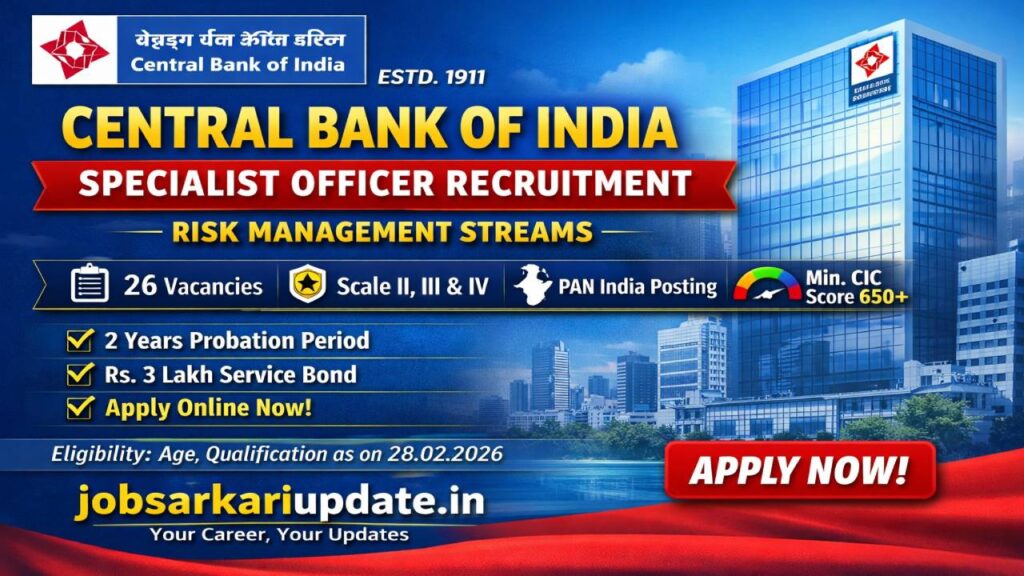
Central Bank of India SO Risk Management Recruitment 2026 – 26 Vacancies Across 5 Streams, Apply by April 30
The Central Bank of India SO Risk Management Recruitment 2026 notification has been officially released by the Human Capital Management (Recruitment & Promotion) Central Office. Central Bank of India, one of India’s leading Public Sector Banks with a PAN India network of more than 4,500 branches, a total business exceeding Rs. 8,12,000 crores, and a workforce of over 33,000 employees, is inviting applications from experienced finance and technology professionals for 26 Specialist Officer vacancies across five Risk Management streams. The online registration window opens on April 9, 2026, and closes on April 30, 2026.
This is a career-defining opportunity for experienced banking and NBFC professionals with backgrounds in quantitative analytics, treasury management, digital/cyber risk, enterprise risk frameworks, or market risk operations. The five streams — Analytics and Model Risk, Asset Liability Management, Digital Risk Management, Enterprise Risk, and Market Risk — span Scale II to Scale IV officer grades, meaning both mid-career and senior professionals can find a relevant opening. This is not a fresher-friendly recruitment: minimum post-qualification experience ranges from 3 to 5 years in banking/financial institutions, making it genuinely competitive within a well-qualified but narrow talent pool.
Two conditions in this notification deserve special attention before applying. First, candidates must have a minimum CIC (Credit Information Company) score of 650 — a credit history check that is unusual in government bank recruitments and filters out applicants with loan defaults or financial irregularities. Second, selected candidates must execute an indemnity bond of Rs. 3,00,000 for a commitment to serve for at least 3 years. Both conditions are non-negotiable eligibility requirements. Candidates who meet these criteria and have genuine risk management expertise in banking/NBFCs should apply without delay — competition for specialist officer posts of this nature tends to be intense but narrower than clerical or general officer exams.
Recruitment Overview
Central Bank of India, established in 1911 and headquartered in Mumbai, is one of India’s oldest and most geographically widespread public sector banks. It operates under the Ministry of Finance, Government of India. The bank has a strong focus on strengthening its Risk Management capabilities in response to evolving RBI guidelines on Basel III, IRRBB, ECL, and digital risk frameworks. This centralized recruitment for Specialist Officers in Risk Management is being conducted through the IBPS online application and examination platform, ensuring a standardized, transparent, and pan-India selection process.
| Detail | Information |
|---|---|
| Organisation Name | Central Bank of India |
| Post Type | Specialist Officers (SO) – Risk Management Streams |
| Total Vacancies | 26 |
| Streams | Analytics & Model Risk | Asset Liability Management | Digital Risk Management | Enterprise Risk | Market Risk |
| Scales Available | Scale II (Manager), Scale III (Senior Manager), Scale IV (Chief Manager) |
| Application Mode | Online Only – https://ibpsreg.ibps.in/cbirmsmar26/ |
| Probation Period | 2 Years from date of joining |
| Posting | PAN India – transferable anywhere in India |
| Service Bond | Rs. 3,00,000 indemnity bond – minimum 3 years service after selection |
| CIC Score Requirement | Minimum 650 (no credit default or financial indiscipline) |
| Eligibility Cutoff Date | 28.02.2026 (for age, qualification, and experience) |
Important Dates
The application window for Central Bank of India SO Risk Management 2026 runs for exactly 22 days — April 9 to April 30, 2026. This is a tight timeline by PSB standards. Candidates should apply in the first week to avoid last-minute technical difficulties on the IBPS portal, which tends to experience high traffic volumes near the closing date of major bank recruitments. The written examination is tentatively scheduled for May 2026 and the interview for June 2026. All exact dates, centres, and admit card download information will be communicated through the bank’s official website and via call letters — candidates must keep checking www.centralbank.bank.in regularly throughout the process.
| Event | Date |
|---|---|
| Online Registration Opens | April 09, 2026 |
| Last Date for Online Registration & Fee Payment | April 30, 2026 |
| Tentative Date of Online Examination | May 2026 |
| Tentative Date of Interview | June 2026 |
| Admit Card Download Date | To be notified on official website |
| Result Date | To be notified on official website |
Note: All dates are tentative and subject to change. Candidates must regularly visit www.centralbank.bank.in under the Career section for all announcements, addenda, corrigenda, and updates. No separate communication will be sent to candidates not shortlisted.
Application Fee
The application fee structure for Central Bank of India SO Risk Management 2026 follows the standard PSB pattern with a significant concession for SC/ST, PwBD (Divyangjan), and Women candidates. The fee is payable online between April 9 and April 30, 2026. Payments can be made using Debit Cards (RuPay, Visa, MasterCard, Maestro), Credit Cards, Internet Banking, IMPS, Cash Cards, Mobile Wallets, or UPI. Bank transaction charges for the online payment will be borne by the candidate. A critical mistake many candidates make is pressing the back or refresh button during payment — always wait for the server confirmation and download the e-receipt immediately upon successful payment, as failure to generate an e-receipt may indicate an unsuccessful transaction.
| Category | Fee (Inclusive of GST) | Payment Window |
|---|---|---|
| SC / ST / PwBD (Divyangjan) / Women candidates | Rs. 175/- (Intimation Charges only) | April 09 – April 30, 2026 (Online only) |
| All Other Candidates (General / EWS / OBC) | Rs. 850/- (Application Fee + Intimation Charges) | April 09 – April 30, 2026 (Online only) |
| Note: Fee once paid is non-refundable and cannot be held in reserve for any future examination. | ||
Age Limit
Age eligibility is calculated as on February 28, 2026 — the designated eligibility cutoff date. Unlike most bank recruitments, age limits here are scale-specific rather than post-specific. For Scale IV (Chief Manager level), the maximum age is 45 years — accommodating senior professionals. For Scale II and III, the maximum age is 35 years. The minimum age across all scales is 20 years. Standard government-mandated age relaxations apply for SC/ST (+5 years), OBC (+3 years), and PwBD (+10 years, with SC/ST PwBD getting +15 years and OBC PwBD getting +13 years), with an absolute maximum age cap of 56 years for PwBD candidates. OBC candidates in the Creamy Layer must apply as General/EWS — they are not entitled to OBC relaxation. Ex-Servicemen receive a standard relaxation of 5 years but there is no reservation for Ex-Servicemen in the officer cadre.
| Scale | Designation | Min Age | Max Age (General/EWS) | SC/ST Relaxation | OBC Relaxation | PwBD Relaxation |
|---|---|---|---|---|---|---|
| Scale IV | Chief Manager | 20 Years | 45 Years | +5 yrs (50 yrs) | +3 yrs (48 yrs) | +10 yrs (55 yrs, max 56) |
| Scale III | Senior Manager | 20 Years | 35 Years | +5 yrs (40 yrs) | +3 yrs (38 yrs) | +10 yrs (45 yrs) |
| Scale II | Manager | 20 Years | 35 Years | +5 yrs (40 yrs) | +3 yrs (38 yrs) | +10 yrs (45 yrs) |
Age calculated as on February 28, 2026.
Eligibility Criteria – Stream-wise Qualification & Experience
Each of the five Risk Management streams has distinct educational qualification and experience requirements. The eligibility cutoff date for both qualification and experience is February 28, 2026. Experience of less than 6 months in any single organisation is not counted towards total experience (unless it is the current employment). Where CGPA/OGPA is awarded instead of percentage marks, candidates must convert to percentage and carry the university conversion certificate to the interview. A score of 59.99% will NOT be rounded up to 60% — this is explicitly stated in the notification. Read each stream’s requirements carefully before deciding which one to apply for.
Stream 1: Analytics and Model Risk (Scale IV / Scale III)
| Detail | Scale IV (Chief Manager) | Scale III (Senior Manager) |
|---|---|---|
| Education | Bachelor’s in Mathematics/Statistics OR BE/B.Tech in Data Science/IT/CS/Software Engineering. Preferred: MBA/PGDM/PG in Statistics/Maths/Economics/Econometrics. Preferred Certifications: FRM (GARP), RAI (GARP), PRM (PRIMA), CFA, CQF, ML/AI/NLP certifications. | |
| Experience | Minimum 5 years in quantitative/risk analytics/Model Validation in commercial Banks/NBFCs/Investment Banks | Minimum 3 years in quantitative/risk analytics/Model Validation in commercial Banks/NBFCs/Investment Banks |
| Desired Skills | SAS, SPSS, R, Python or similar data science programming languages | |
| Key Responsibilities | Develop credit risk models (PD, LGD, EAD), rating scorecards; ensure RBI/DPDP Act compliance; validate analytical models; conduct stress testing; prepare governance documentation | |
Stream 2: Asset Liability Management (Scale III / Scale II)
| Detail | Scale III (Senior Manager) | Scale II (Manager) |
|---|---|---|
| Education | BE/B.Tech in IT/CS/Software Engineering OR Post Graduate Diploma in Management OR MBA OR Chartered Accountant. Desirable certifications: FRM (GARP)/PRIMA/Risk Management from IIBF/NIBM/CISI. | |
| Experience | Total 4 years post-qualification, of which at least 3 years in Risk Management in Banks/NBFCs (not cooperative banks or RRBs) | Total 3 years post-qualification, of which at least 2 years in Risk Management in Banks/NBFCs (not cooperative banks or RRBs) |
| Key Responsibilities | Manage liquidity/interest rate/currency risks; ILAAP; IRRBB framework; monitor Earnings at Risk (EaR) and Market Value of Equity (MVE); FTP analysis; RBI regulatory reporting | |
Stream 3: Digital Risk Management (Scale III / Scale II)
| Detail | Scale III (Senior Manager) | Scale II (Manager) |
|---|---|---|
| Education | Bachelor’s in Computer Science/IT/Cybersecurity. Preferred: MBA, MSc in IT Security/Risk Management. Preferred Certifications: CISA, CISM, CRISC, CISSP. | |
| Experience | Total 4 years post-qualification, of which at least 3 years in Risk Management in Banks/NBFCs (not cooperative banks or RRBs) | Total 3 years post-qualification, of which at least 2 years in Risk Management in Banks/NBFCs (not cooperative banks or RRBs) |
| Key Responsibilities | IT risk identification and mitigation; cyber risk controls; BCP/DR strategies; RBI IT risk compliance; digital product risk assessments (mobile/internet banking, payments); third-party API risk management | |
Stream 4: Enterprise Risk (Scale III only)
| Detail | Scale III (Senior Manager) |
|---|---|
| Education | BE/B.Tech in IT/CS/Software Engineering OR Post Graduate Diploma in Management OR MBA OR Chartered Accountant. Desirable: FRM (GARP)/PRIMA/Risk Management from IIBF/NIBM/CISI. |
| Experience | Total 5 years post-qualification, of which at least 3 years in Risk Management in Banks/NBFCs (not cooperative banks or RRBs) |
| Key Responsibilities | Develop ERM framework; ICAAP (Pillar I & II); Basel III capital charge calculations; Risk Appetite Framework; ECL/RAROC models; climate risk assessment; enterprise-wide stress testing |
Stream 5: Market Risk (Scale III / Scale II)
| Detail | Scale III (Senior Manager) | Scale II (Manager) |
|---|---|---|
| Education | BE/B.Tech in IT/CS/Software Engineering OR Post Graduate Diploma in Management OR MBA OR Chartered Accountant. Desirable: FRM (GARP)/PRIMA/Risk Management from IIBF/NIBM/CISI. | |
| Experience | Total 4 years post-qualification, of which at least 3 years in Risk Management in Banks/NBFCs (not cooperative banks or RRBs) | Total 3 years post-qualification, of which at least 2 years in Risk Management in Banks/NBFCs (not cooperative banks or RRBs) |
| Key Responsibilities | Daily risk limit monitoring on investment portfolio; forex risk framework; VaR and capital charge calculation via SAS; yield curve analysis; stress testing; regulatory reporting for Market Risk | |
Important: Experience in cooperative banks and Regional Rural Banks (RRBs) does not count towards the minimum Risk Management experience requirement for any of the five streams. Only experience in commercial Banks and NBFCs (other than cooperative banks and RRBs) is considered. Any tenure of less than 6 months in a single organisation is excluded from experience calculation (except current employment).
Vacancy Details – Stream-wise & Category-wise
A total of 26 vacancies have been notified across five streams and multiple scales. Digital Risk Management has the highest vacancy count (8 posts), followed by Analytics and Model Risk (6 posts) and Asset Liability Management (5 posts). Enterprise Risk and Market Risk together account for 7 posts. Among categories, the Unreserved (UR) quota dominates with 13 posts, followed by OBC (7 posts), SC (3 posts), EWS (2 posts), and ST (1 post). For PwBD (Divyangjan), 1 seat is reserved for the Orthopedically Challenged (OC) category under Digital Risk Management. The small absolute vacancy count in each stream means the competition within each specific stream-scale-category combination is manageable for well-qualified and experienced candidates, but the high specificity of qualifications and experience creates its own filter.
| Sr.No. | Stream | Scale | SC | ST | OBC | EWS | UR | Total | PwBD (OC) |
|---|---|---|---|---|---|---|---|---|---|
| 1 | Analytics & Model Risk | SC4 | 0 | 0 | 0 | 0 | 2 | 2 | — |
| SC3 | 1 | 0 | 1 | 0 | 2 | 4 | — | ||
| Sub-Total | 1 | 0 | 1 | 0 | 4 | 6 | — | ||
| 2 | Asset Liability Management | SC3 | 1 | 0 | 1 | 0 | 1 | 3 | — |
| SC2 | 0 | 0 | 1 | 0 | 1 | 2 | — | ||
| Sub-Total | 1 | 0 | 2 | 0 | 2 | 5 | — | ||
| 3 | Digital Risk Management | SC3 | 0 | 1 | 2 | 1 | 2 | 6 | 1 |
| SC2 | 0 | 0 | 1 | 0 | 1 | 2 | — | ||
| Sub-Total | 0 | 1 | 3 | 1 | 3 | 8 | 1 | ||
| 4 | Enterprise Risk | SC3 | 1 | 0 | 1 | 1 | 2 | 5 | — |
| 5 | Market Risk | SC3 | 0 | 0 | 0 | 0 | 1 | 1 | — |
| SC2 | 0 | 0 | 0 | 0 | 1 | 1 | — | ||
| Sub-Total | 0 | 0 | 0 | 0 | 2 | 2 | — | ||
| GRAND TOTAL | — | 3 | 1 | 7 | 2 | 13 | 26 | 1 | |
Selection Process
The selection process consists of two main stages — an Online Written Examination and a Personal Interview — with the final merit list prepared on a 70:30 weighted basis. This is a critical ratio to understand: even a candidate who tops the written test can be overtaken if their interview performance is significantly weaker, and vice versa. Both stages have category-wise minimum qualifying marks. Merely meeting the eligibility criteria does not guarantee a call for the test or interview — the bank reserves the right to shortlist candidates based on age, qualification, experience, and suitability criteria.
Stage 1: Online Written Examination (100 Marks, 90 Minutes)
The online test carries 100 marks across three sections. The Stream/Category Specific section is the most heavily weighted — 70 questions for 70 marks — and tests deep domain knowledge in the candidate’s chosen Risk Management stream. The remaining 30 marks cover Reasoning (15 marks, 15 questions) and Banking/Economic/General Awareness (15 marks, 15 questions). All questions are objective type. There is NO penalty for wrong answers — this is a significant advantage that changes the test-taking strategy. Candidates should attempt all questions, prioritizing the stream-specific section for accuracy while using remaining time to attempt Reasoning and GK sections without fear of negative marking. The total composite time for all three sections is 90 minutes with no sectional time limit mentioned separately.
| Section | No. of Questions | Maximum Marks | Duration | Negative Marking |
|---|---|---|---|---|
| Stream / Category Specific Questions | 70 | 70 | Composite 90 Minutes | None |
| Reasoning | 15 | 15 | ||
| Banking, Present Economic Scenario & General Awareness | 15 | 15 | ||
| Total | 100 | 100 | 90 Minutes | No Negative Marking |
Qualifying Marks: General/EWS — 50% (50 out of 100) | SC/ST/OBC/PwBD — 45% (45 out of 100)
Stage 2: Personal Interview (100 Marks)
Only candidates shortlisted from the written test will be called for a Personal Interview carrying 100 marks. The interview assesses domain expertise in the specific risk management stream, understanding of current RBI regulatory frameworks, communication skills, and overall suitability for a specialist banking officer role. Qualifying marks for the interview are 50% for General/EWS and 45% for SC/ST/OBC/PwBD. The interview centre will be at the bank’s sole discretion. No travelling allowance is payable except to unemployed SC/ST candidates who will receive actual to-and-fro second-class rail/ordinary bus fare by the shortest route on production of travel evidence. In case of equal marks, the older candidate ranks higher.
Final Merit: Written Examination : Interview = 70 : 30 weightage. Candidates must qualify both stages independently before being considered for final merit ranking.
Salary & Pay Scale
Central Bank of India follows the bipartite industry settlement pay scales applicable to all Public Sector Banks in India. The pay scales for officer grades are standardized across PSBs, with perquisites, allowances (HRA, DA, CCA, medical, LFC etc.) and other benefits as per the bank’s policy. Specialist Officers at Scale II and above receive the full officer-grade benefits package. The approximate gross monthly CTC at Scale II entry level is typically in the range of Rs. 65,000–75,000 per month (including all allowances) and increases significantly at Scale III and IV levels with experience and allowances varying by posting city. The 2-year probation period is served at full scale pay — unlike some PSU traineeships that pay a reduced stipend during probation.
| Grade / Scale | Designation | Basic Pay Scale | Approx. Gross CTC (Estimated) |
|---|---|---|---|
| Scale IV | Chief Manager | Rs. 1,02,300 – 2980/4 – 1,14,220 – 3360/2 – 1,20,940 | Rs. 1.80–2.20 Lakhs/month (approx.) |
| Scale III | Senior Manager | Rs. 85,920 – 2680/5 – 99,320 – 2980/2 – 1,05,280 | Rs. 1.45–1.80 Lakhs/month (approx.) |
| Scale II | Manager | Rs. 64,820 – 2340/1 – 67,160 – 2680/10 – 93,960 | Rs. 1.00–1.35 Lakhs/month (approx.) |
Service Bond: An indemnity bond of Rs. 3,00,000 must be executed by every selected candidate. If you resign within 3 years of selection, you are liable to pay this amount to the bank. The bond is a binding legal instrument — evaluate your 3-year career commitment to Central Bank of India before accepting the offer.
CIC Score Requirement: You must have a minimum Credit Information Company (CIC) score of 650 on the date of document verification. Any credit default or financial indiscipline visible in your CIC report will result in disqualification or rejection of appointment. This condition is verified as part of the eligibility process. Check your CIBIL/Equifax/CRIF/Experian score before applying.
How to Apply Online – Step-by-Step Guide
Pre-Application Checklist
- Educational qualification certificates (Bachelor’s/PG degree/MBA/CA as applicable to chosen stream)
- Experience certificates from all employers (only commercial Banks/NBFCs count — not cooperative banks or RRBs)
- Date of birth proof (10th board certificate)
- Caste / Category certificate — SC/ST/OBC/EWS (issued by competent authority)
- PwBD disability certificate (from Swavalamban portal if issued after June 1, 2021)
- No Objection Certificate (if currently employed in Govt./PSU/Bank)
- Scanned passport-size photograph (20–50 KB, JPG, white background)
- Scanned signature in black ink (10–20 KB, JPG)
- Scanned left thumb impression (20–50 KB, JPG)
- Handwritten declaration in English (50–100 KB, JPG)
- Valid personal email ID and active mobile number
- Online payment method (Debit/Credit Card, Net Banking, UPI)
- Visit the IBPS Application Portal: Go to https://ibpsreg.ibps.in/cbirmsmar26/ — this is the only valid application platform. No other mode or portal is accepted.
- New Registration: Click “Click Here to Apply Online.” Enter your basic information to generate a Provisional Registration Number and Password. These will also be sent to your registered email and mobile. Note them carefully — they are required for all future logins.
- Fill the Application Form: Log in and complete the form — personal details, educational qualifications, experience details (stream-specific), and category. Choose your specific Risk Management stream and scale. Your name and father’s name must match exactly with your educational certificates.
- Upload Documents: Upload your photograph, signature, left thumb impression, and handwritten declaration as per the prescribed specifications. Also upload a live webcam photograph as required. Do NOT place photo in the signature field or vice versa.
- Select Exam Centre: Choose your preferred online examination centre from the available list for your state. Centre allocation is subject to the bank’s discretion and may be changed.
- Preview and Verify: Use the “Save and Next” facility to review all details. No changes are possible after clicking “Complete Registration.” Verify every field — especially your chosen stream, scale, category, and experience details.
- Pay the Fee and Submit: Click “Payment” and pay Rs. 850 (General/OBC/EWS) or Rs. 175 (SC/ST/PwBD/Women) online. Wait for server confirmation — do NOT press back or refresh. Download and print the e-receipt and application form for your records.
Most Common Application Mistakes — Avoid These:
- Selecting a stream where your experience does not meet the minimum requirement — applications are screened at multiple stages and disqualification can happen even after the exam
- Counting cooperative bank or RRB experience towards the Risk Management experience requirement — it is explicitly excluded; only commercial bank and NBFC experience qualifies
- Writing the handwritten declaration in capital letters or in any language other than English — the application will be treated as invalid
Important Instructions for Candidates
- Verify all eligibility criteria — qualification, experience, age, CIC score — before applying. Disqualification can happen at any stage, including after appointment if false information is detected.
- Government/PSU employees must produce a No Objection Certificate at the time of interview; candidature may not be considered without it.
- OBC candidates must produce a Non-Creamy Layer certificate at interview; OBC candidates in the Creamy Layer must apply as General category.
- Keep the same photograph used in the online application for all subsequent stages (exam, interview) — a change in appearance may lead to disqualification.
- All disputes arising from this recruitment are subject to the jurisdiction of courts in Mumbai only.
- This content is for informational purposes only. The official notification on www.centralbank.bank.in is the authoritative source for all details.
Expert Tips to Crack Central Bank of India SO Risk Management Recruitment 2026
1. Choose Your Stream Based on Experience, Not Vacancy Count
Digital Risk Management has the most vacancies (8) and Analytics & Model Risk is a close second (6), making both appear attractive. However, the right choice is the stream that most closely aligns with your actual work experience. The written test’s stream-specific section carries 70 out of 100 marks — choosing a stream outside your core expertise simply to target higher vacancy numbers is a losing strategy. Your 3–5 years of focused experience is your competitive edge; use it in the stream where you know the most.
2. Check Your CIC Score Before Applying
The minimum CIC score requirement of 650 is a non-negotiable eligibility condition that is checked at the document verification stage. If you have any loan defaults, credit card payment delays, or unsettled disputes in your credit history, check your CIBIL/Equifax/CRIF/Experian report immediately. A score below 650, or any visible credit default, will result in disqualification from appointment even if you clear the written test and interview. Free credit report access is available through RBI-mandated channels once per year from each of the four credit bureaus.
3. Prepare Your Stream-Specific Section at RBI Guideline Level
The 70-mark stream-specific section will likely test knowledge of current RBI circulars and frameworks relevant to your chosen stream — IRRBB (for ALM), Basel III and ICAAP (for Enterprise Risk), VaR and Standardized Approach (for Market Risk), DPDP Act and IT risk guidelines (for Digital Risk), and model governance frameworks (for Analytics). Read the most recent RBI Master Circulars and guidelines for your stream before the exam. This is the differentiator between candidates who score 55–60% and those who score 75%+.
4. Take Advantage of No Negative Marking in the Written Test
Unlike IBPS PO and Clerk exams which carry negative marking, this specialist officer exam has no penalty for wrong answers. This changes the optimal test-taking strategy significantly: after completing all questions you are confident about, go back and attempt every remaining question rather than leaving them blank. For the Reasoning and Banking Awareness sections especially, educated guesses have a positive expected value when there is no negative marking — do not leave any question unanswered.
5. Prepare a Comprehensive Experience and Achievement Portfolio for the Interview
The interview carries 30% of the final merit weightage. For a specialist officer role, interviewers will probe deeply into your actual work — models you built, risks you assessed, regulatory filings you prepared, frameworks you implemented. Prepare a clear, concise narrative of your most impactful projects in risk management, preferably with quantified outcomes. Also prepare for questions on current developments in your stream: recent RBI circulars, Basel IV developments, digital lending guidelines, or climate risk frameworks as applicable.
6. Plan Your 3-Year Commitment to Central Bank of India
The Rs. 3,00,000 service bond for a minimum 3-year post-selection tenure is a binding contractual obligation. Before accepting the appointment, evaluate your career plans honestly. If you are simultaneously preparing for other competitive exams, considering relocating, or have other employment commitments, factor in the bond penalty. However, for professionals who are genuinely seeking a stable, senior banking career in risk management, this bond is a standard feature of PSB specialist recruitment and not unusual in the broader sector.
Frequently Asked Questions (FAQs)
- 1. How many total vacancies are there in Central Bank of India SO Risk Management Recruitment 2026?
- There are 26 total vacancies across five streams — Analytics & Model Risk (6), Asset Liability Management (5), Digital Risk Management (8), Enterprise Risk (5), and Market Risk (2) — distributed across Scale II, Scale III, and Scale IV grades.
- 2. What is the last date to apply for Central Bank of India SO Risk Management 2026?
- The last date for online registration and fee payment is April 30, 2026. The portal opens on April 9, 2026. Apply early to avoid last-minute technical issues on the IBPS portal.
- 3. What experience is required for Scale II posts?
- For most Scale II streams (ALM, Digital Risk, Market Risk), the requirement is a total of 3 years post-qualification experience, of which at least 2 years must be specifically in Risk Management in a commercial Bank or NBFC (excluding cooperative banks and RRBs).
- 4. Does experience in a cooperative bank or RRB count towards eligibility?
- No. The notification explicitly states that Risk Management experience must be in Banks/NBFCs other than cooperative banks and Regional Rural Banks (RRBs). Experience in cooperative banks or RRBs does not count towards the minimum Risk Management experience requirement.
- 5. What is the CIC score requirement and what happens if I don’t meet it?
- Candidates must have a minimum CIC (Credit Information Company) score of 650 on the date of document verification, with no credit default or financial indiscipline in their credit report. Failure to meet this condition will result in disqualification or rejection of appointment, even after clearing the written exam and interview.
- 6. What is the exam pattern for the written test?
- The online written test has 100 questions for 100 marks with a composite time of 90 minutes. It includes 70 stream-specific questions (70 marks), 15 Reasoning questions (15 marks), and 15 Banking/Economic/General Awareness questions (15 marks). There is NO negative marking for wrong answers.
- 7. What is the qualifying score in the written test?
- Qualifying marks are 50% for General/EWS candidates and 45% for SC/ST/OBC/PwBD candidates. Similarly, the interview also requires 50% for General/EWS and 45% for reserved category candidates. Both stages must be qualified independently.
- 8. What is the weightage of the written test vs interview in final selection?
- The final merit list is prepared with a weightage of 70% for the written examination and 30% for the personal interview.
- 9. What is the service bond amount and duration?
- Selected candidates must execute an indemnity bond of Rs. 3,00,000 (three lakh rupees). This bond commits the candidate to serve Central Bank of India for a minimum period of 3 years after selection. Breaking this commitment makes the candidate liable to pay the bond amount to the bank.
- 10. What is the salary for Scale II Specialist Officers at Central Bank of India?
- Scale II (Manager) carries a pay scale of Rs. 64,820 – 2340/1 – 67,160 – 2680/10 – 93,960. The estimated gross monthly salary including all allowances is approximately Rs. 1,00,000–1,35,000 per month depending on posting location. Perquisites and allowances are as per the bank’s policy.
- 11. Are freshers or candidates with only campus placements eligible?
- No. This recruitment is strictly for experienced professionals. The minimum post-qualification experience ranges from 3 to 5 years depending on the stream and scale, with a specific requirement of 2–3 years in Risk Management in commercial Banks/NBFCs. Freshers or candidates without banking/NBFC risk management experience are not eligible.
- 12. What is the probation period for selected candidates?
- Selected candidates will be on probation for 2 years from the date of joining. For officers appointed at Scale II and above, the competent authority may reduce or dispense with the probation period at its discretion. Confirmation in service is communicated in writing per Central Bank of India Officers’ Service Regulations.
Important Links
| Apply Online | Apply Now |
| Download Notification | Click Here |
| Official Website | Click Here |
Recent Jobs
Check out our latest job postings
813 Jobs Available
BPSC Bihar TRE-4 2026 - Quick Summary: BPSC has announced Bihar TRE-4 Recruitment 2026 for 32,388 Teacher vacancies across Primary,...
Read Full Details
Punjab PTI Recruitment 2026 - Quick Summary: Education Recruitment Directorate (ERD), Punjab has released notification for 2,000 Physical Training Instructor...
Read Full Details
SSB Physical Date 2026 - Quick Summary: SSB has announced PET/PST commencement for Constable to Sub Inspector (Non-GD) Recruitment 2025....
Read Full Details
IAF Agniveervayu Rally 2027 - Quick Summary: Indian Air Force is conducting an Open Recruitment Rally for Agniveervayu (Other Than...
Read Full Details
HAL DT & MT Recruitment 2026 - Quick Summary: HAL has released notification for 120 Design Trainee & Management Trainee...
Read Full Details