JSSC JTGLCCE 2026 - Quick Summary: Jharkhand Staff Selection Commission has released 25+ vacancies under JTGLCCE 2026 for technical/graduate posts....
Read Full DetailsNTA NTET 2026 – AYUSH Teachers Eligibility Test Admit Card
NTA NTET 2026 – National Teachers Eligibility Test for AYUSH: Complete Guide to Eligibility, Syllabus & Application
The NTA NTET 2026 notification has been officially released by the National Testing Agency (NTA) on behalf of the Ministry of AYUSH, the National Commission for Indian System of Medicine (NCISM), and the National Commission for Homoeopathy (NCH). This examination — formally known as the National Teachers’ Eligibility Test for Indian System of Medicine and Homoeopathy — is a mandatory qualifying test for postgraduate degree holders in Ayurveda, Siddha, Unani, and Homoeopathy who wish to enter the teaching profession at the level of Assistant Professor or Associate Professor in AYUSH colleges across India.
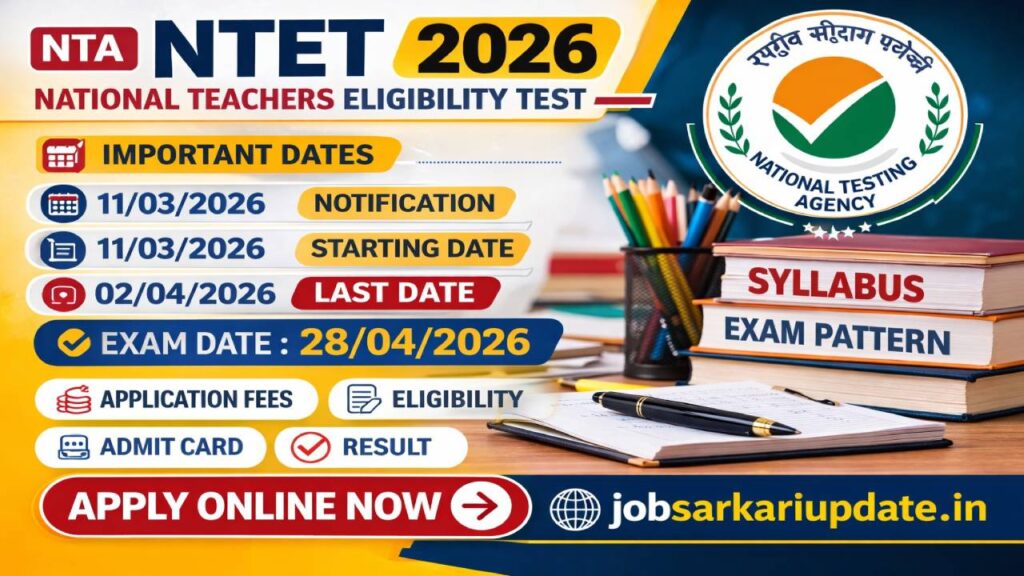
Unlike general teacher eligibility tests, NTET is unique in that it is discipline-specific and governed by two separate statutory commissions — NCISM (for Ayurveda, Siddha, and Unani) and NCH (for Homoeopathy). The examination is conducted in Computer Based Test (CBT) mode in Hindi and English across 40 cities in India. The exam date for NTET 2026 is 10-11 may 2026 (Tuesday), with the online application window open from 11 March 2026 to 2 April 2026.
The NTET certificate, once awarded, is valid for a period of ten years from the date of qualifying. This means candidates who qualify in 2026 have until 2036 to join or remain in the teaching profession without re-appearing. Any break of ten or more years in teaching service requires re-qualification. This longevity makes NTET 2026 one of the most strategically important exams for AYUSH medical professionals planning an academic career.
Competition for the NTET is moderate — the examination pool is limited to AYUSH postgraduates, which is significantly smaller than mainstream UGC-NET candidate pools. However, the specialized nature of the syllabus (which focuses on pedagogy, educational psychology, classroom management, and AYUSH teaching methods) means that candidates without deliberate preparation often underperform. With the application window closing on 2 April 2026, AYUSH postgraduate candidates must act without delay.
NTET 2026 – Examination Overview
The National Testing Agency has been designated to conduct NTET since 2024, operating under the Ministry of Education’s approval on behalf of Ministry of AYUSH. NTA is India’s premier government testing body, responsible for conducting JEE Main, NEET, CUET, and several other national-level examinations. Its involvement ensures that NTET is conducted with high standards of security, transparency, and fairness — CBT infrastructure, answer key challenge mechanisms, and score card hosting are all managed by NTA directly. Candidates can be confident in the credibility and process of this examination.
| Detail | Information |
|---|---|
| Conducting Body | National Testing Agency (NTA) |
| Exam Name | National Teachers Eligibility Test (NTET) 2026 |
| Conducted On Behalf Of | Ministry of AYUSH / NCISM / NCH |
| Applicable Disciplines | Ayurveda, Siddha, Unani, Homoeopathy |
| Exam Mode | Computer Based Test (CBT) |
| Medium of Paper | English and Hindi only |
| Number of Questions | 100 (Multiple Choice Questions) |
| Maximum Marks | 100 |
| Duration | 120 minutes (2 hours) |
| Negative Marking | No |
| Qualifying Marks | Minimum 50% |
| Certificate Validity | 10 years from date of qualifying |
| Date of Exam | 10-11 May |
| Application Mode | Online only |
Important Dates
The NTET 2026 application window is exactly 22 days — from 11 March to 2 April 2026. This is a relatively tight window for an examination of this importance, and candidates must account for the time required to arrange supporting documents, particularly the No Objection Certificate (NOC) for Ayurveda, Siddha, and Unani postgraduate students who are still pursuing their degree. The NOC must be issued by the Principal or Head of Institution — obtaining this from a college can take two to five working days. Candidates are therefore strongly advised to initiate the NOC request the moment they read this notification, and to complete the online application well before the last date of 2 April 2026. A separate correction window (4–6 April) has been provided for fixing specific form errors, but this does not extend to all fields.
| Event | Date |
|---|---|
| Online Registration & Application Start | 11 March 2026 |
| Last Date for Online Application | 7 April 2026 (up to 11:50 PM) |
| Last Date for Fee Payment | 7 April 2026 (up to 11:50 PM) |
| Correction Window (Online Only) | 8 April 2026 to 9 April 2026 (up to 11:50 PM) |
| Advance City Intimation | To be announced later |
| Admit Card Download | To be announced later |
| Date of Examination | 10-11 May 2026 (Tuesday) |
| Duration of Examination | 120 minutes |
| Display of Questions, Responses & Provisional Answer Key | To be announced later |
| Declaration of Result | To be announced later |
Important: All dates are subject to change. Always verify from the official NTA website (exams.nta.nic.in/ntet/) before taking any action. NTA will not be responsible for any miscommunication if candidates rely on unofficial sources.
Application Fee
The NTET 2026 application fee is significantly higher than standard competitive exams because it covers the cost of CBT infrastructure, centre administration, and answer key processing across 40 cities. Payment must be made online through Net Banking, Credit Card, Debit Card (Visa/Master/RuPay), or UPI. Canara Bank is the designated payment gateway; processing charges and GST are borne by the candidate above the base exam fee. One of the most common mistakes in NTA exams is completing the application form but failing to complete fee payment — remember that only after successful fee payment is a Confirmation Page generated. Without the Confirmation Page, your application is considered incomplete and your candidature will not be considered.
| Category | Application Fee | Payment Mode |
|---|---|---|
| General (UR) / NRI / OCI / Foreign Nationals | ₹4,000 | Online (Net Banking / Credit Card / Debit Card / UPI) |
| General-EWS / OBC-NCL | ₹3,500 | Online |
| SC / ST / PwD / PwBD / Third Gender | ₹3,000 | Online |
Note: Fees once paid will not be refunded under any circumstances. Processing charges and GST (as applicable) are payable separately to the Bank/Payment Gateway on top of the above fee amounts. UPI and RuPay Debit Card payments carry no additional processing charges.
Age Limit
Unlike most government recruitment examinations, NTET 2026 does not prescribe a specific minimum or maximum age limit for appearing in the examination. The eligibility is based entirely on educational qualification and completion of the prescribed postgraduate programme. However, age is an indirect factor for specific eligibility pathways — for example, the Associate Professor eligibility route requires five years of experience in regular government health service or as a medical officer after possessing the postgraduate qualification. Candidates who are recent postgraduates or still pursuing their PG degree (30 months completed for Ayurveda/Siddha/Unani) can appear in the exam at any age, provided all qualification conditions are met. The focus of this examination is academic merit and teaching aptitude, not age.
| Candidate Type | Age Condition | Relaxation |
|---|---|---|
| All eligible AYUSH postgraduates | No minimum or maximum age specified | Not applicable — age limit not prescribed for this exam |
| PwD / PwBD candidates | No age limit | Compensatory time of 20 minutes per hour of examination provided |
| SC / ST / OBC-NCL / EWS | No age limit | Reservation benefits as per GoI norms |
Eligibility Criteria
This is the most critical section for NTET 2026 applicants. Eligibility varies significantly across the four AYUSH streams and also depends on which teaching level (Assistant Professor vs. Associate Professor) the candidate is targeting. The most common eligibility mistake is assuming that a BAMS or BHMS degree alone qualifies — the notification explicitly states that a postgraduate (MD/MS or equivalent) degree is mandatory. Additionally, candidates from Ayurveda, Siddha, and Unani streams who are still pursuing their PG degree must have completed a minimum of 30 months of the programme as on the last date of application (2 April 2026), and they must obtain a valid NOC from their institution. Homoeopathy stream candidates, by contrast, must have already completed their PG degree before appearing.
Qualifying Educational Qualification (Post-Graduate Combinations)
| Stream | Qualifying Qualification Combinations (Any One) |
|---|---|
| Ayurveda | BAMS + MD Ayurveda; BAMS + MS Ayurveda; MA Sanskrit; BAMS + M.Sc. Anatomy; BAMS + M.Sc. Physiology; BAMS + MPH (Master in Public Health); BAMS + M.Sc. Ayurbiology |
| Siddha | BSMS + MD Siddha; MA Tamil / MA English; BSMS + M.Sc. Anatomy; BSMS + M.Sc. Physiology; M.Sc. Biochemistry; M.Sc. Microbiology; M.Sc. Botany / Medical Botany / Pharmacognosy; BSMS + M.Sc. Botany; BSMS + MPH; BSMS + M.Sc. Pharmacology / Medical Pharmacology; M.Sc. Anatomy; MPH; M.Sc. Physiology |
| Unani | BUMS + MD Unani; BUMS + MS Unani; MA Arabic; BUMS + MA Arabic; BUMS + M.Sc. Anatomy; BUMS + M.Sc. Physiology; BUMS + M.Sc. Biochemistry; BUMS + M.Sc. Microbiology; BUMS + M.Sc. Pharmacology / Medical Pharmacology; BUMS + MPH |
| Homoeopathy | BHMS + MD (Hom.); BHMS + M.Sc. Anatomy; BHMS + M.Sc. Physiology; BHMS + M.Sc. Biochemistry; BHMS + M.Sc. Forensic Medicine & Toxicology; BHMS + MPH; Ph.D. + M.Sc. Anatomy / Physiology / Biochemistry / Forensic Medicine & Toxicology / MPH |
Important: All qualifications must be from institutes recognized by NCISM / NCH. Candidates pursuing Ayurveda/Siddha/Unani PG programmes must have completed 30 months as on 2 April 2026 and must upload a valid NOC from their Principal/Head of Institution.
Eligibility by Teaching Level
| Teaching Level | Eligibility Condition |
|---|---|
| Assistant Professor (first time) | Any candidate with the qualifying PG degree as listed above. Must score minimum 50% to qualify NTET. |
| Associate Professor (first time — via service route) | Qualifying PG degree + 5 years of experience in regular service (after PG qualification) in Central/State Government Health Services, Ministry of AYUSH, or as a full-time Medical Officer in a recognized Homoeopathy Medical College. |
| Associate Professor (first time — via research route) | Recognized PG qualification in Homoeopathy in concerned subject + 5 years full-time research experience in Central/State/UT/University/National research institutions + at least 3 publications in indexed/peer-reviewed journals. |
| Assistant Professor (Ph.D. route for Homoeopathy) | Ph.D. + M.Sc. Anatomy / Physiology / Biochemistry / Forensic Medicine & Toxicology / MPH from recognized institutes — eligible to appear for Assistant Professor post. |
Reservation Details
NTET 2026 is a qualifying examination, not a direct recruitment — there are no “vacancies” per se. However, reservation benefits apply to the fee structure and to any affiliated admission or appointment processes governed by NCISM/NCH regulations. Reservation of seats in AYUSH colleges for teaching positions is governed by Central Government reservation norms for SC, ST, OBC (NCL), EWS, and PwBD categories. Qualifying NTET with the minimum 50% marks makes a candidate eligible — their reservation category will be applied at the time of actual appointment by the respective institution.
| Category | Application Fee | Reservation in Appointments | Qualifying Marks |
|---|---|---|---|
| General (UR) | ₹4,000 | As per GoI norms | 50% and above |
| OBC (NCL) — Central List Only | ₹3,500 | 27% (Central List OBC) | 50% and above |
| EWS | ₹3,500 | 10% | 50% and above |
| SC | ₹3,000 | 15% | 50% and above |
| ST | ₹3,000 | 7.5% | 50% and above |
| PwD / PwBD | ₹3,000 | 4% horizontal reservation | 50% and above |
| Third Gender | ₹3,000 | As per GoI norms | 50% and above |
Note on OBC candidates: Only candidates appearing in the Central Government’s OBC (NCL) list are eligible for OBC reservation benefits. State list OBC candidates who are not on the Central List must apply under the General/Unreserved category.
Selection Process
Unlike competitive recruitment exams, NTET 2026 follows a straightforward single-stage qualifying process. There is no interview, no skill test, and no document verification round before the exam. The process is: apply → appear in CBT → score 50% or above → receive NTET certificate. However, the actual appointment to a teaching post in an AYUSH college is a separate process governed by NCISM/NCH regulations and the respective institution’s recruitment process. Qualifying NTET is a prerequisite — not a guarantee of appointment.
Stage 1: Online Registration & Application (11 March – 2 April 2026)
Candidates must register on the NTA portal, fill all personal and academic details, upload required documents, and complete fee payment. The Confirmation Page is generated only after successful fee payment — this page must be saved and printed. If the Confirmation Page is not generated despite payment, contact the bank helpline or NTA helpdesk immediately; do not wait.
Stage 2: Correction Window (4–6 April 2026)
NTA provides a limited correction window for fixing specific fields in the application. Not all fields can be corrected — typically, corrections are allowed for non-critical details. Core information like name, date of birth, category, and qualification details entered during registration are generally treated as final. Use the correction window only if there is a genuine error that needs fixing, and double-check before submitting the correction.
Stage 3: Admit Card Download (Date To Be Announced)
The Admit Card will be available for download from the NTA website. It will not be sent by post. Candidates must bring a printed copy of the admit card along with a valid original photo ID to the examination centre. The admit card contains the exam centre address, shift, and timing — all of which are final and cannot be changed.
Stage 4: Computer Based Test (CBT) – 28 April 2026
Candidates must report at least 2 hours before the examination starts. The CBT consists of 100 MCQs to be answered in 120 minutes with no negative marking. Candidates can change/modify answers at any time during the examination. The exam ends automatically when the timer reaches zero. Candidates must not carry any electronic device, mobile phone, calculator, or written material into the examination hall.
Stage 5: Answer Key Challenge & Result Declaration
After the exam, NTA will display provisional answer keys. Candidates can challenge specific answers by paying ₹200 per question as a non-refundable processing fee. Subject experts review all challenges; a final answer key is then published and results are compiled on that basis. Scorecards must be downloaded within 90 days of result declaration — NTA will not provide scorecards beyond this period under any circumstances.
Qualifying NTET is a milestone that opens the door to a respected, permanent academic career in AYUSH medicine. The examination rewards consistent conceptual understanding of teaching methodologies rather than clinical knowledge — a refreshing change of direction for medical professionals who want to contribute to education.
Exam Pattern & Syllabus
One of the most significant strengths of NTET 2026 is that the complete syllabus is officially published in the Information Bulletin (Appendix-II). Unlike many government examinations where the syllabus is vague or unofficial, NTET’s syllabus is clearly structured into eight modules that are identical for all AYUSH streams. This is because the test measures teaching aptitude and educational skills — not clinical specialization. All 100 questions are drawn equally from these eight modules.
Exam Pattern
| Parameter | Details |
|---|---|
| Mode | Computer Based Test (CBT) |
| Type of Questions | Multiple Choice Questions (MCQ) — Single Correct Response |
| Total Questions | 100 |
| Maximum Marks | 100 (1 mark per question) |
| Negative Marking | None |
| Unanswered Questions | Zero marks |
| Duration | 120 minutes (PwBD compensatory time: 20 minutes per hour) |
| Medium | English and Hindi only (English version is final in case of discrepancy) |
| Number of Sections | 8 modules |
| Qualifying Score | Minimum 50 marks out of 100 |
Subject-wise Syllabus (8 Modules)
Module 1: Teaching & Training
- Teaching: Concept, Objectives, Levels of teaching (Memory, Understanding, Reflective), Characteristics and basic requirements
- Teaching methods and new approaches
- Basic teaching skills and their utilization
- Learner characteristics: Adolescent and adult learners (Academic, Social, Emotional, Cognitive); Individual differences
- Factors affecting teaching: Teacher, Learner, Support material, Instructional facilities, Learning environment, Institution
- Methods of clinical/bedside teaching
- Learning styles — VARK (Visual, Aural/Auditory, Reading/Writing, Kinesthetic)
Module 2: Communication
- Communication: Meaning, types, characteristics, purpose
- Effective communication: Verbal and Non-verbal, Intercultural and Group Communication, Classroom Communication
- Barriers to effective communication
- Mass media and society
- Teacher-learner communication; Doctor-patient communication
Module 3: Classroom Management
- Practical Classroom Management; Psychology & Classroom Management
- Personal Approach to Classroom Management
- Ensuring Engagement & Motivation; Routines & Technology in the Classroom
- Forming Positive Learning Environments; Disciplinary Problems
- Management Strategies for Diverse Classrooms
- Managing clinical, OPD, practical labs, skill labs, and community outreach environments
Module 4: Assessment Methods
- Concepts and principles of learning assessment
- Evaluation in Choice Based Credit System in Higher Education
- Computer-based Testing; Innovations in evaluation systems
- Assessment of clinical competence; Role of observation and feedback
- Structured Oral Exam, Long Case, Short Case, and OSCE
- Assessment Types: Formative and Summative; Periodic assessment
Module 5: Educational Technologies
- Advancements in educational technologies
- ICT: General abbreviations and terminology
- Usage of Internet, Intranet, Email, Audio/Video-conferencing
- ICT and Governance; Teacher-centered vs. Learner-centered methods
- Online methods: Swayam, Swayamprabha, MOOCs
- Teaching Support Systems: Traditional, Modern, and ICT-based
Module 6: Educational Psychology
- Educational psychology as a discipline; Role in learning and teaching
- Cognitive development: Brain and cognitive development
- Piaget’s theory of cognitive development
- Vygotsky’s Sociocultural perspective; Bronfenbrenner’s social context
- Self and moral development
Module 7: Andragogy in Education
- Meaning, need, and importance of Andragogy
- Principles of Andragogy; Characteristics of Adult Learners
- Competencies of Self-Directed Learning
Module 8: Learning and Pedagogy
- Concepts and Meaning of Pedagogy
- Steps of Pedagogical Analysis; Concepts of Critical Pedagogy
- Development, need, and importance of Pedagogy
- Formulations of Learning Objectives; Teaching-Learning processes
Preparation Tips Based on Official Syllabus
- Modules 1 & 8 (Teaching & Pedagogy): These two modules overlap significantly. Focus on VARK learning styles, levels of teaching (Bloom’s Taxonomy equivalent), and pedagogical analysis steps — these are highly likely to feature in MCQs.
- Module 4 (Assessment Methods): OSCE, formative vs. summative assessment, and clinical competency evaluation are directly relevant to AYUSH medical education and likely to be heavily weighted.
- Module 6 (Educational Psychology): Piaget and Vygotsky are classic exam topics — learn their stages, key concepts, and the differences between their theories thoroughly.
- Module 5 (Educational Technologies): Focus on practical understanding of ICT tools used in higher education — MOOCs, LMS platforms, and e-learning terminology are current high-frequency topics.
Career Prospects & Pay Scale After Qualifying NTET
NTET qualification does not directly confer a salary — it makes a candidate eligible for appointment as an AYUSH college teacher, after which the applicable pay scale is determined by the institution (government or private aided) and governed by UGC/NCISM/NCH pay norms. Government AYUSH medical colleges follow the 7th Central Pay Commission Academic Pay Level structure. The earning potential is comparable to that of UGC-regulated medical colleges. Beyond salary, an academic career in AYUSH offers publication opportunities, research grants, mentorship roles, and long-term career stability.
| Teaching Position | Academic Pay Level (7th CPC) | Approximate Basic Pay Range | Approximate Gross Salary (Govt. AYUSH College) |
|---|---|---|---|
| Assistant Professor | Academic Level 10 | ₹57,700 – ₹1,82,400 | ₹85,000 – ₹1,00,000+ |
| Associate Professor | Academic Level 13A | ₹1,31,400 – ₹2,17,100 | ₹1,80,000 – ₹2,10,000+ |
| Professor | Academic Level 14 | ₹1,44,200 – ₹2,18,200 | ₹2,00,000 – ₹2,40,000+ |
Disclaimer: Salary figures are approximate estimates based on 7th CPC Academic Pay Levels applicable to government AYUSH medical college faculty positions. Actual pay depends on institution type, location, DA rates at the time of appointment, and applicable HRA. Private AYUSH colleges may offer different pay structures. NTET qualification is required but does not guarantee appointment — the actual appointment is governed by NCISM/NCH regulations and the respective institution’s recruitment process.
How to Apply for NTET 2026 – Step by Step
The entire application process for NTET 2026 is online. No offline or postal applications are accepted. The application is completed in four steps on the NTA portal. The portal address is exams.nta.nic.in/ntet/ — candidates should not use any other URL or third-party registration link. The application involves 11 sub-steps including registering contact and personal details, disability details, identity verification (Aadhaar), APAAR ID, qualification details, additional details (NOC for Ayurveda/Siddha/Unani students), live photograph capture, document upload, and final submission before fee payment.
Pre-Application Checklist
- Aadhaar Card (mandatory for identity verification on the NTA portal)
- APAAR ID (Academic Bank of Credits ID — if available)
- Recent passport-size photograph (colour, white background, 80% face visibility, JPG/JPEG, 10 KB–200 KB)
- Scanned signature (JPG/JPEG, 10 KB–50 KB)
- PwD/PwBD UDID certificate or Disability Certificate (PDF, 50 KB–300 KB) — if applicable
- PG degree certificate / marksheet (for completed PG candidates)
- NOC from Principal/Head of Institution certifying 30 months completion (PDF, 50 KB–300 KB) — mandatory for Ayurveda/Siddha/Unani pursuing candidates
- Valid email ID and mobile number (OTPs will be sent for verification)
- Net Banking / Credit / Debit Card / UPI for fee payment
- Device with working webcam for live photograph capture
- Step 1 — Registration: Visit the NTA NTET portal and click “New Registration.” Enter your personal details, contact information, and address. Create a strong password as per the portal’s policy (8–13 characters, with uppercase, lowercase, numeric, and special character). Note your system-generated Application Number carefully — this is your login ID for all future sessions.
- Step 2 — Fill Application Form: Log in with your Application Number and password. Complete all 11 sub-sections: contact details, personal details, disability details, identity verification (Aadhaar-based), APAAR ID, exam selection and city preferences (choose 3 cities), qualification details (UG and PG), additional details (including NOC confirmation for Ayurveda/Siddha/Unani students), live photograph capture via webcam, document upload, and final submission.
- Step 3 — Fee Payment: After final submission, proceed to fee payment. Select your payment mode (UPI, Net Banking, Credit/Debit Card). Complete the transaction and wait for the payment confirmation. Do not close the browser window mid-transaction.
- Step 4 — Download Confirmation Page: Only after successful fee payment will the Confirmation Page be generated. Download, save, and print this page. It serves as your application receipt and will be needed for future reference. Do not send this page to NTA by post — it is for your records only.
3 Most Common Application Mistakes to Avoid:
- Completing the application form but not completing fee payment — without fee payment, no Confirmation Page is generated and your candidature is not registered
- Not obtaining the NOC before the last date — Ayurveda/Siddha/Unani PG students must upload their NOC as part of the application; applying without it can lead to rejection at eligibility verification stage
- Uploading a photograph that does not meet specifications (less than 80% face visibility, mask worn, non-white background) — this is one of the top reasons for application rejection on NTA portals
Important Instructions for Candidates
- Double-check every personal, academic, and category detail before final form submission — NTA does not modify any information after the application process is complete under any circumstances.
- Keep all documents (photograph, signature, NOC, disability certificate if applicable) ready in the correct format and size before opening the application form.
- Admit Cards will not be sent by post — download from the NTA website only. Candidates who do not carry a valid Admit Card and photo ID will not be permitted to enter the examination hall.
- Use only your own valid email ID and mobile number — all exam-related communications including admit card and result links are sent to the registered email and mobile only.
- NTA shall not be responsible for any missed communication if incorrect email or mobile number is registered.
- Scorecards will only be available for download for 90 days from the declaration of results — download and preserve your scorecard immediately upon result announcement.
- This content is for informational purposes only. The official NTA Information Bulletin is the final authority on all eligibility conditions, dates, and processes.
Expert Tips to Crack NTET 2026
Apply in the First Week
The application window is 22 days (11 March – 2 April 2026), which is comfortable — but the NOC requirement for Ayurveda/Siddha/Unani PG students can cause delays. Your institution may take 3–7 working days to issue the NOC. Contact your college administration on Day 1, request the NOC in the format provided in Appendix-IX of the Information Bulletin, and apply the moment it is ready. Waiting until the last week creates unnecessary risk of technical errors, system downtime, or institutional delays.
Read the Full Information Bulletin
The NTET 2026 Information Bulletin is a 70-page document packed with eligibility nuances that are not summarized anywhere. Specifically: the Associate Professor eligibility conditions (service route and research route) are detailed only in Section 3.2 and are frequently missed by candidates targeting senior positions. The PwBD compensation time rules, the detailed qualification combinations by discipline, and the NOC format (Appendix-IX) are all critical — none of these appear in short news summaries. Spend at least one hour reading the full bulletin before filling the form.
Prepare All Documents Before Starting the Form
The NTA application portal has time-sensitive sessions that may log out if left idle. Having every file — photograph, signature, degree certificate, NOC — ready in the specified format (JPG for photos, PDF for certificates, within the prescribed KB limits) before you open the form ensures a smooth, uninterrupted submission. For webcam-based live photograph capture, ensure your device has a working camera with good lighting and a plain white or light-coloured background behind you.
Begin Exam Preparation Immediately After Applying
With only approximately 26 days between the last application date (2 April) and the exam date (28 April), early starters have a decisive edge. The 8-module syllabus covers educational theory topics — many of which will be unfamiliar to AYUSH medical graduates whose academic background is clinical. Begin with Modules 6 (Educational Psychology — Piaget, Vygotsky) and 4 (Assessment Methods — OSCE, formative/summative) as these are both conceptually rich and highly exam-relevant. Use the NTA mock test facility available on the official website to familiarize yourself with the CBT interface.
Avoid the Most Common Rejection Reasons
NTET candidatures are most commonly rejected for: (a) submitting an NOC that does not certify exactly 30 months of completion by the last date of application, (b) applying under an OBC State List category instead of the OBC Central List, (c) uploading a blurry or non-compliant photograph, and (d) selecting the wrong stream (e.g., Ayurveda instead of Homoeopathy) when filling the application. All four are entirely avoidable errors — take 15 minutes to review your form on the review page before clicking “Final Submit.”
Stay Updated and Download Your Scorecard Promptly
All updates regarding city intimation, admit card, answer key challenges, and result declaration will be posted only on the NTA website (exams.nta.nic.in/ntet/). No information will be provided under RTI once uploaded, and the portal removes documents after fixed periods. Crucially, the scorecard is available for only 90 days from result declaration — NTA will not regenerate or share scorecards after this period under any circumstances. Set a reminder to download your scorecard the moment the result is declared.
Frequently Asked Questions (FAQs)
- 1. What is NTET 2026 and who should appear in it?
- NTET (National Teachers Eligibility Test) 2026 is a mandatory qualifying examination for postgraduate degree holders in Ayurveda, Siddha, Unani, and Homoeopathy who wish to enter the teaching profession in AYUSH medical colleges. It is conducted by NTA on behalf of NCISM and NCH. Any person appearing for the position of Assistant Professor or Associate Professor (for the first time) in an AYUSH college must qualify this exam.
- 2. What is the minimum educational qualification required for NTET 2026?
- A postgraduate (PG) degree in the relevant AYUSH discipline from a recognized institute of NCISM/NCH is the minimum qualification. For Ayurveda candidates, this means BAMS plus an MD/MS Ayurveda or equivalent PG degree. For Homoeopathy, BHMS plus MD (Hom.) or an approved M.Sc. combination. A UG degree alone (BAMS, BHMS, BUMS, BSMS) is not sufficient.
- 3. Is there an age limit for NTET 2026?
- No. NTET 2026 does not prescribe any minimum or maximum age limit. Eligibility is based entirely on educational qualification and programme completion status, not age.
- 4. What is the application fee for OBC candidates?
- OBC (Non-Creamy Layer, Central List) candidates are required to pay ₹3,500 as the base application fee, plus applicable processing charges and GST charged by the Bank/Payment Gateway. Only OBC candidates on the Central Government’s OBC-NCL list are eligible for this reduced fee — State List OBC candidates must pay the General category fee of ₹4,000.
- 5. What is the last date to apply for NTET 2026?
- The last date for online application and form submission is 2 April 2026 (up to 11:50 PM). The last date for fee payment is 3 April 2026 (up to 11:50 PM). A correction window is available from 4–6 April 2026 for specific field corrections only.
- 6. What are the stages of the NTET 2026 selection process?
- NTET is a single-stage qualifying examination. There is no interview, skill test, or group discussion. Candidates register online, appear in a 100-question MCQ CBT on 28 April 2026, and those who score 50% or above are awarded the NTET certificate. Actual appointment to teaching posts is a separate process governed by the respective institution and NCISM/NCH regulations.
- 7. What is the NTET certificate validity period?
- The NTET certificate is valid for 10 years from the date of qualifying. If a candidate fails to join the teaching profession within 10 years, or has a break of 10 or more years in teaching service, they must re-qualify NTET to join or re-join the teaching profession.
- 8. Is there negative marking in NTET 2026?
- No. There is no negative marking in NTET 2026. Unanswered questions receive zero marks. This means candidates should attempt all 100 questions — even if unsure, attempting a question gives a chance of scoring, while leaving it guarantees zero marks for that question.
- 9. Can Ayurveda/Siddha/Unani PG students who have not yet completed their degree appear for NTET 2026?
- Yes, but with a condition. Ayurveda, Siddha, and Unani postgraduate students who have completed at least 30 months of their PG programme as on 2 April 2026 (the last date of application) are eligible to appear. They must upload a valid NOC issued by the Principal/Head of their Institution certifying this. Homoeopathy stream candidates must have already completed their PG degree before appearing.
- 10. What documents are needed at the time of the examination?
- Candidates must carry: (1) a printed copy of the Admit Card with Self-Declaration, (2) one passport-size photograph (same as uploaded), (3) any one original valid photo ID (Aadhaar, PAN, Passport, etc.), (4) PwBD/PwD certificate if claiming disability benefits, and (5) a simple transparent ballpoint pen. No electronic devices, bags, or written material are permitted inside the examination hall.
- 11. How many cities is NTET 2026 being conducted in?
- NTET 2026 will be conducted in 40 cities across India, spanning all major regions — East (Guwahati, Kolkata, Bhubaneshwar, Ranchi, Imphal), North (Delhi, Lucknow, Patna, Agra, Varanasi, Chandigarh, Jaipur, Srinagar, Jammu), South (Hyderabad, Chennai, Bangalore, Thiruvananthapuram, Coimbatore, Madurai, Cochin, Tirupati), and West (Mumbai, Ahmedabad, Bhopal, Nagpur, Jabalpur, Surat, Gwalior, Aurangabad). Candidates select three city preferences — actual city allotment is at NTA’s discretion.
- 12. Where can I find the admit card and result after the exam?
- Both the admit card and the result/scorecard will be hosted only on the official NTA website at exams.nta.nic.in/ntet/. Admit cards will not be sent by post. Results must be downloaded within 90 days of declaration — NTA will not provide scorecards after this period. Candidates should regularly check the NTA website for updates on admit card release and result announcement dates.
Important Links
| Apply Online | Apply Now |
| Download Notification | Click Here |
| Official Website | Click Here |
| Admit Card | Click Here |
| Admit Card Notice | Click Here |
Recent Jobs
Check out our latest job postings
632 Jobs Available
AMC Assistant Senior Clerk 2026 - Quick Summary: Ahmedabad Municipal Corporation has released 250 vacancies for Assistant Senior Clerk posts....
Read Full Details
Rajasthan CET 2026 Senior Secondary - Quick Summary: Rajasthan Staff Selection Board has released 14 posts under CET Senior Secondary...
Read Full Details
Assistant District Prosecution Officer 2026 - Quick Summary: CGPSC has released 15 vacancies for Assistant District Prosecution Officer posts. Approximate...
Read Full Details
RRB Section Controller 2026 - Quick Summary: Railway Recruitment Boards have released an indicative notice for 119 Section Controller posts...
Read Full Details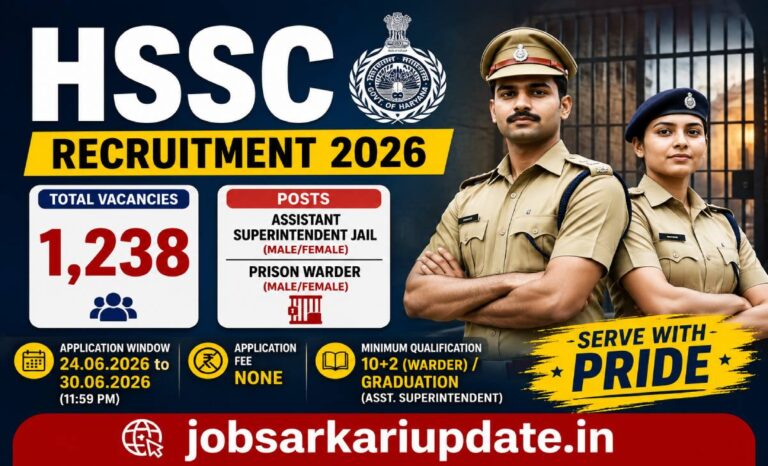
Quick Summary: HSSC Advertisement No. 06/2026 invites applications for 1,238 Group-C posts (Assistant Superintendent Jail and Prison Warder) in the...
Read Full Details