Bank of India RSETI Office Assistant Recruitment 2026 – Gondia & Gadchiroli, Eligibility, Salary & Apply The Bank of India...
Read Full DetailsSupreme Court of India Recruitment 2026 – Apply Online
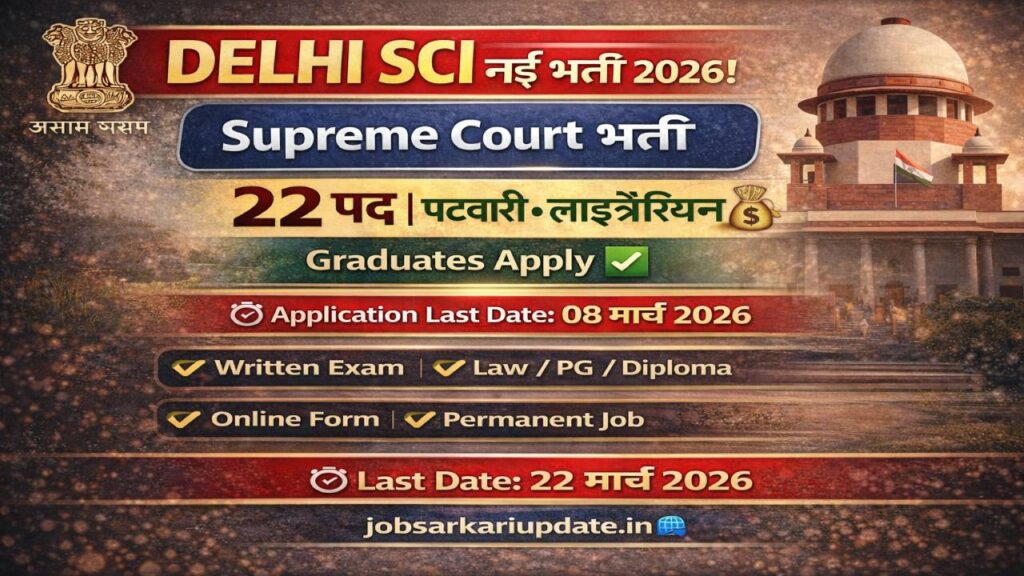
Supreme Court of India Recruitment 2026 – 22 Vacancies Across Four Prestigious Posts
The Supreme Court of India Recruitment 2026 has been officially announced through Advertisement No. F.6/RC-2025, dated February 18, 2026. The Registry of the Supreme Court of India, New Delhi, is inviting online applications from eligible Indian citizens for a total of 22 posts across four distinct cadres: Assistant Editor (Supreme Court Reports), Assistant Director (Supreme Court Museum), Senior Court Assistant (Supreme Court Museum), and Assistant Librarian. Online registration opens on 23 February 2026 and the last date to apply is 08 March 2026 — giving candidates a tight window of just 14 days to submit their applications.
This recruitment is a genuinely rare opportunity. The Supreme Court of India is the highest judicial authority in the country, and positions within its Registry carry unmatched prestige, job security, excellent pay, and the unique satisfaction of contributing directly to the functioning of constitutional justice. The posts span highly specialised domains — law reporting and editorial work, museology and heritage management, and library science — meaning the competition, while intense, is drawn from specific talent pools rather than a mass applicant base. Eligible professionals from law, museology, and library science backgrounds should treat this notification with the highest priority. The eligibility conditions apply as on 01 March 2026.
Supreme Court India Recruitment 2026 – Overview
| Detail | Information |
|---|---|
| Organisation Name | Supreme Court of India, Registry |
| Advertisement No. | F.6/RC-2025 |
| Post Names | Assistant Editor (SCR), Assistant Director (SC Museum), Senior Court Assistant (SC Museum), Assistant Librarian |
| Total Vacancies | 22 Posts |
| Job Location | New Delhi – 110001 |
| Job Type | Permanent Government Service (Direct Recruitment) |
| Application Mode | Online only via www.sci.gov.in |
| Eligibility Date | As on 01 March 2026 |
| Test Cities | Delhi/NCR, Mumbai, Kolkata, Chennai |
| Interview City | Delhi only |
The Registry of the Supreme Court of India functions as the administrative backbone of the country’s apex court. It manages the publication of the Supreme Court Reports — the official law reports of India — runs the Supreme Court Museum, and maintains one of the most significant law libraries in the nation. Positions here are not merely government jobs — they are roles at the intersection of law, history, and institutional memory. Unlike most government recruitments managed by SSC or UPSC, the Supreme Court conducts its own recruitment process with standards and procedures set by the Chief Justice of India, adding an additional layer of institutional credibility and selectivity to this hiring round.
Important Dates – SCI Vacancy 2026
| Event | Date |
|---|---|
| Notification Date | 18 February 2026 |
| Eligibility Cut-off Date | 01 March 2026 |
| Online Application Start Date | 23 February 2026 |
| Last Date to Apply Online | 08 March 2026 |
| Fee Payment Last Date | On or before 08 March 2026 (online only) |
| Admit Card Download | To be notified on www.sci.gov.in |
| Written Test / Computer Test Date | To be announced on www.sci.gov.in |
| Interview Date | To be announced; held in Delhi only |
Expert Timing Advice: With only 14 days between the opening date (23 Feb) and last date (08 March 2026), candidates have almost no buffer for delays. Apply within the first 3–4 days to avoid last-minute portal errors. Ensure your payment via UCO Bank’s online gateway goes through and you receive confirmation — the fee is non-refundable, and failed transactions without proper follow-up can cost you your slot. Keep your registered mobile number and email active throughout the entire recruitment cycle, as admit cards, test dates, and updates will be communicated only through those channels.
Application Fee
| Category | Application Fee (per post) |
|---|---|
| General / OBC | Rs. 1,500/- |
| SC / ST / Ex-Servicemen / Differently Abled / Dependent of Freedom Fighters | Rs. 750/- |
| Payment Mode | Online only – UCO Bank Payment Gateway |
| Refund Policy | Non-refundable under any circumstances |
The application fee must be paid exclusively through the UCO Bank online payment gateway integrated with the Supreme Court’s application portal — no other payment mode (cash, DD, UPI via other banks) will be accepted. Since candidates must apply separately for each post, a candidate applying for two posts from the General/OBC category will need to pay Rs. 3,000 in total. A critical and often overlooked rule: General/OBC candidates who pay the fee prescribed for reserved categories will not be considered. Always pay the fee applicable to your actual category. The fee is strictly non-refundable, even if a candidate mistakenly submits multiple applications for the same post — only the last submitted application is entertained.
Age Limit (as on 01 March 2026)
| Post | Minimum Age | Maximum Age | SC/ST Relaxation | OBC Relaxation | PwD / Ex-SM |
|---|---|---|---|---|---|
| Assistant Editor (SCR) | 30 years | 40 years | As per GoI Rules | As per GoI Rules | As per GoI Rules |
| Assistant Director (SC Museum) | 30 years | 40 years | As per GoI Rules | As per GoI Rules | As per GoI Rules |
| Senior Court Assistant (SC Museum) | Not specified | 35 years | As per GoI Rules | As per GoI Rules | As per GoI Rules |
| Assistant Librarian | Not specified | 30 years | As per GoI Rules | As per GoI Rules | As per GoI Rules |
Age relaxation follows standard Government of India rules for SC, ST, OBC, Physically Challenged, Ex-Servicemen, and Dependents of Freedom Fighters. An important distinction: there is no upper age limit for departmental candidates (those already working in the Registry of the Supreme Court of India). However, no relaxation is extended to candidates working in other government departments — they are treated at par with general/direct recruitment candidates. Age must be calculated as on 01 March 2026, and only the date of birth as recorded in the Class 10 / Matriculation certificate will be accepted. Any name change must be supported by a Gazette notification.
Eligibility Criteria – Supreme Court India Recruitment 2026
| Post | Essential Qualification | Experience Required |
|---|---|---|
| Assistant Editor, Supreme Court Reports | Law Degree from BCI-recognised Indian University OR Member of English Bar OR Attorney of High Court in India; Plus computer knowledge | Min. 3 years as Advocate in HC/SC; OR 3 years in judicial post; OR 3 years law research in University/ILI; OR 3 years as Law Reporter/Editorial staff of law reports; OR 3 years as Law Lecturer; OR 7 years service (min. 4 in Class-II Gazetted post in SC/HC) |
| Assistant Director, SC Museum (Ex-cadre) | Master’s Degree in Museology (1st Class) from a recognised University; Knowledge of Indian antiquities, museum techniques, publications; Computer knowledge | Min. 5 years research experience in a museum of standing or comparable institution, with documentary evidence of published work |
| Senior Court Assistant, SC Museum (Ex-cadre) | Master’s Degree in Museology (high 2nd Class / min. 55%) from a recognised University; Computer knowledge | Min. 2 years research experience in Museology (preferably in organizing exhibitions and educational programmes) OR 2 years working experience in any Museum as Assistant Curator or above |
| Assistant Librarian | Degree in Library Science from a recognised University; Diploma in Computer Application (AICTE/DOEACC) or Library Automation Course (NISCAIR); Computer operation knowledge including Library Automation Software (cataloguing, acquisition, circulation), online/offline database search | Min. 2 years relevant experience in a library of a recognised University or Law Library |
The eligibility framework for the Supreme Court India Recruitment 2026 is notably domain-specific and strict. The most common eligibility mistake candidates make is assuming a general Master’s degree substitutes for a domain-specific qualification. For Assistant Director and Senior Court Assistant positions, the essential qualification is a Master’s in Museology specifically — not History, Archaeology, or a related field alone. Similarly, for Assistant Librarian, the qualification is a Degree in Library Science plus an AICTE/DOEACC-approved Computer Application Diploma or NISCAIR’s Library Automation Course. Candidates claiming an equivalent qualification must submit an equivalency certificate from the issuing university/institution at the time of interview. Equivalent claims without proper certification will be rejected.
Vacancy Details – Post-wise & Category-wise
| Post | UR | SC | ST | OBC | Total | Pay Level |
|---|---|---|---|---|---|---|
| Assistant Editor, SC Reports | 5 | – | – | – | 05 | Level 12 |
| Asst. Director, SC Museum (Ex-cadre) | 1 | – | – | – | 01 | Level 11 |
| Sr. Court Asst., SC Museum (Ex-cadre) | 2 | – | – | – | 02 | Level 8 |
| Assistant Librarian | 10 | 3 | 1 | – | 14 | Level 8 |
| Total Vacancies | 22 | |||||
With 14 out of 22 posts dedicated to Assistant Librarian, this is by far the largest single category in this Supreme Court India Recruitment 2026 and also the most competitive numerically. The inclusion of SC (3) and ST (1) reserved posts for Assistant Librarian makes it the only post in this advertisement with category-wise reservation — all other posts are UR (Unreserved). The Assistant Editor posts carry the highest pay (Level 12) and demand the most specialised background in law practice or legal academia. At the other end, the single post of Assistant Director (SC Museum) is arguably the most niche opening in India for a Museology professional — with only 1 vacancy, every application in that pool will receive granular scrutiny.
Selection Process – Supreme Court India Recruitment 2026
Stage 1: Written Test
All four posts involve a written examination as the first stage. The written test is conducted at four cities — Delhi/NCR, Mumbai, Kolkata, and Chennai. For Assistant Editor, the written test is divided into Part-A (Précis Writing and Editorial Skill, 100 marks, 2 hours) and Part-B (Law and Constitution, 100 marks, 2 hours). For the remaining three posts, the written test covers both objective and subjective questions. Expert tip: past law graduates applying for Assistant Editor should invest significant preparation time in Part-B (Law and Constitution), as this section directly tests command over constitutional law and judicial process — areas where a non-practising candidate will show gaps very quickly.
Stage 2: Computer Test (Not applicable for Assistant Editor)
For Assistant Director (SC Museum), Senior Court Assistant (SC Museum), and Assistant Librarian, a Computer Test follows the written test. For the Museum posts, it is qualifying in nature (adjudged Proficient or Non-Proficient) and carries no marks. For Assistant Librarian, the Computer Test carries 100 marks (qualifying marks: 50 for General, 45 for reserved categories) and lasts 1 hour. Expert tip: library automation software knowledge — especially working familiarity with tools like KOHA or SOUL — is what this test specifically assesses for Assistant Librarian applicants. Practice on actual library management software before the exam, not just theoretical knowledge.
Stage 3: Shortlisting for Interview
Candidates are shortlisted for interview in a ratio of 1:3 against the number of vacancies (i.e., for every 1 vacancy, 3 candidates are called). For Museum and Library posts, shortlisting to Computer Test is first done at 1:10 ratio, followed by interview shortlisting at 1:3. This stringent ratio means that for the single Assistant Director (Museum) vacancy, only 3 candidates will be called for interview — making the stakes at every stage extremely high.
Stage 4: Interview
The interview carries 25 marks (minimum qualifying marks: 13 for General, 12 for reserved categories). It is held exclusively in Delhi. No TA/DA is paid for attending. Candidates working in government departments, banks, or PSUs must bring a No Objection Certificate from their employer at the time of interview. The interview panel at the Supreme Court Registry is known for its thoroughness — expect in-depth questioning on your specific domain, your published work, and your understanding of the Supreme Court’s institutional functioning.
Stage 5: Document Verification and Empanelment
All eligibility documents are verified at the interview stage. Placement on the final panel does not automatically confer a right to appointment — the Registry makes actual appointment decisions separately. Importantly, candidates who applied in response to the earlier advertisement dated 25th July 2025 need not apply again; their previous applications remain valid.
Exam Pattern & Syllabus
Exam Pattern Overview
| Post | Test Component | Max Marks | Qualifying Marks | Duration | Negative Marking |
|---|---|---|---|---|---|
| Assistant Editor (SCR) | Part-A: Précis Writing & Editorial Skill | 100 | 50 | 2 hours | Not mentioned |
| Part-B: Law and Constitution | 100 | 50 | 2 hours | Not mentioned | |
| Interview | 25 | 13 | – | – | |
| Asst. Director & Sr. Court Asst. (Museum) | Written Test (Obj + Subj): General English, GK, Aptitude (30) + Museology, Archaeology, Ancient/Indian History (70) | 100 | 50 | 3 hours | Not mentioned |
| Computer Test (Qualifying) | Proficient/Non-Proficient | Must be Proficient | – | – | |
| Interview | 25 | 13 | – | – | |
| Assistant Librarian | Written Test (Obj + Subj): General English, GK, Aptitude (30) + Library Management (70) | 100 | 50 (Gen) / 45 (Reserved) | 3 hours | Not mentioned |
| Computer Test | 100 | 50 (Gen) / 45 (Reserved) | 1 hour | – | |
| Interview | 25 | 13 (Gen) / 12 (Reserved) | – | – |
Subject-wise Syllabus (Based on Official Notification)
Assistant Editor – Part A: Précis Writing & Editorial Skill
- Précis writing of legal passages and judgments
- Editorial skills for legal reports — headnote writing, indexing, case summarisation
- Ability to condense complex judicial language into clear, accurate summaries
Assistant Editor – Part B: Law and Constitution
- Constitutional Law of India — fundamental rights, directive principles, emergency provisions, judicial review
- Civil Procedure Code and Criminal Procedure Code
- Indian Evidence Act, Limitation Act
- Landmark Supreme Court judgments and constitutional amendments
- Interpretation of statutes and legal drafting principles
Museum Posts – Written Test Syllabus
- General English (part of 30 marks): comprehension, grammar, vocabulary
- General Knowledge & Aptitude (part of 30 marks): current affairs, logical reasoning
- Museology (part of 70 marks): museum techniques, exhibition design, conservation, educational programmes, documentation, Indian antiquities
- Archaeology and Ancient/Indian History (part of 70 marks): major archaeological sites, historical periods, Indian cultural heritage
Assistant Librarian – Written Test Syllabus
- General English, GK, Aptitude (30 marks): comprehension, vocabulary, current affairs, logical reasoning
- Library Management (70 marks): library cataloguing (AACR2, RDA), classification systems (DDC, UDC), acquisition processes, circulation management, OPAC, library automation software (KOHA/SOUL), reference services, database searching (online and offline), information retrieval systems
Preparation Tips
For Assistant Editor aspirants, reading and summarising 10–15 Supreme Court judgments per week is the most effective practice. Focus especially on constitutional matters and the structure of headnotes in the Supreme Court Reports themselves — these are your benchmark. For Museum posts, standard references in Museology (including works by S.K. Bhowmik and G. Ellis Burcaw) combined with a thorough revision of NCERT-level Ancient and Medieval Indian History will cover the 70-mark domain section effectively. For Assistant Librarian, the Computer Test is often what differentiates candidates — get hands-on practice with a live library automation software installation rather than relying on textbook knowledge alone. Previous year papers from similar Supreme Court or High Court library recruitment examinations are highly recommended for all categories.
Salary & Pay Scale
| Post | Pay Level | Initial Basic Pay | Approx. Gross Salary (with DA, HRA @ Delhi) |
|---|---|---|---|
| Assistant Editor, SC Reports | Level 12 | Rs. 78,800/- | Approx. Rs. 1,20,000 – 1,35,000/- per month |
| Assistant Director, SC Museum | Level 11 | Rs. 67,700/- | Approx. Rs. 1,05,000 – 1,15,000/- per month |
| Senior Court Assistant, SC Museum | Level 8 | Rs. 47,600/- | Approx. Rs. 75,000 – 85,000/- per month |
| Assistant Librarian | Level 8 | Rs. 47,600/- | Approx. Rs. 75,000 – 85,000/- per month |
All posts carry “other allowances as admissible under the Rules” — which for Central Government employees in Delhi means Dearness Allowance (currently revised every 6 months), House Rent Allowance at the highest ‘X’ city rate (27% of basic pay for Delhi), and Transport Allowance. The in-hand salary will vary based on your HRA entitlement (whether you are in government accommodation or not), GPF/NPS deductions, and CGHS contributions. The gross figures above are indicative estimates as of the current DA cycle. Beyond the monetary compensation, Supreme Court Registry employees also benefit from CGHS medical facilities, Leave Travel Concession, children’s education allowance, and the long-term security of a permanent Central Government post. Compared to equivalent roles in High Court registries, SCI posts at the same pay level command significantly higher professional standing.
How to Apply Online – Step-by-Step Guide
- Visit the official Supreme Court of India website (www.sci.gov.in) and navigate to the Recruitment section.
- Click on the online application link for the specific post you wish to apply for. Note: you must apply separately for each post with a separate fee payment.
- Register with your basic details and create a login. Note down your Application Number carefully — it is required for admit card generation and all future correspondence.
- Fill in the application form accurately — personal details, educational qualifications, experience, and category. All details must match your documentary proof exactly.
- Upload scanned copies of: recent passport-size photograph, signature, and all required eligibility documents (degree certificates, experience letters, category certificate if applicable).
- Pay the application fee online through the UCO Bank payment gateway (Rs. 1,500/- for General/OBC; Rs. 750/- for SC/ST/Ex-SM/PwD/DFF). Retain the payment confirmation.
- Preview your complete application carefully before final submission. Once submitted, no modifications or withdrawal are possible.
- Download and print the filled application for your records. Do not send the printout to the Registry.
Pre-Application Checklist
- ✅ Degree/Masters certificate in relevant domain (self-attested scanned copy)
- ✅ Experience certificate(s) with clearly stated dates, role, and organisation letterhead
- ✅ Class 10 certificate (for date of birth verification)
- ✅ Category certificate (SC/ST/OBC/PwD) if applicable — ensure it is current and valid
- ✅ Computer Application diploma or NISCAIR certificate (for Assistant Librarian)
- ✅ Evidence of published research work (for Museum posts)
- ✅ Bar Council enrolment certificate / judicial service record (for Assistant Editor)
- ✅ Valid personal email ID and mobile number — keep both active throughout the process
- ✅ UCO Bank net banking / debit card ready for online fee payment
- ✅ If employed in Govt/PSU/Bank: prepare for NOC from employer at interview stage
Two critical mistakes to avoid: (1) Applying under the wrong fee category — a General/OBC candidate paying Rs. 750 will be disqualified. (2) Submitting multiple applications carelessly — if you submit more than one application for the same post, only the last-submitted application is considered, and all fees previously paid for that post are forfeited without refund.
Important Instructions for Candidates
✔ Apply separately for each post — one application per post, with a separate fee payment per post.
✔ Eligibility conditions must be fulfilled as on 01 March 2026.
✔ Unsigned applications will be summarily rejected.
✔ Applications received through any mode other than online will not be accepted.
✔ Admit cards will NOT be sent by post — download from www.sci.gov.in only.
✔ No TA/DA is payable for appearing in tests or interview.
✔ Candidates applying in response to the earlier advertisement (25 July 2025) need not apply again.
✔ Misconduct — including submitting fabricated documents or false information — can lead to prosecution, debarment, and service termination even after joining.
✔ In case of dispute, the jurisdiction will be Delhi only.
✔ This content is for informational purposes only. Always refer to the official notification on www.sci.gov.in for the final and binding terms.
Expert Tips to Crack Supreme Court of India Recruitment 2026
1. Apply Immediately — The Window is Only 14 Days
The application window from 23 Feb to 08 March 2026 is extraordinarily tight. There is no margin for technical delays, payment failures, or document gathering. Candidates who are even slightly prepared should apply on Day 1 or Day 2. Do not wait to “finalize” your application — start filling it the moment the portal goes live.
2. Read the Full Notification Before You Apply
This advertisement has multiple post-specific eligibility conditions that differ significantly from each other. A law graduate assuming they can apply for the Museum posts or a Museology graduate assuming experience in exhibitions automatically qualifies them for the Assistant Director post — these are common category errors that waste application fees. Read the eligibility for each post meticulously before deciding which posts to apply for.
3. Gather Eligibility Documents Before Starting the Application
You must upload scanned documents within the same online session when completing your application. Have all certificates — degree, experience, computer diploma, category certificate, Class 10 board certificate — already scanned, properly named, and in the correct file size/format before you begin filling the form. A poorly scanned or incorrectly formatted document upload is one of the most common reasons for rejection during verification.
4. Start Exam Preparation from Today
Given the tight application window and the fact that exam dates will follow quickly, begin subject preparation immediately in parallel with your application. For law candidates, start reading Supreme Court judgments and revising constitutional law fundamentals. For Museum candidates, revise Museology theory and Indian cultural heritage. For Library candidates, get hands-on with library automation software. Waiting until after you receive your admit card is a strategy that consistently underperforms.
5. Understand the 1:3 Interview Ratio — Every Mark in the Written Test Matters
With only 1:3 shortlisting for the interview stage, merely qualifying the written test is not enough — you need to rank highly within the qualifiers. For posts with very few vacancies (especially the 1-vacancy Museum Director post), the margin between being called for interview and not being called can be a single mark in the written test. Approach each section of the written exam with the goal of maximising your score, not just crossing the minimum qualifying threshold.
6. Prepare for Test City Uncertainty
While you can express city preferences, the Registry explicitly reserves the right to shift candidates to any of the four test cities — or even another city — for administrative reasons. Make peace with this reality in advance. If you are based outside Delhi, have travel and accommodation plans flexible enough to adapt to any of the four designated cities.
Frequently Asked Questions – Supreme Court India Recruitment 2026
- 1. How many total vacancies are there in Supreme Court of India Recruitment 2026?
- There are 22 total vacancies — 5 for Assistant Editor (SC Reports), 1 for Assistant Director (SC Museum), 2 for Senior Court Assistant (SC Museum), and 14 for Assistant Librarian.
- 2. Who can apply for the Assistant Editor post?
- Candidates with a Law Degree from a BCI-recognised university (or membership of the English Bar, or Attorney of a High Court in India) plus at least 3 years of qualifying experience (as Advocate in HC/SC, judicial post, law researcher, law reporter, or Law Lecturer) are eligible. The upper age limit is 40 years.
- 3. What is the age limit for the General category candidate for Assistant Librarian?
- The upper age limit for Assistant Librarian is 30 years as on 01 March 2026 for General category candidates. Standard Government of India age relaxations apply for SC/ST/OBC/PwD/Ex-SM categories.
- 4. What is the application fee for OBC candidates?
- OBC candidates are required to pay Rs. 1,500/- per post — the same as General category candidates. The concessional fee of Rs. 750/- applies only to SC, ST, Ex-Servicemen, Differently Abled, and Dependents of Freedom Fighters.
- 5. What is the last date to apply online?
- The last date for online registration is 08 March 2026. The application window opens on 23 February 2026. Candidates should apply well before the last date to avoid last-minute technical issues.
- 6. How many stages are there in the selection process?
- For Assistant Editor: Written Test (2 parts) followed by Interview (3 stages). For Museum and Library posts: Written Test, then Computer Test, then Interview (3 stages). Shortlisting for interview is in a 1:3 ratio against vacancies.
- 7. What is the expected in-hand salary for an Assistant Librarian after joining?
- The initial basic pay is Rs. 47,600/- at Pay Level 8. With Dearness Allowance, HRA (at Delhi rates), and Transport Allowance, the gross monthly emolument is approximately Rs. 75,000 – 85,000/-. In-hand will be lower after CGHS, NPS/GPF, and other deductions.
- 8. Is there negative marking in the written test?
- The official notification does not mention negative marking for any of the written tests. However, candidates are advised to confirm this on the official exam instructions provided at the time of the test, as this detail may be clarified in the admit card or hall ticket.
- 9. Can final year students or appearing candidates apply?
- No. All eligibility conditions must be fulfilled as on 01 March 2026. Candidates currently in their final semester or awaiting results are not eligible to apply.
- 10. What documents are needed at the interview stage?
- All original documents supporting eligibility — degree certificates, experience letters, caste/category certificates, computer qualification certificates, date of birth proof (Class 10 board certificate), and proof of published work (for Museum posts) — are required at the interview stage. Government/PSU/Bank employees must also bring a No Objection Certificate from their employer.
- 11. Is there age relaxation for women candidates?
- The notification does not specify separate age relaxation for women candidates. Standard Government of India relaxation rules apply for SC/ST/OBC/PwD/Ex-SM/DFF categories. Verify specific relaxation entitlements from the official notification.
- 12. Where can I download my admit card?
- Admit cards will not be sent by post. All candidates must download their admit cards from the official Supreme Court of India website — www.sci.gov.in. The link and dates will be notified on the website. Candidates will also receive SMS and email alerts on their registered mobile and email ID.
Important Links
| Apply Online | Click Here |
| Download Notification | Click Here |
| Official Website | Click Here |
Recent Jobs
Check out our latest job postings
279 Jobs Available

Ordnance Factory Khamaria DBW Recruitment 2026 – 350 Tenure Based Vacancy, Eligibility & Apply Offline The Ordnance Factory Khamaria DBW...
Read Full Details
IRFC Assistant Manager Finance Recruitment 2026 – Eligibility, Syllabus, Salary & Apply Online The IRFC Assistant Manager Finance Recruitment 2026...
Read Full Details
UIDAI Internship 2026 Apply Online – Technology Centre Bengaluru, Eligibility & Last Date The UIDAI Internship 2026 Apply Online opportunity...
Read Full Details
DSHM IPHL Lab Technician Recruitment 2026 – Overview, Eligibility & How to Apply The DSHM IPHL Lab Technician Recruitment 2026...
Read Full Details
SAI NIS Diploma in Sports Coaching 2026: Complete Admission Guide The Sports Authority of India (SAI) has officially published the...
Read Full Details Follow WhatsApp Channel