SVPUAT Meerut Non-Teaching Recruitment 2026 - Quick Summary: Sardar Vallabhbhai Patel University of Agriculture & Technology has released 62 vacancies...
Read Full DetailsUPTET 2026 – Eligibility, Syllabus, Exam Date & Apply Online
Important Notice: This article is based on the official UPTET 2026 notification (Adv. No. 01/UPTET/2026) published by UPESSC, Prayagraj on 20 March 2026. All information is for guidance only. Verify all details from the official portal before applying.
UPTET 2026 – Complete Information, Eligibility & Apply Online
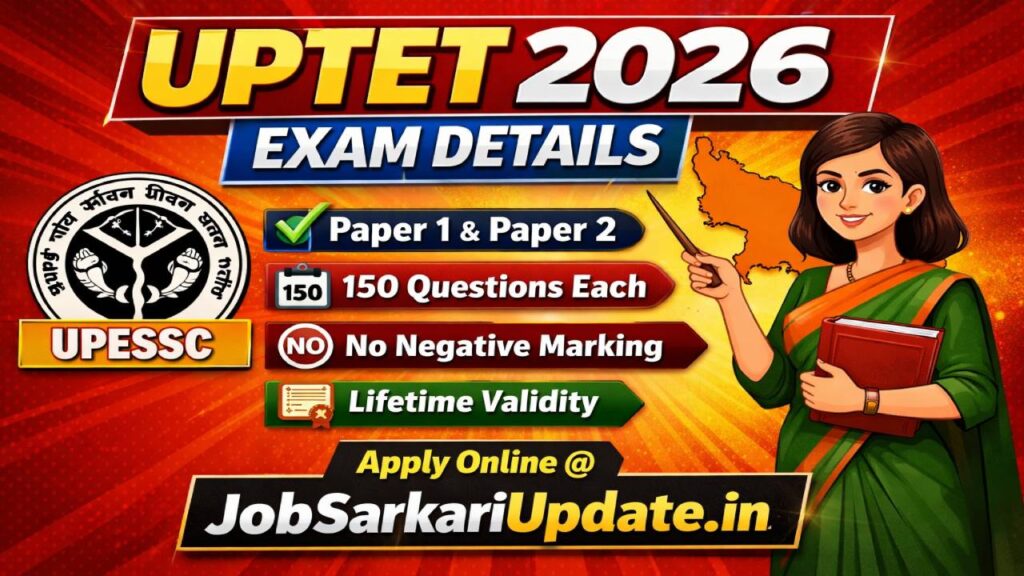
The UPTET 2026 Apply Online process has officially begun with the release of Advertisement No. 01/UPTET/2026 by the Uttar Pradesh Shiksha Seva Chayan Aayog (UPESSC), Prayagraj on 20 March 2026. UPTET — Uttar Pradesh Teacher Eligibility Test — is a mandatory qualifying examination for candidates who wish to be appointed as teachers in government primary (Class 1 to 5) and upper primary (Class 6 to 8) schools across Uttar Pradesh.
This is one of the most anticipated teacher eligibility exams in India, drawing lakhs of applicants every cycle. Passing UPTET does not guarantee a teaching job on its own — it certifies that you meet the minimum eligibility standard for teaching appointments, as mandated under the Right to Education Act and NCTE guidelines. However, it is a prerequisite for participation in UP teacher recruitment drives conducted by UPESSC and other recruitment bodies in the state.
A standout feature of UPTET 2026 is that the certificate, once earned, is valid for lifetime — a policy change that significantly increases its long-term value. The exam is scheduled on 2, 3, and 4 July 2026, with admit cards to be released on 30 June 2026. Candidates can apply online between 27 March and 26 April 2026. Given that UPTET attracts heavy competition from across Uttar Pradesh and neighboring states, early preparation starting from the day of application is essential.
UPTET 2026 – Exam Overview
UPESSC — Uttar Pradesh Shiksha Seva Chayan Aayog — was established on 21 August 2023 under the UP Education Service Selection Commission Act 2023. It is the apex state authority empowered to conduct the UPTET examination and oversee teacher selection processes in Uttar Pradesh. With its headquarters at 23 Alenganj, Prayagraj, UPESSC operates with a mandate for transparent and merit-based selection, following directives from the UP government and NCTE. Its credibility is directly backed by the state government, making the UPTET certificate recognized across all government-aided, government-run, and affiliated schools in UP.
| Field | Details |
|---|---|
| Organization Name | Uttar Pradesh Shiksha Seva Chayan Aayog (UPESSC), Prayagraj |
| Exam Name | Uttar Pradesh Teacher Eligibility Test (UPTET) 2026 |
| Advertisement Number | 01/UPTET/2026 |
| Papers Available | Paper I (Class 1–5) & Paper II (Class 6–8) |
| Total Questions per Paper | 150 MCQs |
| Total Marks per Paper | 150 Marks |
| Exam Duration | 2 Hours 30 Minutes (150 Minutes) |
| Negative Marking | None |
| Certificate Validity | Lifetime (from date of result declaration) |
| Application Mode | Online (OTR + Application on upessc.up.gov.in) |
| Job Location | Uttar Pradesh |
| Exam Type | State Level Teacher Eligibility Test |
UPTET 2026 Important Dates
Timing matters enormously in any competitive exam application. Candidates who apply in the very first week — ideally between 27 and 31 March 2026 — get the benefit of early OTR registration processing, more time to rectify any errors before the 01 May 2026 correction deadline, and avoid the notorious server overload that hits every government portal in the final 48 hours before the last date. It is also wise to keep the exam district notification date (22 June 2026) and admit card release (30 June 2026) marked in your calendar, as admit cards must be downloaded and printed before arriving at the exam center. All information flows through the UPESSC website — no individual communication is sent to candidates.
| Event | Date |
|---|---|
| Notification Publication Date | 20 March 2026 |
| Application / OTR Registration Start Date | 27 March 2026 |
| Last Date to Submit Online Application & Fee | 26 April 2026 |
| Last Date for Fee Correction & Application Edit | 01 May 2026 |
| Exam District Information to Candidates | 22 June 2026 |
| Admit Card Download Date | 30 June 2026 |
| UPTET 2026 Exam Date | 02, 03, 04 July 2026 |
| Result Date | Not mentioned in official notification. Candidates are advised to check the official notice for updates. |
Note: All dates are subject to change. Always verify from the official UPESSC notification and website before taking any action.
UPTET 2026 Application Fee
The application fee for UPTET 2026 varies by category and is charged separately for each paper. Candidates appearing in both Paper I and Paper II must pay the fee for both. The fee can be paid online through SBI or ICICI Bank payment gateways — supporting UPI, Net Banking, and Debit/Credit Card options. One very common and costly mistake candidates make is paying the fee for only one paper when they intend to appear in both. Always verify your paper selection in the application form before proceeding to payment — the system allows both papers to be selected in a single online application.
| Category | Fee – Paper I | Fee – Paper II | Fee – Both Papers |
|---|---|---|---|
| General / EWS / OBC | ₹1,000 | ₹1,000 | ₹2,000 |
| SC / ST | ₹500 | ₹500 | ₹1,000 |
| PwD (Divyang) | ₹300 | ₹300 | ₹600 |
Payment Support Contacts: For SBI payment issues: Mo. +919899677276 / sbiepay@sbi.co.in | For ICICI payment issues: 022-65361671 (24×7) | For application-related issues: uptet.support@upessc.org
UPTET 2026 Age Limit
The official UPTET 2026 notification does not specify a separate age limit for appearing in the eligibility test itself. The age limit criteria are typically applicable at the time of actual teacher recruitment (appointment), not for the eligibility exam. However, candidates must note that their date of birth as recorded in the High School (Class 10) marksheet or equivalent certificate will be the only accepted document for age verification. No other record of birth will be entertained. Standard Government of Uttar Pradesh reservation-based age relaxation rules will apply at the recruitment stage for reserved category candidates.
| Category | Age Limit for UPTET Exam | Remarks |
|---|---|---|
| All Categories | Not specified for the eligibility test | Age is verified at recruitment stage; birth date from Class 10 certificate is final |
UPTET 2026 Eligibility Criteria
UPTET 2026 offers two separate papers with distinct eligibility conditions. The most common eligibility mistake candidates make is assuming that a B.Ed degree alone qualifies them for Paper I (Class 1–5) — it does not. Paper I specifically requires a D.El.Ed (BTC) or equivalent primary education training, whereas B.Ed qualifies for Paper II (Class 6–8). Candidates in the final year of qualifying degrees are provisionally eligible — their UPTET certificate will only be validated after successfully completing and passing their qualifying examination. Reserved category candidates are eligible for minimum mark relaxation as per UP government reservation norms.
Paper I – Class 1 to 5 (Primary Level)
| Qualification | Minimum Requirement |
|---|---|
| Graduation + D.El.Ed (BTC) – 2 Year | Final year or passed; from NCTE-recognized, UP govt-affiliated institution |
| Graduation + D.El.Ed (BTC) via Distance Mode | For untrained/Shiksha Mitras; final year or passed |
| Graduation + 2-Year Diploma in Education (D.Ed / D.Ed Special Ed.) | NCTE or RCI recognized institution |
| Graduation + Specialized BTC (NCTE recognized in UP) | Final year or passed |
| Graduation + BTC Urdu Special Training (2-Year) | Final year or passed |
| Graduation + Diploma in Teaching (AMU) | Final year or passed |
| Moalim-e-Urdu (before 11-08-1997) – AMU | For Urdu teachers |
| Intermediate (50% marks) + 4-Year B.El.Ed | Final year or passed; NCTE/UGC recognized |
Paper II – Class 6 to 8 (Upper Primary Level)
| Qualification | Minimum Requirement |
|---|---|
| Graduation + 2-Year D.El.Ed (BTC) | Final year or passed; NCTE-recognized, UP govt-affiliated institution |
| Graduation (min. 50%) + B.Ed | Final year or passed; from NCTE-recognized institution |
| Graduation (min. 45%) + B.Ed | As per NCTE norms (Recognition, Norms and Procedure) Regulations |
| Graduation (min. 50%) + B.Ed Special Education (NCTE/RCI recognized) | Final year or passed |
| Intermediate (50%) + 4-Year B.Ed / B.A.B.Ed / B.Sc.B.Ed | NCTE/UGC recognized; final year or passed |
| Intermediate (50%) + 4-Year B.El.Ed | Final year or passed |
| Graduation (50%) + 1-Year B.Ed Special Education (RCI recognized) | Final year or passed |
UPTET 2026 Qualifying / Passing Marks
The qualifying threshold for UPTET 2026 is set at 60% for General category candidates — meaning you must score at least 90 out of 150 marks to pass. For reserved categories (SC/ST, OBC, EWS, Freedom Fighter dependents, Ex-Servicemen, and PwD), the minimum qualifying marks are set at 55%, which translates to 82 out of 150. It is important to understand that qualifying UPTET does not by itself give you any right to appointment or employment — it is strictly a minimum eligibility criterion for teacher recruitment, and actual job selection happens through separate recruitment processes. Score normalization will apply if the exam is conducted in multiple shifts across the three exam dates.
| Category | Minimum Qualifying % | Minimum Marks (out of 150) |
|---|---|---|
| General / UR | 60% | 90 Marks |
| SC / ST / OBC / EWS / PwD / Freedom Fighter Dependents / Ex-Servicemen | 55% | 82 Marks |
UPTET 2026 – Exam Process & Selection
Written Examination
UPTET 2026 consists entirely of a written objective-type examination. Both Paper I and Paper II contain 150 MCQs carrying 1 mark each, with a total exam duration of 2 hours 30 minutes (150 minutes). All questions are compulsory — there are no optional questions within any section. The exam medium is bilingual (Hindi and English) for subjects other than languages. There is no negative marking, which means every attempt is strategically beneficial — never leave any question unanswered. If the number of applicants is very high and a single-day/single-shift exam is not feasible, the exam may be conducted across multiple shifts on 2, 3, and 4 July 2026, with score normalization applied for fair comparison across shifts.
Prep Tip: Since there is no negative marking, attempt all 150 questions. Practice under timed conditions to ensure you complete the paper within 150 minutes, leaving time for revision. Allocate roughly 1 minute per question as your baseline target.
OMR Sheet Evaluation
Answer sheets (OMR) are evaluated through computerized electronic scanning. Candidates must carefully fill in the correct Roll Number, Question Booklet Serial Number, Registration Number, and Language Option/Part-IV (Science/Math or Social Science) bubble on the OMR sheet. If any of these are left unfilled or incorrectly filled, the OMR will not be evaluated, and no appeal in this regard will be entertained. This is a strict and non-negotiable rule — review your OMR markings twice before submission.
Prep Tip: Practice filling OMR sheets during your mock tests. One wrong bubble mark — especially on the booklet code column — can invalidate your entire answer sheet regardless of how well you performed.
Result & Certificate Distribution
After the written examination, results will be declared on the UPESSC website. Candidates who qualify will receive their UPTET certificate digitally through DigiLocker — the official digital document wallet used by the Government of India. Physical certificates will not be distributed separately. The UPTET certificate issued from 2026 onwards carries lifetime validity as per the UP Government order (No. 392/Arast-4-2021-9(16) dated 16 June 2021). Candidates must note that no alterations to photo, category, or special reservation details will be made in the certificate once issued — accuracy at the time of application is therefore critical.
Prep Tip: Create and verify your DigiLocker account before the exam — this will be the official medium for certificate download. Keep your Aadhaar-linked mobile number active for OTP verification.
UPTET 2026 Exam Syllabus & Pattern
The complete official syllabus for UPTET 2026 has been provided in Appendix 5 of the official notification. Both papers follow the same structural logic: mandatory sections on Child Development & Teaching Methods and Language I (Hindi), with the remaining sections varying based on the paper and teaching subject chosen. Below is the full syllabus extracted directly from the official notification.
Paper I – Exam Pattern (Class 1 to 5)
| Section | Subject | Questions | Marks |
|---|---|---|---|
| 1 | Child Development & Teaching Methods (Mandatory) | 30 MCQs | 30 |
| 2 | Language I – Hindi (Mandatory) | 30 MCQs | 30 |
| 3 | Language II – English / Urdu / Sanskrit (Mandatory) | 30 MCQs | 30 |
| 4 | Mathematics (Mandatory) | 30 MCQs | 30 |
| 5 | Environmental Studies (Mandatory) | 30 MCQs | 30 |
| Total | 150 MCQs | 150 | |
Paper II – Exam Pattern (Class 6 to 8)
| Section | Subject | Questions | Marks |
|---|---|---|---|
| 1 | Child Development & Teaching Methods (Mandatory) | 30 MCQs | 30 |
| 2 | Language I – Hindi (Mandatory) | 30 MCQs | 30 |
| 3 | Language II – English / Urdu / Sanskrit (Mandatory) | 30 MCQs | 30 |
| 4(a) | Mathematics & Science (for Math/Science teachers) | 60 MCQs | 60 |
| 4(b) | Social Studies / Social Science (for Social Studies teachers) | ||
| 4(c) | Either (a) or (b) for any other subject teacher | ||
| Total | 150 MCQs | 150 | |
Paper I – Subject-wise Syllabus
I. Child Development & Teaching Methods (30 Questions)
- Meaning, need and scope of child development; stages — physical, mental, emotional, language and creative development
- Factors affecting child development: heredity and environment (family, social, school, media)
- Meaning of learning and factors affecting it; effective methods of learning
- Laws of learning: Thorndike’s key laws and their importance
- Major theories of learning: Thorndike’s trial and error, Pavlov’s conditioned reflex, Skinner’s operant conditioning, Kohler’s insight theory, Piaget’s theory, Vygotsky’s theory
- Learning curve: meaning and types; plateau in learning
- Teaching, teaching methods, new approaches (micro-teaching), basic teaching skills
- Inclusive education: identification and types of excluded groups (language, religion, caste, gender, physical disability), TLM, guidance and counselling for inclusive children
- Child learning strategies as social activity; child as a problem-solver and scientific inquirer
- Cognition and emotions; motivation and learning
II. Language I – Hindi (30 Questions)
- Unseen passage; Hindi alphabet (vowels and consonants)
- Word formation from letter combinations (matric and non-matric words)
- Sentence construction; knowledge of all phonemic differences in Hindi
- Use of punctuation marks, conjuncts and nasal sounds
- Antonyms, synonyms, rhyming words, homophones
- Nouns, pronouns, verbs, adjectives, tense, gender, number
- Prefixes, suffixes, tatsam, tadbhav, deshaj word recognition
- Idioms and proverbs; sandhi (Svar, Vyanjan, Visarg)
- Voice (vachya), compound words (samas), figures of speech (alankar)
- Works and authors; language teaching methodology: learning and acquisition, grammar role, remedial teaching
III. Language II – English (30 Questions)
- Unseen Passage; The Sentences — Subject and Predicate, Kinds of Sentences
- Parts of Speech: Noun, Pronoun, Adverb, Adjective, Verb, Preposition, Conjunction
- Tenses — Present, Past, Future; Articles; Punctuation
- Word Formation; Active & Passive Voice; Singular & Plural; Gender
III. Language II – Urdu (30 Questions)
- Unseen passage; knowledge of linguistic skills of the language
- Famous writers and poets — their life and works
- Different literary forms: Mazmoon, Afsana, Marsiya, Masnavi, Dastan etc.
- Ism, Zameer, Sifat, Mutazad alfaz, singular, plural, muzakkar, moannaz
- Idioms and proverbs; social issues in poetry and stories
III. Language II – Sanskrit (30 Questions)
- Unseen passage; Sanjna (nouns) — akaarant, ikarant, ukaarant forms in all genders
- Sanskrit names for household items, body parts, animals and birds
- Pronouns, verbs, indeclinable words (avyay), sandhi (Deergh sandhi), numbers in Sanskrit
- Lingas, Vachana, Pratyahara, types of Svara and Vyanjana, Samas, Upsarga, Viruddha words, Karak, Pratyaya, Vachya
- Works of poets and authors; language development pedagogy
IV. Mathematics (30 Questions)
- Numbers and operations: addition, subtraction, multiplication, division
- LCM and HCF; fractions — addition, subtraction, multiplication, division
- Decimals — all operations; unitary method; percentage; profit and loss; simple interest
- Geometry: shapes, surfaces, angles, triangles, circles; money (rupees and paise)
- Measurement: time, weight, capacity, length and temperature
- Perimeter: triangle, rectangle, square, quadrilateral; area of rectangle and square
- Calendar; data; volume/capacity — cube and cuboid; railway/bus timetable
- Data presentation and interpretation; mathematical/logical reasoning; nature of mathematics; community mathematics; evaluation; remedial teaching
V. Environmental Studies (30 Questions)
- Family; food, health and hygiene; shelter; plants and animals; our environment
- Fair; local occupations and professions; water; transport and communication
- Games and sports; India — rivers, mountains, plateaus, forests, transport, continents and oceans
- Our State — rivers, mountains, plateaus, forests, transport
- Constitution; governance — local self-governance, Gram Panchayat, city bodies, district administration
- State governance system; legislature, judiciary, executive; national festivals, symbols, voting, national unity
- Environment — need, importance, conservation, social responsibility, environment protection schemes
- Concept and scope of EVS; integrated EVS; learning principles; science and social science interface; concept presentation; activities; practical work; discussion; continuous comprehensive evaluation
Paper II – Subject-wise Syllabus (Additional / Different Sections)
IV. Mathematics & Science – Paper II (60 Questions)
Mathematics Topics
- Natural numbers, whole numbers, rational numbers; integers, brackets, LCM, HCF
- Square roots, cube roots; surds
- Algebra: variables, constants, powers of variables; addition, subtraction, multiplication, division of algebraic expressions; polynomials (degree, like and unlike terms); one, two and three variable expressions
- Linear equations, quadratic equations, simultaneous equations
- Parallel lines, quadrilateral construction, triangle
- Circle and cyclic quadrilateral; tangents to circle
- Commercial mathematics: ratio and proportion, percentage, profit/loss, simple interest, compound interest, tax, barter system
- Banking: current currency, bills and cash memos
- Statistics: data classification, pictograph, mean, median, mode, frequency
- Pie chart, bar chart, ungrouped data representation
- Probability; graphs, bar charts, mixed bar charts; Cartesian plane; mensuration (area measurement); exponents
- Pedagogy: mathematical/logical thinking, place of mathematics in curriculum, language of mathematics, community mathematics, evaluation, remedial teaching, teaching problems
Science Topics
- Science in daily life, important discoveries, importance, human science and technology
- Fibre and cloth (process from fibre to cloth); living and non-living things; classification of organisms; plant and animal adaptations
- Animal structure and function; microorganisms and their classification; cell to organ systems
- Adolescence, disability; food, health, hygiene and diseases; crop production, nitrogen cycle
- Animal and plant nutrition; respiration and excretion in organisms
- Measurement; electric current; magnetism; motion, force and machines; energy
- Computer; sound; static electricity; light and light instruments
- Air — properties, composition, need, utility, ozone layer, greenhouse effect
- Water — need, utility, sources, properties, pollution, water conservation
- Matter, groups of matter, separation, structure and nature; physical and chemical changes
- Acid, base, salt; heat and temperature; man-made objects; minerals and metals; carbon and its compounds; alternate energy sources
- Pedagogy: nature of science, natural science objectives, understanding science, observation/experiment/inquiry (scientific method), evaluation, remedial teaching, teaching problems
IV. Social Studies – Paper II (60 Questions)
- History: Sources of history; Stone Age, Copper Age, Vedic civilization; India in 6th century BCE; early states; Maurya Empire; post-Maurya India, Gupta period, Rajput period, Pushyabhuti dynasty; South Indian states; advent of Islam; Delhi Sultanate; Mughal Empire, culture and decline; arrival of European powers; establishment of British rule; expansion of Company rule; Renaissance in India, rise of nationalism; Freedom Movement; Independence and Partition
- Civics: Our society; rural and urban lifestyle; rural and urban self-governance; district administration; our Constitution; traffic safety; central and state governance; democracy in India; national security and foreign policy; global community and India; civil safety; disability
- Geography: Earth in the solar system, globe, Earth’s motions; mapping, four hemispheres, land and water forms; India’s physical form, soil, vegetation, wildlife, climate, economic resources, transport, trade and communication; UP — location, political divisions, climate, soil, vegetation, wildlife, agriculture, minerals, industries, population and urbanization; landforms and their changes (internal and external factors); atmosphere, hydrosphere; major natural regions and human habitation; mineral resources and industries; disasters and disaster management
- Environmental Studies: Natural resources and their uses; natural balance; resource use; impact of population growth on environment; pollution; waste management; disasters; environmentalists; environment awards; environment days; environment calendar
- Home Science / Home Economics: Health and hygiene; nutrition, diseases and prevention, first aid; food preservation; pollution; digestive diseases and common illnesses; home management, sewing, washing, cooking, weaving, knitting
- Physical Education & Games: Physical education, exercise, yoga and pranayama; marching, national games and awards; small and recreational games; international games; games and food; first aid; effects of narcotics and prevention; sports management and planning
- Music: Knowledge of notes (Svar); introduction to Raga; rhythm and tala; ragas with teevra madhyam; prayer songs/flag songs; patriotic songs, bhajans; nature conservation/tree plantation; action songs
- Horticulture & Fruit Preservation: Soil and soil formation, land improvement, machines, seeds, fertilizers; irrigation and irrigation machinery; gardening, school garden; shrubs and creepers, ornamental plants, seasonal flowers, fruit farming, vegetable garden; vegetative propagation; fruit testing, fruit preservation — jam, jelly, sauce, pickle; climate science; crop cycle
- Pedagogy: Concept and methods of social science; classroom processes, activities, discourse; developing critical thinking; investigative/empirical evidence; teaching problems; project work; evaluation
UPTET 2026 Preparation Tips (Based on Official Syllabus)
- Child Development section is the highest-scoring opportunity — It carries 30 marks in both papers and covers largely theory-based content (Piaget, Vygotsky, Thorndike). These are predictable, repeatable topics. Master these theories thoroughly — they are asked every year.
- For Paper I Mathematics: Focus on LCM/HCF, fractions, percentages, perimeter/area and data interpretation. These topics have the highest question frequency based on previous UPTET papers.
- For Paper II Section 4: If you are a Math/Science teacher, allocate at least 50% of your study time to the 60-mark combined subject section. The science topics are varied — create a topic checklist from the official syllabus and tick off each one.
- Language sections require daily practice: Hindi grammar (sandhi, samas, alankar) and English (voices, narration) need consistent daily revision rather than last-minute cramming.
- EVS for Paper I covers both science and social content — it is a wide syllabus within 30 marks. Prioritize Constitution, governance, and environment topics as these are frequently tested.
Salary & Pay Scale After UPTET Qualification
Passing UPTET 2026 does not directly result in a salary — it qualifies you to participate in teacher recruitment processes. Once selected through a separate recruitment drive (conducted by UPESSC or other state bodies), appointed teachers in UP government schools are placed in the 7th Pay Commission pay matrix. Primary school teachers (Class 1–5) are typically placed at Pay Level 6 (₹35,400–₹1,12,400), while Upper Primary teachers (Class 6–8) may be placed at Pay Level 7 (₹44,900–₹1,42,400), depending on the specific recruitment notification. The in-hand salary after NPS deduction, HRA and DA varies by posting location and may range approximately between ₹30,000–₹45,000 per month for primary and ₹38,000–₹55,000 for upper primary teachers in urban postings.
| Teaching Level | Pay Level (7th CPC) | Basic Pay | Approx. Gross Salary |
|---|---|---|---|
| Primary Teacher (Class 1–5) | Level 6 | ₹35,400 | ₹40,000–₹50,000 (varies by posting) |
| Upper Primary Teacher (Class 6–8) | Level 7 | ₹44,900 | ₹50,000–₹65,000 (varies by posting) |
Note: Salary figures above are indicative estimates based on 7th Pay Commission norms applicable to UP government teachers and are subject to change per actual recruitment notification. Final salary will be as per the specific recruitment advertisement.
How to Apply for UPTET 2026 – Step by Step
The application process for UPTET 2026 is entirely online through the UPESSC official portal. All candidates — including those who have applied in previous UPTET cycles — must complete a mandatory One Time Registration (OTR) before they can apply for this exam. The OTR and application form submission window opens on 27 March 2026.
- Step 1 – Complete OTR (One Time Registration): Visit upessc.up.gov.in and complete the One Time Registration (OTR) process. This is mandatory for all candidates and must be done before the application form can be submitted. Keep your Aadhaar number, educational documents, and a valid mobile number ready.
- Step 2 – Log In to Your Account: After OTR, log in to the UPESSC portal using your registered credentials (OTR ID and password).
- Step 3 – Select the Exam and Paper(s): Choose UPTET 2026 from the list of available exams. Select whether you are applying for Paper I (Class 1–5), Paper II (Class 6–8), or both. Candidates eligible for both papers can select both in a single application.
- Step 4 – Fill the Application Form: Enter all personal, educational, and category details accurately. Ensure your name, date of birth, and category match your official documents exactly.
- Step 5 – Upload Documents: Upload a recent passport-size photograph and signature in the prescribed format and size. Ensure they are clear, recent, and meet the portal’s specifications.
- Step 6 – Pay the Application Fee: Pay the applicable fee online via SBI or ICICI Bank payment gateway using UPI, Net Banking, or Debit/Credit Card. Retain the payment confirmation.
- Step 7 – Submit and Save Confirmation: Review all details carefully before final submission. After submission, download and save your application confirmation number. You can make corrections until 01 May 2026 — after that no changes will be permitted.
Pre-Application Checklist
- Valid Aadhaar Card / Photo ID
- Class 10 Marksheet (for date of birth verification)
- Graduation Certificate / Final Year Marksheet
- D.El.Ed / B.Ed / BTC certificate or final year enrollment proof
- Category certificate (SC/ST/OBC/EWS) — if applicable
- Recent passport-size photograph (digital)
- Scanned signature
- Active email ID and mobile number for OTR registration
- Bank account details or UPI ID for fee payment
3 Most Common Application Mistakes in UPTET:
- Selecting the wrong paper (Paper I vs Paper II) based on eligibility — always re-read the eligibility conditions before selecting
- Uploading photographs that are older than 6 months or not in prescribed size/format — portal may reject or flag the application
- Not completing the correction before 01 May 2026 — after this date, no changes are possible in any field whatsoever
Important Instructions for UPTET 2026 Candidates
- Only original domicile candidates of Uttar Pradesh are eligible for reservation benefits.
- Date of birth as mentioned in High School (Class 10) certificate is the only accepted proof — no other document will be considered.
- Candidates appearing in Paper I who hold a B.Ed degree (without D.El.Ed/BTC) must complete a 6-month bridge course (Setu Paathyakram) within 2 years of appointment as a primary teacher.
- Married male candidates with more than one living wife, and female candidates who have married such a man, are not eligible — unless exemption is granted by the Governor.
- UPESSC does not communicate with candidates individually — all information is published on the official website only. Regularly check upessc.up.gov.in.
- Any malpractice (impersonation, use of unfair means) will lead to cancellation and may result in punishment under UP Public Examination (Prevention of Unfair Means) Act, 2024, including life imprisonment and fine up to ₹1 crore.
- This content is for informational and guidance purposes only. jobsarkariupdate is not affiliated with UPESSC or the Government of Uttar Pradesh.
Expert Tips to Crack UPTET 2026
Apply in the First Week — Before 31 March 2026
The application window opens 27 March 2026 and the last date is 26 April 2026. Candidates who apply in the first week have a significant advantage: the portal is least congested, any technical issues can be resolved well before the deadline, and early applicants have the maximum time window (until 01 May 2026) to correct any mistakes. Applying on the last day carries the real risk of server failure, payment gateway errors, and zero correction time. Don’t let procrastination cost you your UPTET seat.
Read the Full Notification Before Filling the Form
UPTET eligibility varies significantly between Paper I and Paper II. Candidates often make the critical mistake of assuming their B.Ed or BTC degree qualifies them for the wrong paper. Before you begin your OTR registration or application, print out the eligibility table from this article and from the official notification, and mark which qualification you hold and which paper it qualifies you for. A wrong paper selection cannot be corrected after 01 May 2026.
Prepare All Documents Before Starting the Application
The UPESSC portal may time out if you take too long to upload documents during the application process. Keep all your documents scanned and organized in a dedicated folder on your device before you begin. Photograph specifications (size, format, dimension) are strict — upload a fresh photo rather than an old saved file. Your signature scan must also be clear and within prescribed limits.
Begin Exam Preparation from Day One of Application
The exam is on 2–4 July 2026, which gives roughly 3 months from the application start date. The UPTET syllabus is detailed and covers multiple subjects. Starting preparation on the same day you submit your application means you have the full available window. Divide your syllabus into weekly targets. Focus first on Child Development (highest theoretical weightage) and your specialized subject (Mathematics/EVS for Paper I, or Science/Math/Social Studies for Paper II). Use the official syllabus — not any unofficial or guessed version.
Avoid the Most Common Rejection Reasons
The top reasons UPTET applications are rejected or cancelled include: wrong details in the application that cannot be verified by certificates; uploading blurry or mismatched photographs; incorrect paper selection; and providing false information about category or qualification. In more serious cases, candidates who provide wrong information can be debarred from all UPESSC examinations — a consequence far more damaging than simply missing one exam cycle. Always cross-verify your form against your original documents before hitting submit.
Stay Updated on Admit Card, Result, and Cut-off Dates
UPESSC communicates exclusively through its official website. Admit cards will be released on 30 June 2026 — just 2–3 days before the exam. This is a very short window. Make it a habit to check upessc.up.gov.in at least three times a week from 15 June onwards. Download your admit card as soon as it is available, verify all details on it (exam center, roll number, date and time), and print multiple copies. If there is any discrepancy on the admit card, immediately contact UPESSC on the provided helpline numbers.
Frequently Asked Questions – UPTET 2026
- Q1. What is UPTET 2026?
- UPTET 2026 is the Uttar Pradesh Teacher Eligibility Test conducted by UPESSC, Prayagraj. It is a mandatory qualifying exam for candidates seeking appointment as teachers in UP government-run primary (Class 1–5) and upper primary (Class 6–8) schools. Passing it certifies your minimum eligibility for teacher recruitment — it is not a direct job appointment.
- Q2. How many papers are there in UPTET 2026?
- There are two papers: Paper I is for candidates who want to teach Class 1 to 5, and Paper II is for Class 6 to 8. Eligible candidates can apply for both papers in a single online application. Each paper has 150 MCQs worth 150 marks.
- Q3. What is the eligibility for UPTET 2026 Paper I?
- For Paper I, candidates generally need to be a graduate with a 2-year D.El.Ed (BTC) degree from an NCTE-recognized institution affiliated with UP government, or equivalent qualifications like B.El.Ed, or the Diploma in Education. Final year candidates are also eligible provisionally.
- Q4. Is B.Ed sufficient for UPTET 2026 Paper I?
- Generally, no. A standalone B.Ed degree qualifies candidates for Paper II (Class 6–8), not Paper I (Class 1–5). For Paper I, a D.El.Ed (BTC) or specific equivalent is required. However, candidates with an Intermediate degree and a 4-year B.El.Ed may qualify for Paper I. Always verify against the full official eligibility list in the notification.
- Q5. What is the application fee for UPTET 2026?
- General/EWS/OBC candidates pay ₹1,000 per paper. SC/ST candidates pay ₹500 per paper. PwD (Divyang) candidates pay ₹300 per paper. Candidates appearing in both papers pay double the per-paper fee.
- Q6. What is the last date to apply for UPTET 2026?
- The last date to submit the online application and fee is 26 April 2026. Fee correction and application edit window closes on 01 May 2026. After this date, no changes will be possible under any circumstances.
- Q7. Is there negative marking in UPTET 2026?
- No. There is absolutely no negative marking in UPTET 2026. Every correct answer earns 1 mark and wrong answers do not deduct any marks. Candidates should therefore attempt all 150 questions.
- Q8. What are the qualifying marks for UPTET 2026?
- General category candidates must score at least 90 out of 150 (60%) to qualify. SC, ST, OBC, EWS, PwD, freedom fighter dependents, and ex-servicemen category candidates need a minimum of 82 out of 150 (55%) to qualify.
- Q9. How long is the UPTET 2026 certificate valid?
- As per UP Government Order No. 392/Arast-4-2021-9(16) dated 16 June 2021, the UPTET certificate is valid for lifetime from the date of result declaration. This applies to all categories of candidates.
- Q10. Can final year B.Ed students apply for UPTET 2026?
- Yes. Candidates in the final year of B.Ed or D.El.Ed (BTC) may apply provisionally. However, their UPTET certificate will only become valid after they successfully pass their qualifying examination. They will be admitted to the exam on a provisional basis.
- Q11. What is OTR registration in UPTET 2026?
- OTR stands for One Time Registration. It is a mandatory first step on the UPESSC portal before any application can be submitted. All candidates — including those who have previously applied for UPTET — must complete OTR on upessc.up.gov.in. Only after OTR completion can you proceed to fill the exam application form.
- Q12. Where will the UPTET 2026 admit card be available?
- Admit cards will be issued through the official UPESSC website (upessc.up.gov.in) on 30 June 2026. Candidates will be informed about their exam district on 22 June 2026. UPESSC does not send individual admit cards by post — candidates must download and print them from the portal themselves.
Important Links
| Apply Online | Apply Now |
| Download Notification | Click Here |
| Official Website | Click Here |
| Corregindum Notice | Click Here |
Recent Jobs
Check out our latest job postings
661 Jobs Available
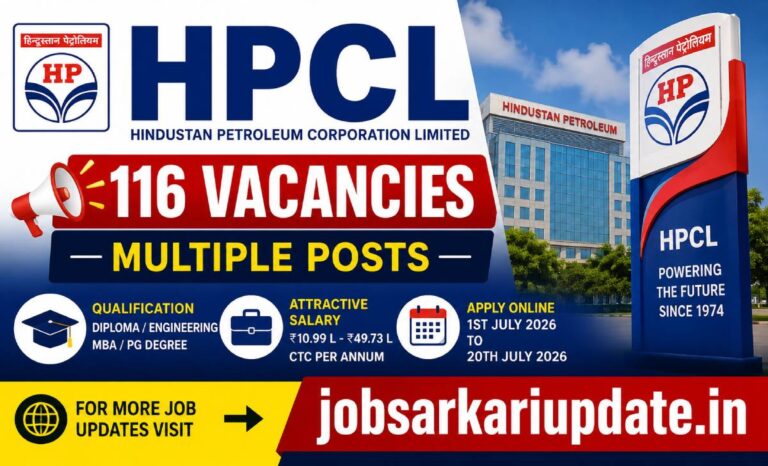
HPCL Officer Recruitment 2026 - Quick Summary: HPCL has released 116 vacancies for Officer positions across freshers and experienced professional...
Read Full Details
Bihar Assistant Professor 2026 - Quick Summary: Bihar State University Service Commission invites applications for contractual Assistant Professor posts in...
Read Full Details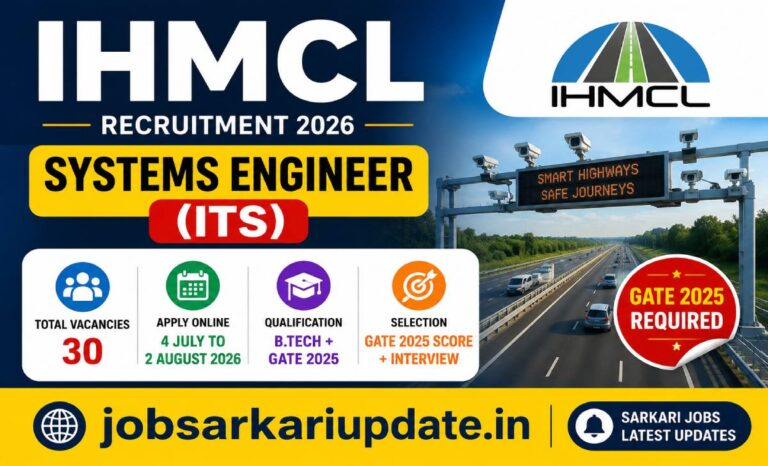
IHMCL Systems Engineer 2026 - Quick Summary: Indian Highways Management Company Limited (IHMCL) invites applications for 30 Systems Engineer (ITS)...
Read Full Details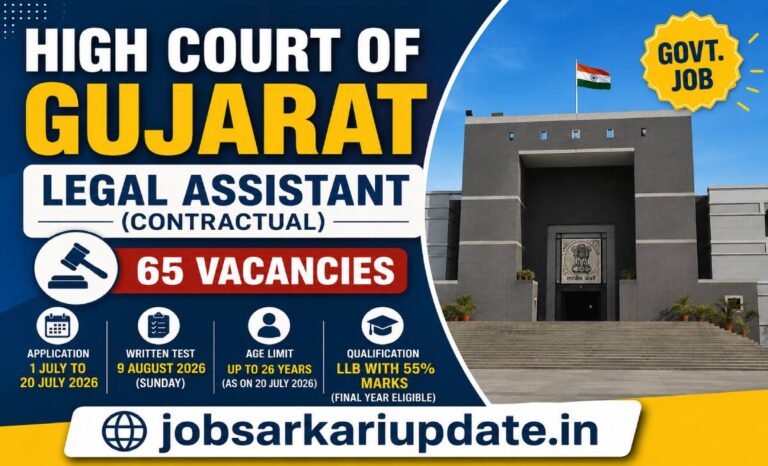
Gujarat High Court Legal Assistant 2026 - Quick Summary: Gujarat High Court invites applications for 65 Legal Assistant posts on...
Read Full Details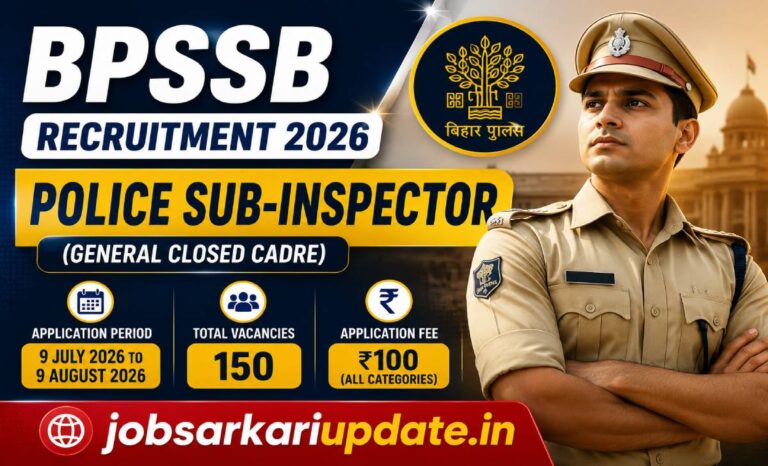
Bihar Police SI Recruitment 2026 - Quick Summary: Bihar Police Subordinate Services Commission has released 150 Sub-Inspector (General Closed Cadre)...
Read Full Details