SVPUAT Meerut Non-Teaching Recruitment 2026 - Quick Summary: Sardar Vallabhbhai Patel University of Agriculture & Technology has released 62 vacancies...
Read Full DetailsUPSSSC Technical Assistant Syllabus 2026 & Exam Pattern
UPSSSC Technical Assistant Syllabus 2026 – Complete Subject-Wise Breakdown
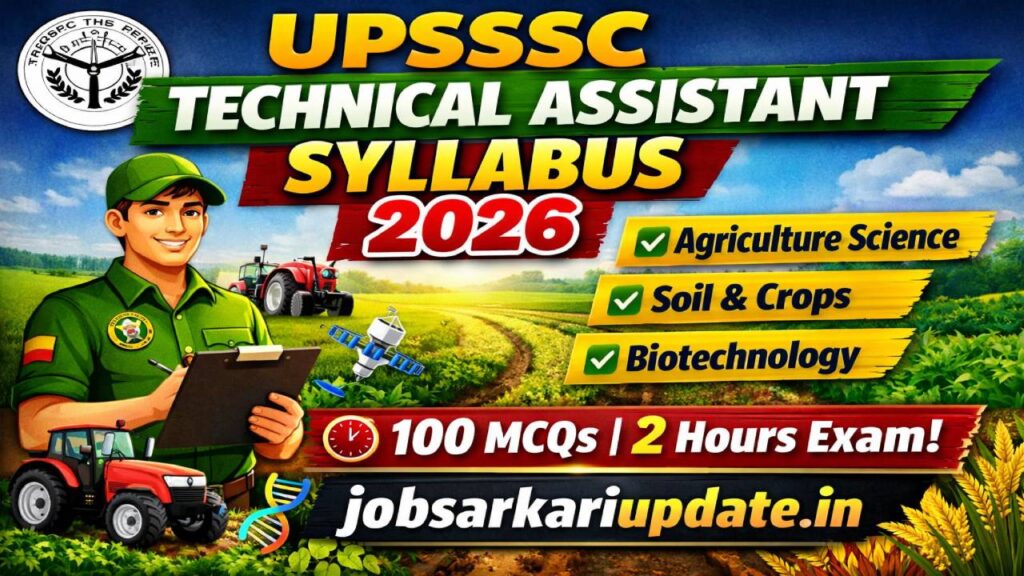
The Uttar Pradesh Subordinate Services Selection Commission (UPSSSC) has officially released the detailed syllabus for the UPSSSC Technical Assistant Group-C Main Examination 2026. This examination is the gateway to 2,759 coveted government posts in the Uttar Pradesh Agriculture Directorate. For candidates who have cleared the PET-2025, understanding the syllabus is the first and most critical step toward success. The UPSSSC Technical Assistant syllabus 2026 is designed to test candidates on a wide range of agricultural sciences, from crop production and soil conservation to modern concepts like biotechnology and information technology.
In this comprehensive guide, we break down the syllabus into manageable sections, provide the latest exam pattern, weightage analysis, and expert preparation tips. Whether you are a fresh graduate or a working professional, this subject-wise guide will help you create a winning study plan. The exam consists of 100 objective questions, with a total duration of 2 hours and a negative marking of 0.25 marks per wrong answer—making accuracy just as important as speed.
UPSSSC Technical Assistant Exam Pattern 2026 (At a Glance)
| Feature | Details |
|---|---|
| Mode of Exam | Offline (OMR-based) / Online (as per UPSSSC decision) |
| Total Questions | 100 |
| Total Marks | 100 |
| Duration | 120 Minutes (2 Hours) |
| Type of Questions | Objective Multiple Choice Questions (MCQs) |
| Negative Marking | 0.25 marks deducted for each wrong answer |
📌 Key Strategy Insight: With negative marking in place, your goal should be to maximize your “net score.” Attempt only those questions you are 90% confident about. In mock tests, practice the art of skipping risky questions. A well-planned 75% accuracy can yield a higher score than a hasty 100% attempt with mistakes.
Subject-Wise Syllabus & Weightage for UPSSSC Technical Assistant 2026
The question paper is divided into three main parts. Part 1 focuses on core agricultural subjects (65 marks), Part 2 on Computer & IT (15 marks), and Part 3 on Uttar Pradesh General Knowledge (20 marks). Let’s explore each section in detail.
📗 Part 1: Core Agricultural Science (65 Marks)
25 Marks 🌾 1. Crop Science
- Classification of crops: cereals, pulses, oilseeds, millets, fiber, cash crops, spices, fodder, fruits, flowers, vegetables grown in Uttar Pradesh.
- Major crop production techniques, agro practices, and post-harvest management (preservation, processing).
- Crop rotation principles, cropping patterns, types of farming: dry farming, integrated farming, natural farming, mono/multiple cropping, intercropping.
- Organic farming: types, socio-economic importance, and role in sustainable agriculture.
- Seed technology: importance, types of seeds, production methods, seed treatment methods and benefits.
- Crop protection: basic principles, major equipment, chemicals used, Integrated Pest Management (IPM).
- Management of major insect pests, diseases of crops.
- Produce storage: principles, systems, factors affecting quality, storage management.
💡 Preparation Tip: This is the highest-scoring section. Focus on state-specific crops grown in Uttar Pradesh and the latest government schemes related to organic farming and crop diversification.
10 Marks 🧬 2. Biotechnology, Plant Breeding & Crop Physiology
- Importance and utility of Biotechnology in agriculture (tissue culture, genetic engineering, biofortification).
- Genetics & Plant Breeding: principles, methods, and importance (hybridization, selection, mutation breeding).
- Crop Physiology: Photosynthesis, respiration, transpiration, plant anatomy, and metabolic processes.
💡 Preparation Tip: Focus on applied aspects—how biotechnology improves crop yield and stress tolerance. Diagrams of plant cell and physiological processes can help in retention.
15 Marks 💧 3. Soil and Water Conservation
- Soil properties, components, formation process, types of soil erosion and conservation techniques.
- Essential plant nutrients, their role and deficiency symptoms.
- Fertilizers: classification, nutrient content, application methods. Integrated Nutrient Management (INM), bio-fertilizers, organic manure.
- Soil microbiology and its role in crop production. Soil survey and sampling methods.
- Irrigation: sources, methods, and importance. Drainage concepts and methods.
- Watershed management principles. Types of pollution and environmental protection.
💡 Preparation Tip: Link soil conservation techniques with current issues like land degradation in Bundelkhand region. Prepare comparative tables for irrigation methods.
5 Marks 📢 4. Agriculture Extension
- Principles of agriculture extension and rural development.
- Extension methodologies: visual aids, audio-visual aids, classification and importance.
- Training: objectives, importance, and types.
- Programs and schemes of Govt. of India & Uttar Pradesh for farmer welfare and rural development (PM-KISAN, Kisan Credit Card, etc.).
💡 Preparation Tip: Stay updated on flagship schemes launched in 2025-2026, especially those related to the “One Trillion Economy” vision for Uttar Pradesh.
5 Marks 📊 5. Agriculture Economics & Schemes
- Role of agriculture in UP’s one-trillion-dollar economy.
- Economic reforms in agriculture sector, concepts of import/export of agricultural produce.
- Formulation of agricultural plans, principles of agricultural statistics.
- Minimum Support Price (MSP) for various crops, agricultural marketing systems.
💡 Preparation Tip: Revise the latest MSP rates for paddy, wheat, sugarcane, and pulses. Understand the significance of APMC markets and e-NAM.
5 Marks 🐄 6. Dairy & Animal Husbandry
- Different breeds of domestic animals, feed management practices.
- Animal breeding: objectives and methods (artificial insemination, etc.).
- Milk production, processing, and distribution systems.
- Poultry farming, fish farming, apiculture (beekeeping), sericulture (silkworm rearing).
- Major diseases of domestic animals: symptoms, diagnosis, and treatment.
💡 Preparation Tip: Focus on indigenous breeds of Uttar Pradesh and government initiatives like the National Livestock Mission.
💻 Part 2: Computer & Information Technology (15 Marks)
🖥️ IT Concepts & Modern Tech
- History, introduction, and applications of Computers, IT, Internet, WWW.
- Hardware & Software, Input & Output devices, Internet Protocol (IP Address).
- IT gadgets and their applications, creating and operating email accounts.
- Printer, Tablet, Mobile operation basics.
- Word Processing (MS-Word) and Excel Processing (MS-Excel) – essential elements.
- Operating Systems, Social Networking, e-Governance concepts.
- Digital Financial Tools, Cyber Security fundamentals, future skills (AI, Big Data, Deep Learning, Machine Learning, IoT) and India’s achievements in tech.
💡 Preparation Tip: This section is scoring if you practice basic computer operations. Create one or two Excel sheets and practice formulas like SUM, VLOOKUP. Stay updated on recent AI developments like ChatGPT and their application in agriculture.
🏛️ Part 3: General Information about Uttar Pradesh (20 Marks)
🇮🇳 UP Special – Culture, History, Economy, Current Affairs
- History: Ancient, medieval, and modern history of Uttar Pradesh (freedom struggle, prominent leaders).
- Culture & Heritage: Art, architecture, festivals, folk dances (Kathak, Nautanki, Raslila), literature, regional languages, heritage sites (Taj Mahal, Varanasi, etc.).
- Geography: Landscape, climate, soil types, forests, wildlife sanctuaries, rivers, minerals, natural resources.
- Economy: Agriculture, industry, MSMEs, business, employment scenario.
- Polity & Administration: Local governance, Panchayati Raj, recent administrative reforms.
- Current Events: Achievements of UP in various fields (sports, infrastructure, digital initiatives), state budgets, recent awards, and state-specific government schemes.
💡 Preparation Tip: This 20-mark section can be a game-changer. Focus on UP-specific current affairs from the last 12–18 months. Refer to reliable UP GK annual compilations. Pay special attention to the “One Trillion Economy” roadmap and agricultural policies of the state.
Strategic Preparation Plan for UPSSSC Technical Assistant 2026
📅 3-Month Study Calendar
- Month 1: Build Foundation – Focus on Crop Science (50% time), Soil & Water Conservation (30%), and basic Computer concepts.
- Month 2: Depth & Practice – Cover remaining subjects (Biotech, Economics, Animal Husbandry, UP GK). Start taking weekly topic-wise tests.
- Month 3: Revision & Mock Tests – Attempt full-length mock tests (at least 10–12). Analyze weak areas and revise accordingly.
📚 Recommended Resources
- NCERT Agriculture textbooks (Class 11 & 12).
- Standard reference: “Principles of Agronomy” by Reddy & Reddy.
- UPSSSC previous year papers (for PET and similar technical exams).
- Monthly current affairs magazines with UP state focus.
- Online mock test series simulating UPSSSC pattern.
🎯 Expert Tip – Prioritize High-Yield Topics: Crop Science (25 marks) and Soil & Water Conservation (15 marks) together account for 40% of the total score. Devote 40% of your preparation time to these two sections. Simultaneously, ensure you do not neglect the 20-mark UP GK section—it often acts as a differentiator in final merit lists.
Mastering Negative Marking & Mock Test Strategy
The official notification clearly states: “There is a provision of negative marking for each wrong answer for the examination, which will be 25 percent i.e. 1/4 of the marks prescribed for that question.” This means every incorrect answer costs you 0.25 marks. While this might seem small, 5 wrong answers effectively cancel out one correct one.
- Safe Attempt Strategy: Aim to attempt 80–85 questions with high accuracy rather than all 100 with guesswork.
- Mock Test Analysis: After each mock test, categorize your mistakes: lack of knowledge, careless reading, or time pressure. Work systematically to reduce each category.
- Simulate Exam Conditions: Take at least 5 full-length mocks in a distraction-free environment with a strict 2-hour timer.
Frequently Asked Questions (UPSSSC Technical Assistant Syllabus & Exam)
- Where can I download the official UPSSSC Technical Assistant Syllabus 2026 PDF?
- The syllabus is part of the official notification available on the UPSSSC website (upsssc.gov.in). The detailed subject-wise topics are also explained in this guide.
- Is the UPSSSC Technical Assistant exam bilingual (Hindi/English)?
- Yes, the question paper is generally set in both Hindi and English languages, unless specified otherwise.
- What is the marking scheme for the Technical Assistant main exam?
- Each question carries 1 mark. There is a negative marking of 0.25 marks for every incorrect answer. Unanswered questions carry no penalty.
- Is the syllabus entirely different from the PET 2025 syllabus?
- Yes. The PET 2025 was a general eligibility test. The Technical Assistant Main Exam syllabus is entirely technical and domain-specific, as detailed above.
- Are practical questions (e.g., calculations, field problems) expected?
- Yes. The exam tests applied knowledge. Questions may include basic calculations related to fertilizer doses, water requirement, or simple economic concepts.
- How many questions will be asked from the Computer section?
- Part 2 (Computer & IT) contains 15 questions worth 15 marks. Topics range from basics to contemporary innovations like AI and IoT.
- Will there be any interview or skill test after the written exam?
- The selection process consists of shortlisting based on PET-2025, a written main examination, and document verification. No interview is mentioned in the notification for this post.
- Can I use a calculator during the exam?
- No. Electronic devices, including calculators, are strictly prohibited inside the examination hall. Rough work is to be done on the provided sheet.
Important Links
| Apply Online | Apply Now |
| Download Notification | Click Here |
| Official Website | Click Here |
Recent Jobs
Check out our latest job postings
661 Jobs Available

HPCL Officer Recruitment 2026 - Quick Summary: HPCL has released 116 vacancies for Officer positions across freshers and experienced professional...
Read Full Details
Bihar Assistant Professor 2026 - Quick Summary: Bihar State University Service Commission invites applications for contractual Assistant Professor posts in...
Read Full Details
IHMCL Systems Engineer 2026 - Quick Summary: Indian Highways Management Company Limited (IHMCL) invites applications for 30 Systems Engineer (ITS)...
Read Full Details
Gujarat High Court Legal Assistant 2026 - Quick Summary: Gujarat High Court invites applications for 65 Legal Assistant posts on...
Read Full Details
Bihar Police SI Recruitment 2026 - Quick Summary: Bihar Police Subordinate Services Commission has released 150 Sub-Inspector (General Closed Cadre)...
Read Full Details