








HSSC CET OMR Sheet 2026 - Quick Summary: HSSC has released the CET-2025 Group-C OMR Sheet on July 4, 2026....
Read Full DetailsUPSSSC Platoon Commander Recruitment 2026 – 295 Vacancy
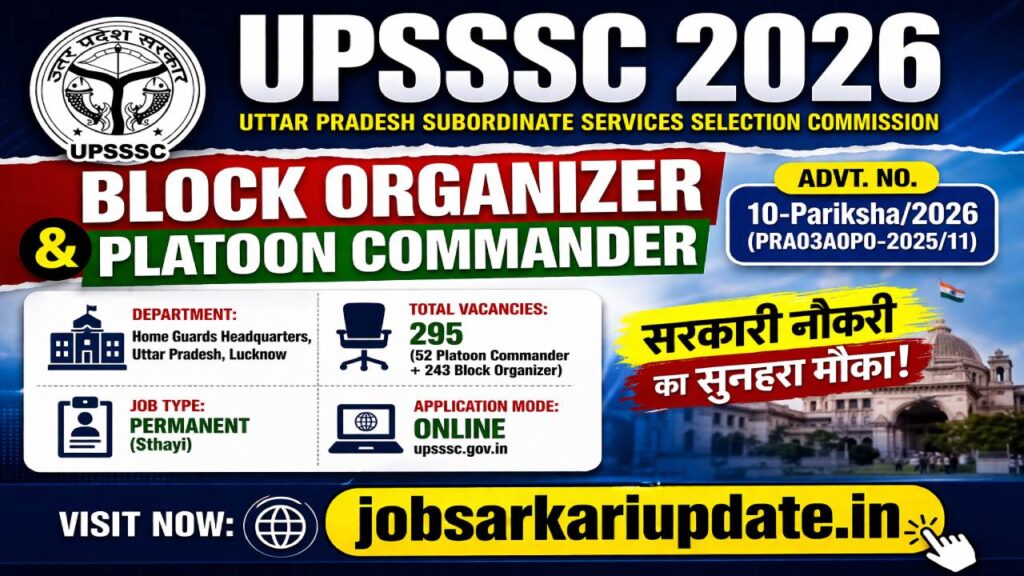
UPSSSC Platoon Commander Block Organizer Recruitment 2026 – 295 Vacancies, Apply Online Before 06 July
The UPSSSC Platoon Commander Block Organizer Recruitment 2026 has officially been announced by Uttar Pradesh Subordinate Services Selection Commission (UPSSSC), Lucknow, through Advertisement No. 10-Pariksha/2026 dated 15 April 2026. Under this notification, a total of 295 posts — comprising 52 Platoon Commander posts and 243 Block Organizer posts — are available under the Home Guards Headquarters, Uttar Pradesh, Lucknow. Both positions are permanent (sthayi) government jobs, offering long-term career security under the Uttar Pradesh State Government.
What makes this recruitment uniquely important is that it is a Main Examination (Mukhya Pariksha) — candidates cannot apply directly unless they have already appeared in the Preliminary Eligibility Test 2025 (PET-2025) conducted by UPSSSC and hold a valid Score Card issued by the Commission. This is a two-stage selection system, and only PET-2025 qualified candidates with non-zero or non-negative normalised scores are eligible to apply for this main exam. If you have your PET-2025 score card, this notification published in April 2026 is your direct gateway to a Class Group-C state government position.
With 243 Block Organizer vacancies at Pay Level-5 and 52 Platoon Commander vacancies at Pay Level-6, the competition will be significant — particularly for the Block Organizer post, which has far more seats. Candidates who apply early, prepare systematically for the written exam, and maintain the required physical standards will have the strongest shot at selection. The application window opened on 16 June 2026 and closes on 06 July 2026.
Recruitment Overview
UPSSSC is one of the most active and credible state-level recruitment commissions in India, responsible for filling thousands of Group-C posts under the Uttar Pradesh government each year. Its PET-based two-stage recruitment system, introduced in recent years, has brought greater transparency and merit-based selection to UP government hiring. The Home Guards Headquarters under which these posts fall is a recognised law enforcement and civil defence organisation — making the Platoon Commander and Block Organizer roles both prestigious and socially impactful positions. Candidates selected through this process will be permanent state employees entitled to full Pay Matrix benefits, promotions, pension, and other government service perks.
| Detail | Information |
|---|---|
| Organisation Name | Uttar Pradesh Subordinate Services Selection Commission (UPSSSC) |
| Advertisement Number | 10-Pariksha/2026 (Advt. No. PRA03A0P0-2025/11) |
| Department | Home Guards Headquarters, Uttar Pradesh, Lucknow |
| Posts Advertised | Block Organizer (Block Aarganaizar) & Platoon Commander (Platoon Kamander) |
| Total Vacancies | 295 (52 Platoon Commander + 243 Block Organizer) |
| Job Type | Permanent (Sthayi) |
| Application Mode | Online (upsssc.gov.in) |
| Notification Date | 15 April 2026 |
| PET Prerequisite | PET-2025 Score Card is mandatory for all applicants |
| Selection Basis | Written Examination (Main Exam) → Physical Standards Test → Physical Efficiency Test → Document Verification |
Important Dates
Candidates must note that this recruitment follows a strict, non-negotiable timeline. The fee payment and application submission deadline of 06 July 2026 is absolute — no applications or fees will be accepted after this date under any circumstances, and UPSSSC has explicitly stated that no representation will be entertained post-deadline. Additionally, candidates have a grace window of 7 days beyond the last date (until 13 July 2026) to complete bank fee reconciliation, and during this grace period they may also amend permissible fields in their application. Printing the application form before 13 July 2026 is critical — after fee reconciliation closes, the application cannot be printed. Apply in the first week of opening (16–23 June 2026) to avoid technical issues and give yourself time to fix any errors.
| Event | Date |
|---|---|
| Notification Publication Date | 15 April 2026 |
| Online Application & Fee Payment Start Date | 16 June 2026 |
| Last Date for Application Submission & Fee Payment | 06 July 2026 |
| Last Date for Fee Reconciliation & Application Amendment | 13 July 2026 |
| Written (Main) Exam Date | To be notified via Admit Card / Official Website |
| Physical Standards & Efficiency Test Date | To be notified after Written Exam result |
| Result Date | Not mentioned in official notification |
Note: All dates are subject to change by UPSSSC. Always verify from the official website upsssc.gov.in before taking any action. Any corrigendum will be published on the official website only — no separate press advertisement will be issued.
Application Fee
The fee structure for this UPSSSC Main Exam is straightforward and notably low — the actual application fee for all categories is ₹0 (zero), with only an online processing charge of ₹25 applicable across all categories. Payment can be made through Credit Card, Debit Card, Internet Banking, UPI, or via SBI e-challan at any SBI branch. No other payment modes are accepted. A common and critical mistake candidates make with SBI e-challan payments is not completing the reconciliation step after branch payment — the application form is only auto-submitted after fee reconciliation is confirmed on the portal. If your payment is successful but the form is not showing as submitted, use the “Update Your Transaction ID by Double Verification” option in the Applicant Segment on the UPSSSC homepage to complete the reconciliation manually.
Also note: the Main Exam fee is separate and will be collected only from candidates shortlisted for the Main Exam, before their admit card is made available. Do not confuse the current registration fee with the Main Exam fee.
| Category | Application Fee | Online Processing Charge | Total Payable |
|---|---|---|---|
| Unreserved (General) | ₹0 | ₹25 | ₹25 |
| Other Backward Class (OBC) | ₹0 | ₹25 | ₹25 |
| Scheduled Caste (SC) | ₹0 | ₹25 | ₹25 |
| Scheduled Tribe (ST) | ₹0 | ₹25 | ₹25 |
| Freedom Fighter Dependant / Ex-Serviceman / Women / PwD / Outstanding Sportsperson | Fee as per their original/main category (rows 1–4 above) | ₹25 | |
Payment Mode: Credit Card / Debit Card / Internet Banking / UPI / SBI e-Challan only. No cash or other modes accepted. Fee once paid is non-refundable.
Age Limit
The age limit for both posts is calculated based on the year in which the vacancy is advertised. For posts advertised between 1 January and 30 June, the candidate’s age is reckoned as on 1 January of that year. For posts advertised between 1 July and 31 December, the age cutoff is 1 July of that year. The minimum age is 21 years and the maximum is 40 years for the General/UR category. Standard UP Government relaxation rules apply for reserved categories. Additionally, candidates who are serving Home Guards members (informal/avaitanik) and have served at least 3 years in that capacity are eligible for an upper age relaxation of 2 years, provided they are currently active.
Simple calculation example: If you were born on 15 March 1986, your age on 1 January 2026 (the likely reference date for this notification advertised in Jan–June period) would be 39 years 9 months — within the 40-year upper limit for UR. An OBC candidate born on 15 March 1983 would qualify with the 3-year relaxation (effective upper limit 43 years).
| Category | Minimum Age | Maximum Age | Age Relaxation |
|---|---|---|---|
| Unreserved (UR / General) | 21 Years | 40 Years | Nil |
| OBC (Non-Creamy Layer) | 21 Years | 40 Years | +3 Years (as per GoUP norms) |
| Scheduled Caste (SC) | 21 Years | 40 Years | +5 Years (as per GoUP norms) |
| Scheduled Tribe (ST) | 21 Years | 40 Years | +5 Years (as per GoUP norms) |
| EWS (Economically Weaker Section) | 21 Years | 40 Years | As per GoUP norms |
| Home Guards (avaitanik / serving, min. 3 yrs) | 21 Years | 40 Years | +2 Years additionally |
| State Govt. Employees (Rajyadhin Sevaon ke karmchari) | 21 Years | 40 Years | +5 Years (as per GoUP notification) |
| CM Fellowship (Mukhyamantri Adhyetavritti) candidates | 21 Years | As per GoUP Niyamavali 2026 | Special relaxation as notified |
Eligibility Criteria
The eligibility for both posts is governed by the Uttar Pradesh Home Guards Service Rules, 1982 (Part-4, Rule-8). The essential educational qualification for both Block Organizer and Platoon Commander is a Bachelor’s degree (Graduation) from any recognised university. Importantly, the notification specifies this is for non-departmental (non-ministerial) candidates — departmental employees may receive preferential treatment. There is also a desirable (adhimani) qualification: candidates who have served in the Provincial Armed Constabulary (PAC) for at least two years, OR who hold an NCC ‘B’ Certificate, OR who have served continuously for at least three years in the Home Guards organisation will be given preference in the event of a tie in the final merit list.
The most common eligibility mistake candidates make here is assuming that any PET-2025 score is sufficient. The notification is clear: candidates who scored zero (absolute) or negative (normalised) in PET-2025 are not eligible to apply. Your PET-2025 normalised score must be a positive number, and you must have received a Score Card from UPSSSC. Shortlisting for the Main Exam is based on PET-2025 normalised scores — up to 15 times the number of vacancies (per category) are shortlisted for the written exam.
| Post Name | Essential Qualification | Desirable Qualification | PET Prerequisite |
|---|---|---|---|
| Block Organizer (Ek Organizer) | Graduation from any recognised university (Non-Departmental candidates) | PAC service ≥ 2 years OR NCC ‘B’ Certificate OR Home Guards service ≥ 3 consecutive years | PET-2025 valid Score Card with positive normalised score |
| Platoon Commander (Platoon Kamander) | Graduation from any recognised university (Non-Departmental candidates) | PAC service ≥ 2 years OR NCC ‘B’ Certificate OR Home Guards service ≥ 3 consecutive years | PET-2025 valid Score Card with positive normalised score |
Vacancy Details – Category-Wise Breakdown
The 295 total vacancies are distributed across two posts under the Home Guards Headquarters, UP, Lucknow. The Block Organizer post with 243 vacancies is by far the larger opportunity, offering nearly five times more seats than the Platoon Commander post (52 seats). From a category perspective, UR candidates have the highest absolute vacancy count across both posts. OBC and SC candidates also have a significant share. The horizontal reservation (क्षैतिज आरक्षण) provides 04 vacancies for freedom fighters’ dependants and physically challenged (specified sub-categories) candidates in Block Organizer, and 01 in Platoon Commander. Women candidates have 48 reserved slots in Block Organizer and 10 in Platoon Commander. Additionally, 60 posts in Block Organizer and 13 posts in Platoon Commander are reserved for Home Guards volunteers under the 25% horizontal quota for direct recruitment as per the Home Guards service rules.
| Post Name | Pay Level | UR | OBC | SC | ST | EWS | Total | Nature |
|---|---|---|---|---|---|---|---|---|
| Block Organizer | Level-5 | 98 | 48 | 02 | 71 | 24 | 243 | Permanent |
| Platoon Commander | Level-6 | 23 | 11 | 01 | 12 | 05 | 52 | Permanent |
| Total | — | 121 | 59 | 03 | 83 | 29 | 295 | Permanent |
| Post | Freedom Fighter Dependant / Specified PwD | Ex-Serviceman / Former Military | Women Candidates | Outstanding Sportsperson |
|---|---|---|---|---|
| Block Organizer | 04 | — | 48 | 04 |
| Platoon Commander | 01 | — | 10 | 01 |
Home Guards Quota: As per UP Home Guards rules, 25% of direct recruitment seats are reserved for serving Home Guards volunteers with a current district commandant certificate — 60 posts in Block Organizer and 13 posts in Platoon Commander fall under this quota. Candidates in this category must hold a valid certificate from their district commandant.
Selection Process
The selection for UPSSSC Platoon Commander and Block Organizer 2026 follows a multi-stage process. Unlike many direct recruitment exams, this process has a compulsory physical dimension in addition to the written test — making it physically and academically demanding. The final merit list is prepared based solely on the marks secured in the Written (Main) Examination. Physical tests are qualifying in nature (pass/fail), not merit-adding.
Stage 1 – PET-2025 Score Shortlisting
Only candidates with a valid PET-2025 Score Card and a positive normalised score are eligible. UPSSSC shortlists candidates for the Main Exam at 15 times the number of category-wise vacancies, based on PET-2025 normalised scores (up to 2 decimal places). Candidates with the same score at the cut-off mark are all included. This is your first filter — if your PET score was zero or negative, you cannot proceed.
Stage 2 – Written Examination (Main Exam / Mukhya Pariksha)
The main written examination consists of a single paper with 100 objective-type multiple-choice questions, to be completed in 2 hours (120 minutes). Total marks: 100. There is a negative marking penalty of 25% (i.e., ¼ mark deducted for each wrong answer). The exam will be conducted by UPSSSC and the date will be communicated through the admit card. Scoring high in this exam is the primary determinant of your final selection, so start subject-wise preparation from Day 1 of applying. For a detailed syllabus, see Section 9 below.
Stage 3 – Physical Standards Test (Sharirik Mapdand)
Candidates shortlisted after the Written Exam must appear for a Physical Standards Test, which is qualifying in nature. The physical standards differ by gender and category — see the detailed table in the Eligibility section. Failure to meet these standards results in disqualification regardless of your written exam score. Begin regular physical training alongside your exam preparation to avoid a situation where a strong written score goes to waste due to failing the physical round.
Stage 4 – Physical Efficiency Test (Sharirik Dakshata Pariksha)
Candidates who clear the Physical Standards Test must complete a timed running test — 4.8 km in 25 minutes for male candidates, and 2.4 km in 14 minutes for female candidates. Failure to complete the run within the stipulated time results in disqualification. This test is also qualifying (not merit-based). Start cardiovascular training and stamina building at least 4–6 weeks before your expected physical test date to ensure consistent performance.
Stage 5 – Document Verification
Candidates who clear all previous stages must present original documents for verification as specified. Any mismatch between documents and application data, or failure to produce required certificates, results in cancellation of candidature. Begin gathering all original documents — educational certificates, caste certificates, EWS certificate (valid for FY 2025-26), PET Score Card, and any reservation-category proof — well before your expected document verification date.
This is a demanding but deeply rewarding selection process. The combination of written preparation, physical fitness, and meticulous documentation management is what separates successful candidates from unsuccessful ones. Treat all five stages as equally important — candidates who neglect any one stage often reach a later stage only to be disqualified for something avoidable.
Exam Syllabus & Pattern (Main Written Examination)
The official syllabus and exam pattern for this Main Examination are fully detailed in the notification. The exam has 100 questions for 100 marks in 120 minutes, divided into three parts. There is negative marking of 25% (¼ mark) for every wrong answer. All questions are objective-type and multiple-choice. Below is the complete, notification-accurate syllabus — do not rely on any outside source.
Exam Pattern
| Part | Subject | No. of Questions | Total Marks | Time Period |
|---|---|---|---|---|
| Part-1 | 1. History of India and Indian National Movement | 05 | 05 | 2 Hours (120 Minutes) Combined |
| 2. Indian Polity and Indian Constitution | 10 | 10 | ||
| 3. Geography of India and World | 05 | 05 | ||
| 4. Indian Economy and Social Development | 10 | 10 | ||
| 5. Current Events of National and International Importance | 05 | 05 | ||
| 6. Sports in India | 05 | 05 | ||
| 7. Human Anatomy | 05 | 05 | ||
| 8. Environmental Ecology and Disaster Management | 10 | 10 | ||
| 9. Data Interpretation | 10 | 10 | ||
| Part-2 | Knowledge of Concepts of Computer & IT, Contemporary Technological Development & Innovation | 15 | 15 | |
| Part-3 | General Information related to the State of Uttar Pradesh | 20 | 20 | |
| Total | 100 | 100 | 120 Min | |
Subject-Wise Syllabus
Part-1: General Studies Subjects
(1) History of India and Indian National Movement
Social, cultural, economic and political aspects of Indian history. The Indian National Movement — the freedom struggle, rise of nationalism, and the attainment of independence.
(2) Indian Polity and Indian Constitution
Constitutional development in India, the Indian Constitution, Indian political system and governance, Panchayati Raj and local self-governance, public policy and official issues, community development.
(3) Geography of India and World
Physical, social and economic geography of India — agriculture, horticulture, forestry, animal husbandry, population and urbanisation patterns, Smart Cities and Smart Villages. General knowledge of world geography.
(4) Indian Economy and Social Development
Economic planning, objectives and achievements in India, role of NITI Aayog, Sustainable Development Goals (SDGs), government budget components and financial system. Development of agriculture, industry and trade commerce. Land reforms post-independence. Effects of globalisation and liberalisation. Industrial policy changes and their impact. Infrastructure — power, ports, roads, airports, railways etc.
(5) Current Events of National and International Importance
Knowledge of recent events at both national and international level.
(6) Sports in India
Rules and general information on sports like athletics, judo, kabaddi, volleyball, badminton, wrestling, weightlifting, football, swimming, kho-kho etc. Efforts and achievements in promoting sports in India.
(7) Human Anatomy
Elementary knowledge of cells, tissues, organs and organ systems, bones, muscles, nerves and blood vessels. Structure and functions of organs of taste, smell, hearing, sight, vision, and feeling (touch).
(8) Environmental Ecology and Disaster Management
Environmental protection, ecosystems, wildlife conservation, biodiversity, environmental pollution and degradation, environmental impact assessment, climate change. Disaster Management Act-2005, NDMA, SDMA, NDRF, SDRF. Efforts at the global level for disaster mitigation and management.
(9) Data Interpretation
Interpretation and analysis of data. Statistical Analysis — graphs and diagrams to test the candidate’s ability to draw general knowledge conclusions from information presented in statistical and graphical form.
Part-2: Computer & Information Technology
- History, introduction and application of Computer, Information Technology, Internet and World Wide Web (WWW)
- Hardware and Software; Input and Output; Internet Protocol / IP Address
- IT gadgets and their applications
- Creation of e-mail ID and use/operation of e-mail; operation of Printer, Tablet and Mobile
- Important elements of Word Processing (MS-Word) and Excel Processing (MS-Excel)
- Operating System, Social Networking, e-Governance
- Digital Financial Tools and Applications; Future Skills and Cyber Security
- Technological Development and Innovation in Computer and IT — AI, Big Data Processing, Deep Learning, Machine Learning, Internet of Things (IoT) and India’s achievements in this field
Part-3: General Information related to Uttar Pradesh
History, culture, art, architecture, festivals, folk dances, literature, regional languages, heritage, social customs, tourism, geographical landscape and environment, natural resources, climate, soil, forests, wildlife, mines and minerals, economy, agriculture, industry, business and employment, polity and administration, current events and achievements of Uttar Pradesh State in various fields.
Preparation Tips Based on Actual Syllabus
Tip 1 – Prioritise UP GK (20 marks): Part-3 has the highest single-section weightage at 20 questions. Make UP-specific history, culture, geography, and current events your strongest subject — read UP Samsamayiki monthly magazines and follow UP government press releases regularly.
Tip 2 – Score big on Polity + Economy (20 marks): Together, Indian Polity and Indian Economy account for 20 questions. Use standard NCERT textbooks (Class 9–12) and practice previous year UPSSSC papers for these sections.
Tip 3 – Do not underestimate Data Interpretation (10 marks): The Data Interpretation section tests graph and table reading skills — these are learnable with practice. Dedicate at least 30 minutes daily to DI exercises and you can score near-perfect marks in this section.
Tip 4 – Computer section is entirely practical knowledge (15 marks): Focus on MS-Word, MS-Excel, Internet basics, cyber security, and AI/ML concepts in simple terms. There are excellent free resources on YouTube for UP exam-oriented IT preparation.
Tip 5 – Negative marking caution: With ¼ mark negative marking, avoid blind guessing. If you can eliminate 2 out of 4 options, attempt the question. If completely unsure, skip it — a wrong answer here costs 0.25 marks, which compounds significantly over 20–30 uncertain questions.
Salary & Pay Scale
Both posts are permanent government positions in the Uttar Pradesh State Pay Matrix. Block Organizer falls at Pay Level-5 and Platoon Commander at Pay Level-6 — making the Platoon Commander a higher-paying and higher-responsibility role. The salary figures below reflect the 7th Pay Commission Pay Matrix with current Dearness Allowance (DA) estimates for Uttar Pradesh. In addition to basic pay, employees receive House Rent Allowance (HRA), Travel Allowance (TA), and other applicable allowances as per UP government service rules. The estimated gross (in-hand) salary after standard deductions like NPS contribution (10% of basic), and applicable taxes, would typically be 75–80% of the gross figure — making the Platoon Commander role one of the most attractive Group-C positions in the state.
| Post Name | Pay Level | Basic Pay (Minimum) | Basic Pay (Maximum) | Estimated Gross Salary (Approx.) |
|---|---|---|---|---|
| Block Organizer | Level-5 | ₹29,200 / month | ₹92,300 / month | ₹38,000 – ₹50,000 / month (with DA + HRA) |
| Platoon Commander | Level-6 | ₹35,400 / month | ₹1,12,400 / month | ₹46,000 – ₹60,000 / month (with DA + HRA) |
Career Growth Note: Both positions are permanent state government posts with defined promotion pathways within the Home Guards and civil administration structure of Uttar Pradesh. Employees are entitled to annual increments, periodic DA revisions, and pension benefits under the New Pension Scheme (NPS) as applicable to UP state government employees.
Physical Standards & Physical Efficiency Test
Both Block Organizer and Platoon Commander candidates are subject to mandatory physical standards tests as per the UP Home Guards Service Rules, 1982. Physical measurement and efficiency tests are qualifying in nature — failure at this stage means disqualification regardless of written exam merit. Candidates are advised to begin physical training well before the exam date so that they have several months to build the required fitness levels. The physical standards are the same for both posts.
Physical Standards (Sharirik Mapdand) – Male Candidates
| Measurement | General / OBC / SC | Hill Region Candidates | Scheduled Tribe (ST) |
|---|---|---|---|
| Height | 167.7 cm (minimum) | 162.6 cm (minimum) | 160 cm (minimum) |
| Chest (without expansion) | 78.8 cm (minimum) | 76.5 cm (minimum) | 76.5 cm (minimum) |
| Chest (with expansion) | 83.8 cm (minimum) | 81.5 cm (minimum) | 81.5 cm (minimum) |
Physical Standards – Female Candidates
| Measurement | General / OBC / SC | Hill Region / ST |
|---|---|---|
| Height | 152 cm (minimum) | 147 cm (minimum) |
| Chest / Weight | Not mentioned in official notification. Candidates are advised to check the official notice for updates. | |
Physical Efficiency Test (Sharirik Dakshata Pariksha)
| Candidate Type | Running Distance | Time Limit |
|---|---|---|
| Male Candidates | 4.8 km | 25 Minutes |
| Female Candidates | 2.4 km | 14 Minutes |
Disqualification Rule: Failure to complete the running distance within the stipulated time results in immediate disqualification from the selection process. The physical efficiency test is qualifying (not merit-adding). All candidates must be mentally and physically healthy and must be free of any condition that would prevent active physical service.
How to Apply Online – Step by Step
Applications must be submitted exclusively through the UPSSSC official website upsssc.gov.in. No other mode of application is accepted. Candidates log in using their PET-2025 Registration Number and an OTP sent to their registered mobile number or email. The entire application can be completed in a single session — have all required documents and information ready before you begin. Applications open from 16 June 2026 and close on 06 July 2026 at 5:00 PM.
Pre-Application Checklist
Keep the following ready before opening the application portal:
- PET-2025 Registration Number (for login)
- Registered Mobile Number / Email (for OTP)
- Photograph and Signature (as uploaded during PET-2025 — these will be auto-populated)
- Caste Certificate – SC/ST (if applicable)
- OBC (Non-Creamy Layer) Certificate (if applicable, issued within 6 months from a competent authority)
- EWS Certificate (if applicable – based on FY 2025-26 income, valid for FY 2026-27; issued between 01-04-2026 and 06-07-2026)
- Home Guards Service Certificate from District Commandant (if claiming Home Guards quota or age relaxation)
- Outstanding Sportsperson Certificate (if applicable, from competent authority as per prescribed format)
- Disability Certificate (if applicable — in prescribed format from Parishisht-6/7/8/9)
- Freedom Fighter Dependant Certificate (if applicable — as per Parishisht-5)
- NCC ‘B’ Certificate (if claiming desirable qualification preference)
- Visit upsssc.gov.in and go to the Live Advertisement Segment — Find Advertisement No. 10-Pariksha/2026 and click to open it. Read the notification completely before proceeding.
- Login via PET-2025 Registration Number — On the Applicant’s Dashboard, enter your PET-2025 Registration Number. An OTP will be sent to your registered mobile number or email for authentication.
- Verify auto-populated personal information — Your name, parents’ names, date of birth, address, category (EWS, caste reservation), gender, marital status, and contact details from PET-2025 will be displayed automatically. Verify all details carefully.
- Select the post(s) you are applying for — Choose Block Organizer or Platoon Commander (or both if eligible). Indicate your post preference (variyata) as required. Remember: only one application is to be submitted for advertised posts.
- Fill in educational qualification and desirable qualification details — Enter your graduation details (board/university name, year of passing, roll number, percentage), certificate details, and the Yes/No option for desirable/adhimani qualification. Update your Divyangta category if applicable (mandatory per state guidelines).
- Enter Verification Code and click Submit — After completing all sections, enter the verification code shown on screen and click the “Sambit” (Submit) button. Your 11-digit registration number application form will be displayed. Download and print it.
- Pay the application fee — Pay ₹25 via Credit/Debit Card, Internet Banking, UPI, or SBI e-Challan. After successful payment and reconciliation, your form is finally submitted. Download and print your final application immediately — do not wait until the last date.
3 Most Common Application Mistakes to Avoid
- Submitting the application without completing fee reconciliation — your form is not submitted until the fee is successfully reconciled, even if the OTP and verification steps are done.
- Selecting the wrong post preference order — your variyata (preference) for Block Organizer vs Platoon Commander directly affects how UPSSSC allocates your candidature; read the preference section carefully.
- Not printing the submitted application form before 13 July 2026 — after the fee reconciliation deadline, the form cannot be downloaded or printed.
Important Instructions for Candidates
- Only UP domicile candidates are eligible for reservation benefits — candidates from other states will be treated as Unreserved (UR).
- Candidates claiming multiple reservation categories are entitled to only one relaxation — whichever is more beneficial.
- Women candidates in UP will be placed in the sub-categories of their original caste (SC/OBC/UR etc.) — a father’s side caste certificate is the only acceptable proof for female candidates’ caste claims.
- Candidates serving in Central or State Government must obtain a No-Objection Certificate (NOC) from their employer to participate in this recruitment.
- A candidate’s application can be amended only for permissible fields (address, EWS category, Divyangta sub-category, marital status, educational qualification details) up to 13 July 2026 — no other changes are allowed after submission.
- UPSSSC does not give individual communication — check the official website regularly for all updates on exam dates, admit cards, and results.
- All dates mentioned are from the official notification and are subject to change — verify from upsssc.gov.in before acting.
- This content is published for informational purposes only and does not constitute official communication from UPSSSC.
Expert Tips to Crack UPSSSC Platoon Commander Block Organizer Recruitment 2026
Apply in the First Week of Opening
The application window opens on 16 June 2026 and closes on 06 July 2026 — a window of only 20 days. Unlike some recruitments with 60-day windows, this is a tight timeline that sees massive portal congestion in the final 3 days. Submitting your application between 16–23 June gives you time to verify the submission, resolve any payment reconciliation issues, and still make permissible amendments before 13 July 2026. Candidates who wait until the last two days regularly face server errors, failed transactions, and missed deadlines — risks that are entirely avoidable.
Read the Full Notification Before Applying
The UPSSSC notification for this Main Exam is a 32-page document that includes specific conditions for Home Guards quota candidates, horizontal reservation rules, Divyangta category update requirements, and detailed physical standards that are different by gender and region. Many candidates read only the first page summary and proceed to apply — then discover at the document verification stage that they don’t meet a specific sub-condition. Invest 45 minutes reading the full notification from cover to cover before filling the form.
Prepare All Documents Before Starting the Application
Several document requirements in this notification are time-sensitive: the EWS certificate must be issued between 01 April 2026 and 06 July 2026, and the OBC (NCL) certificate must be current (within 6 months). If you are claiming EWS reservation and don’t yet have a valid certificate for FY 2025-26, apply for it at your Tehsildar’s office immediately — the process can take 2–4 weeks in some areas, and you cannot submit the certificate after the application deadline. Waiting until the last week of June to discover your EWS certificate is expired is an avoidable disaster.
Start Physical Training from Day One
With the written exam likely to be held a few months after the application closes, you have a window to build physical fitness simultaneously with academic preparation. Male candidates need to run 4.8 km in 25 minutes — roughly a 5 min 12 sec per km pace. For candidates who currently run 7–8 minutes per km, achieving this target requires consistent structured training over 8–12 weeks. Begin with a 30-minute jogging routine three days a week and progressively build pace and distance. Do not leave physical preparation for the last month before the physical test date.
Avoid the Most Common Rejection Reasons
Based on UPSSSC’s own instruction clauses, the leading disqualification triggers are: submitting applications with incomplete or false information (which can lead to permanent debarment from all UPSSSC exams), OBC certificates beyond 6 months old, EWS certificates not covering the current financial year, and candidates from other states claiming UP reservation benefits. Additionally, candidates who fail to update their Divyangta (disability) category in the application as per the recent UP government orders will face issues at document verification. Double-check every reservation and relaxation claim against the actual rules before submission.
Stay Updated on Exam Dates, Admit Card, and Results
UPSSSC does not send individual communications to candidates — all updates, including exam dates, admit card release, and result publication, are posted exclusively on upsssc.gov.in. Bookmark the website and check it at least twice a week after submitting your application. Downloading and printing your admit card as soon as it is released — not on the day of the exam — is crucial. Many candidates discover last-minute printing or photo mismatch issues on the exam day itself, which can result in denial of entry at the exam centre. Plan well ahead and keep all exam documents ready at least 2 days before the exam.
Frequently Asked Questions (FAQs)
- Q1. How many total vacancies are there in UPSSSC Platoon Commander Block Organizer Recruitment 2026?
- A total of 295 vacancies have been announced — 52 for Platoon Commander (Pay Level-6) and 243 for Block Organizer (Pay Level-5). Both posts are permanent (sthayi) government jobs under Home Guards Headquarters, UP, Lucknow.
- Q2. Is PET-2025 compulsory for applying to this recruitment?
- Yes, absolutely. Only candidates who appeared in UPSSSC PET-2025 and have been issued a valid Score Card with a positive normalised score are eligible to apply. Candidates who scored zero or negative marks in PET-2025 are not eligible.
- Q3. What is the educational qualification required for Block Organizer and Platoon Commander?
- A Bachelor’s degree (Graduation) from any recognised university is the essential educational qualification for both posts. Desirable qualifications include PAC service of 2+ years, NCC ‘B’ Certificate, or 3+ years of continuous Home Guards service.
- Q4. What is the age limit for UPSSSC Platoon Commander Recruitment 2026?
- The minimum age is 21 years and the maximum is 40 years for the General/UR category. SC/ST candidates get up to 5 years relaxation and OBC (NCL) candidates get 3 years relaxation as per UP Government norms. Serving Home Guards members with 3+ years of service get an additional 2 years relaxation.
- Q5. What is the application fee for UPSSSC Block Organizer Recruitment 2026?
- The application fee is ₹0 for all categories. Only an online processing charge of ₹25 is applicable for all candidates including UR, OBC, SC, ST, EWS, Women, Ex-Servicemen, and PwD.
- Q6. What is the last date to apply for UPSSSC Platoon Commander 2026?
- The last date for online application submission and fee payment is 06 July 2026. The last date for fee reconciliation and permissible application amendment is 13 July 2026. No application will be accepted after these dates under any circumstances.
- Q7. What is the selection process for UPSSSC Block Organizer 2026?
- The selection process has five stages: PET-2025 shortlisting → Written Main Examination (100 marks, 120 minutes) → Physical Standards Test (height, chest measurement) → Physical Efficiency Test (running) → Document Verification. The final merit list is based only on the Written Exam score. Physical tests are qualifying (pass/fail).
- Q8. Is there negative marking in the UPSSSC Platoon Commander written exam?
- Yes. There is a negative marking of 25% (i.e., ¼ mark) for every wrong answer. Each correct answer carries 1 mark, and each wrong answer deducts 0.25 marks. Unanswered questions carry no penalty.
- Q9. What is the salary for Block Organizer and Platoon Commander posts?
- Block Organizer falls at Pay Level-5 with basic pay ranging from ₹29,200 to ₹92,300 per month. Platoon Commander falls at Pay Level-6 with basic pay from ₹35,400 to ₹1,12,400 per month. With DA, HRA, and other allowances, the gross salary is estimated at ₹38,000–₹50,000 for Block Organizer and ₹46,000–₹60,000 for Platoon Commander.
- Q10. What are the physical standards for male candidates in UPSSSC Platoon Commander Recruitment 2026?
- For General/OBC/SC male candidates: minimum height 167.7 cm, chest without expansion 78.8 cm, chest with expansion 83.8 cm. For Hill region candidates: height 162.6 cm, chest 76.5–81.5 cm. For ST candidates: height 160 cm, chest 76.5–81.5 cm. Male candidates must also complete a 4.8 km run in 25 minutes.
- Q11. Can final-year graduation students apply for UPSSSC Block Organizer 2026?
- The notification requires candidates to possess the essential qualification (Graduation) by the application deadline of 06 July 2026. Final-year students who have not yet received their final result or degree certificate may not meet this requirement. Candidates are advised to verify their eligibility from the official notification before applying.
- Q12. Where will the admit card and exam date be published for UPSSSC Platoon Commander 2026?
- All information including the exam date, admit card, result, and cut-off will be published exclusively on the official UPSSSC website upsssc.gov.in. UPSSSC does not send individual communications to candidates. Regularly check the website and note that no separate press advertisements will be issued for updates.
Important Links
| Apply Online | Apply Now |
| Download Notification | Click Here |
| Official Website | Click Here |
Recent Jobs
Check out our latest job postings
815 Jobs Available
Delhi Police Physical Admit Card 2026 - Quick Summary: Delhi Police has released new dates for Physical Endurance & Measurement...
Read Full Details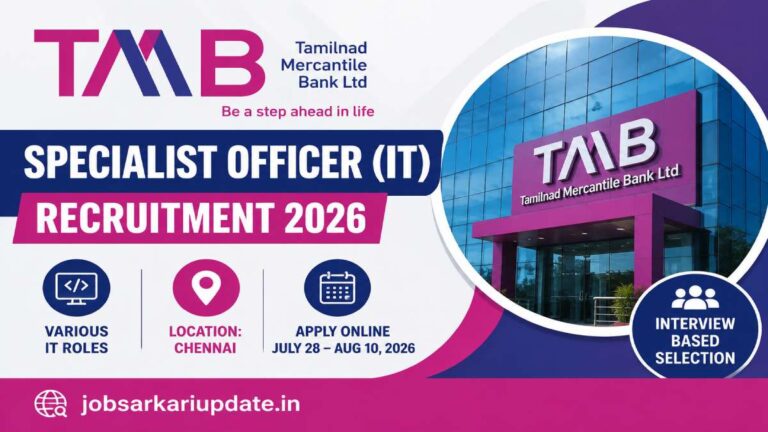
TMB Specialist Officer 2026 - Quick Summary: Tamilnad Mercantile Bank has released notification for Specialist Officer (IT) vacancies in Chennai....
Read Full Details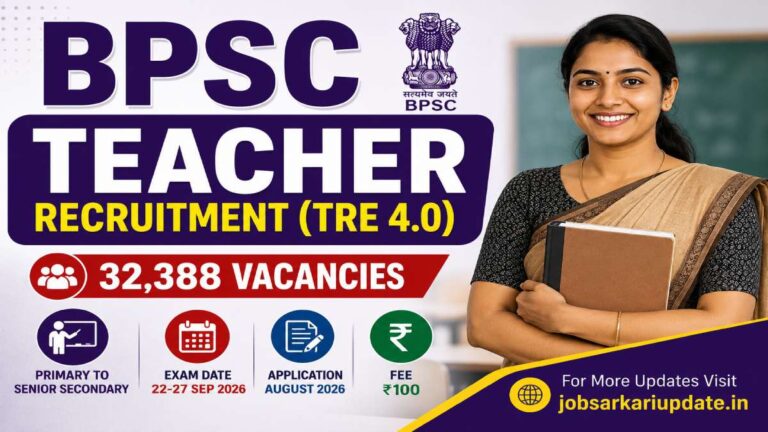
BPSC Bihar TRE-4 2026 - Quick Summary: BPSC has announced Bihar TRE-4 Recruitment 2026 for 32,388 Teacher vacancies across Primary,...
Read Full Details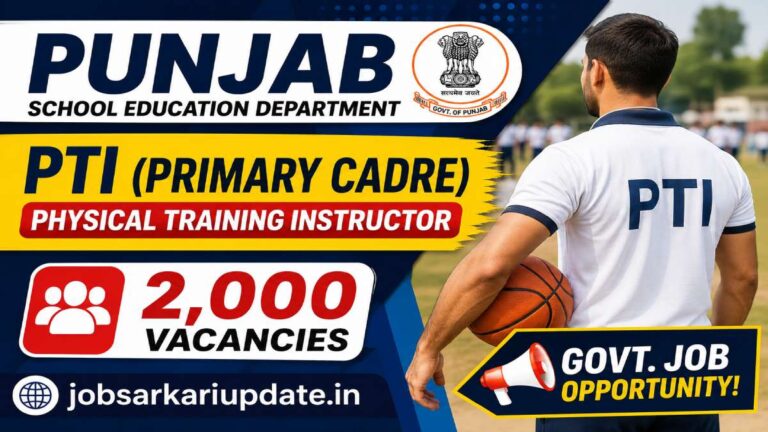
Punjab PTI Recruitment 2026 - Quick Summary: Education Recruitment Directorate (ERD), Punjab has released notification for 2,000 Physical Training Instructor...
Read Full Details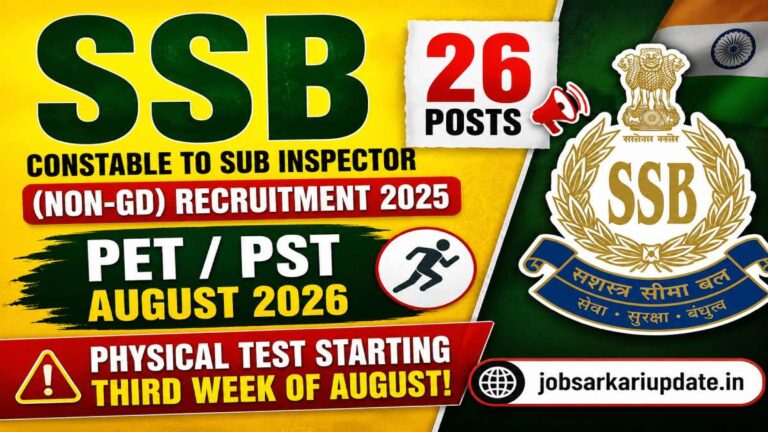
SSB Physical Date 2026 - Quick Summary: SSB has announced PET/PST commencement for Constable to Sub Inspector (Non-GD) Recruitment 2025....
Read Full Details