










SSB Physical Date 2026 - Quick Summary: SSB has announced PET/PST commencement for Constable to Sub Inspector (Non-GD) Recruitment 2025....
Read Full DetailsRBI Junior Engineer Recruitment 2026 – Civil & Electrical
RBI Junior Engineer Recruitment 2026 – Apply for Civil & Electrical Posts, Panel Year 2026
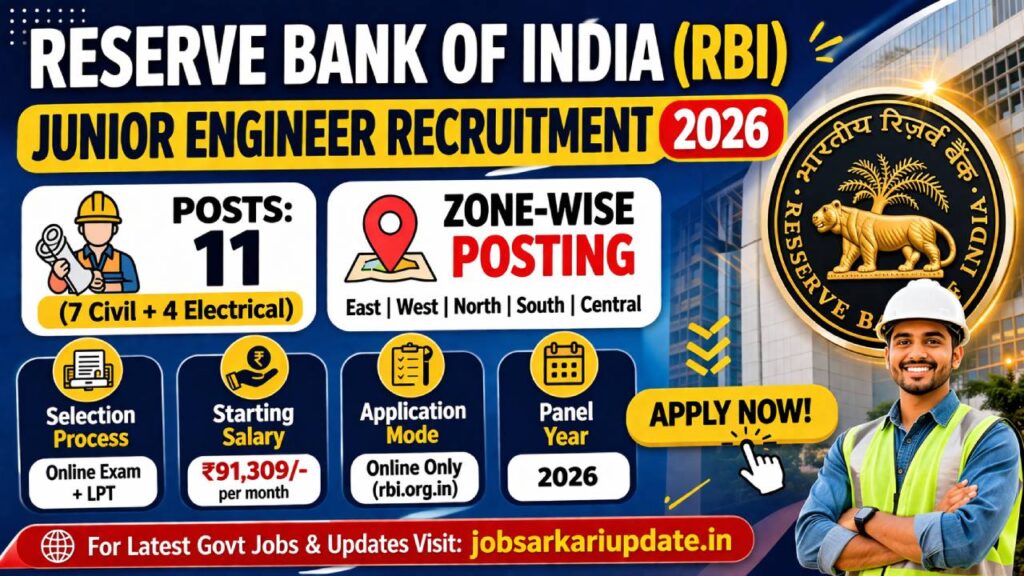
RBI Junior Engineer Recruitment 2026 is one of the most coveted engineering job opportunities in India’s central banking sector, and the Reserve Bank of India has officially opened applications for Panel Year 2026 starting April 16, 2026. The Reserve Bank of India — the country’s apex monetary authority — is inviting online applications from eligible candidates for the posts of Junior Engineer (Civil) and Junior Engineer (Electrical) across its five recruitment zones. Selection will be through a country-wide competitive online examination followed by a Language Proficiency Test (LPT).
With a total of 11 vacancies — 7 for Junior Engineer (Civil) and 4 for Junior Engineer (Electrical) — this is an exceptionally selective recruitment. The low vacancy count makes it a high-prestige, high-competition appointment. However, it also means that a well-prepared candidate targeting a specific zone faces a realistic path to selection. An RBI job offers unmatched job security, a starting gross monthly emolument of approximately ₹91,309/-, Bank accommodation, medical benefits, housing loan at concessional rates, and genuine career growth within one of India’s most reputed institutions.
The notification was released in April 2026, with the application window running from April 16 to May 6, 2026. The tentative online examination is scheduled for June 6, 2026. Given the Bank’s prestige and the salary package on offer, competition will be fierce — engineers with a Diploma or Degree in Civil or Electrical Engineering and the relevant work experience should apply at the earliest and begin exam preparation immediately.
Recruitment Overview
The Reserve Bank of India is not just India’s central bank — it is one of the most institutionally credible employers in the country, with a track record spanning over nine decades. RBI officers and staff are governed by well-defined service regulations with transparent pay revisions, structured promotions, and comprehensive perquisites. The Bank conducts its recruitment with IBPS as the examination partner, bringing in standardized, transparent processes. Being selected for an RBI role — even at the Junior Engineer level — carries significant professional prestige and opens doors to a structured career within the infrastructure and estates management division of one of the world’s most respected central banks.
| Parameter | Details |
|---|---|
| Organization Name | Reserve Bank of India (RBI) |
| Post Name | Junior Engineer (Civil) and Junior Engineer (Electrical) |
| Panel Year | 2026 |
| Total Vacancies | 11 (7 Civil + 4 Electrical) |
| Job Type | Permanent, Central Government (RBI) |
| Job Location | Zone-wise postings across India (East, West, North, South, Central) |
| Application Mode | Online Only (rbi.org.in) |
| Selection Process | Online Examination + Language Proficiency Test (LPT) |
| Starting Gross Salary | Approximately ₹91,309/- per month |
| Help Desk for Queries | cgrs.ibps.in |
Important Dates
The application window for RBI JE 2026 is exactly 21 days — from April 16 to May 6, 2026. This is shorter than most government job application windows, which makes early action even more critical. The RBI website, like most central government portals, experiences heavy traffic on the last few days of any application window. Submitting your application in the first week also gives you access to the Edit Window that RBI provides post-closing date, allowing you to correct limited fields like exam centre and parents’ names. If you apply at the last moment, any portal issue on May 6 could cost you this opportunity entirely. Aim to complete your application by April 25, 2026.
| Event | Date |
|---|---|
| Application Submission Window Opens | April 16, 2026 |
| Last Date for Online Application & Fee Payment | May 06, 2026 |
| Edit Window to Modify/Rectify Application | To be notified on rbi.org.in |
| Admit Card / Call Letter Download | To be notified on rbi.org.in |
| Tentative Date of Online Examination | June 06, 2026* |
| Language Proficiency Test (LPT) | To be notified on rbi.org.in |
| Result / Final Selection | To be notified on rbi.org.in |
* The Bank reserves the right to change the date of examination.
Note: All dates are subject to change. Always verify from the official notification on rbi.org.in before taking any action. Any corrigendum issued will be published only on the Bank’s official website.
Application Fee
The application fee for RBI JE 2026 is non-refundable and payable only through online mode between April 16 and May 6, 2026. Note that 18% GST is levied on top of the base fee amount — so the total amount charged to your account will be slightly higher than the base figures listed below. RBI staff candidates are fully exempt from the fee. An important feature unique to this recruitment is the Edit Window — if you need to correct limited fields after submission, a flat correction fee of Rs. 200/- (inclusive of GST) applies, uniformly across all categories. This fee is also non-refundable. A common mistake during fee payment is pressing the Back or Refresh button while the server processes the transaction — always wait for the e-Receipt to appear before closing the browser.
| Category | Fee Amount (+ 18% GST) | Payment Mode |
|---|---|---|
| SC / ST / PwBD / Ex-Servicemen | ₹50/- + GST (Intimation Charges only) | Online (Debit Card, Credit Card, Net Banking, IMPS, Mobile Wallet) |
| OBC / General (UR) / EWS | ₹450/- + GST (Examination Fee + Intimation Charges) | Online |
| RBI Staff Candidates | Exempt (No fee) | N/A |
| Edit Window Correction Fee (All Categories) | ₹200/- (Inclusive of GST) | Online |
Age Limit
Age is calculated as on April 1, 2026. The standard age band is 20 to 30 years, meaning candidates born between April 2, 1996 and April 1, 2006 (both inclusive) are eligible. A practical check: if you were born on July 15, 1997, you are 28 years old on the reference date — you are eligible. If you were born on March 31, 1996, you are exactly 30 years and 1 day old — you are over-age for General category. Note that cumulative age relaxation is not permitted; only the single applicable relaxation applies. Widows, divorced women, and women who are judicially separated and have not remarried get relaxation up to 35 years (40 for SC/ST) — a provision often overlooked.
| Category | Age Relaxation | Upper Age Limit |
|---|---|---|
| General / EWS (Unreserved) | No relaxation | 30 years |
| OBC | 3 years | 33 years |
| SC / ST | 5 years | 35 years |
| PwBD – General / EWS | 10 years | 40 years |
| PwBD – OBC | 13 years | 43 years |
| PwBD – SC / ST | 15 years | 45 years |
| Ex-Servicemen | Military service period + 3 years | Maximum 50 years |
| Widows / Divorced women / Judicially separated (not remarried) | Up to 35 years | 35 years (40 for SC/ST) |
Important: SC/ST/OBC candidates will not be eligible for age relaxation in zones where no vacancies are reserved for them. Check the vacancy table carefully before claiming category-based relaxation.
Eligibility Criteria
The educational qualification and experience requirement for RBI JE 2026 is more demanding than most state-level Junior Engineer recruitments — it is not enough to hold a Diploma or Degree; you also need verified post-qualification work experience. This is the single most common reason candidates are rejected at the document verification stage. Diploma holders need at least 2 years of relevant experience, while Degree holders need at least 1 year. Alternatively, a 1-year graduate apprenticeship training at a PSU is accepted in lieu of work experience. All qualifications must be held and experience must be complete as on April 1, 2026. The percentage calculation rule is strict — 49.99% is treated as less than 50%, with no rounding up.
| Post | Qualification | Minimum Marks | Experience Required |
|---|---|---|---|
| Junior Engineer (Civil) | 3-Year Diploma in Civil Engineering from a recognised Institute/University/Board | 65% (55% for SC/ST/PwBD) | At least 2 years in execution and supervision of civil construction/maintenance of office/commercial/residential buildings with basic knowledge of RCC design, computer knowledge, and tender preparation experience — OR 1-year graduate apprenticeship in a PSU |
| Degree (B.E./B.Tech) in Civil Engineering from a recognised University | 55% (45% for SC/ST/PwBD) | At least 1 year in civil construction/maintenance work as above — OR 1-year graduate apprenticeship in a PSU | |
| Junior Engineer (Electrical) | 3-Year Diploma in Electrical or Electrical & Electronic Engineering from a recognised Institute/University/Board | 65% (55% for SC/ST/PwBD) | At least 2 years in execution and supervision of electrical installations in large/commercial buildings with HT/LT substations, central AC plants, lifts, UPS, DG sets, CCTV, fire alarm systems — OR 1-year graduate apprenticeship in a PSU |
| Degree (B.E./B.Tech) in Electrical or Electrical & Electronic Engineering from a recognised University | 55% (45% for SC/ST/PwBD) | At least 1 year in electrical installations as above — OR 1-year graduate apprenticeship in a PSU |
CGPA to Percentage Conversion
If your university awards CGPA/OGPA/CPI on a 10-point scale, the following conversion applies (as per RBI’s official notification). If your grade point system is not on a 10-point scale, it will be normalized to 10 first.
| CGPA/OGPA/CPI (on 10-point scale) | Equivalent Percentage |
|---|---|
| 6.75 | 60% |
| 6.25 | 55% |
| 5.75 | 50% |
Vacancy Details
With only 11 total vacancies — 7 for Civil and 4 for Electrical — this is an elite, selective recruitment. The West Zone has the highest concentration of vacancies for both posts (4 Civil, 3 Electrical), making it the most competitive zone. The East, North, and Central Zones each have just 1 vacancy for Civil, meaning a single shortlisted candidate could potentially be the only selection from that entire zone. The South Zone has no Civil vacancies and only 1 Electrical vacancy. Candidates are allowed to apply for only one post and only one zone, making the zone and post selection decision critically important. The General/Unreserved category accounts for the majority of posts — 4 out of 7 Civil and 2 out of 4 Electrical. There is also 1 backlog PwBD vacancy in the West Zone for each post, indicated by the brackets in the official notification.
Junior Engineer (Civil) – Zone-wise Vacancies
| Recruitment Zone | SC | ST | OBC | EWS | General/UR | Total | PwBD (Category B) |
|---|---|---|---|---|---|---|---|
| East | – | – | – | – | 1 | 1 | – |
| West | – | 1 | 1 | 1 | 1 | 4 | 1 (Backlog) |
| North | – | – | – | – | 1 | 1 | – |
| South | – | – | – | – | – | 0 | – |
| Central | – | – | – | – | 1 | 1 | – |
| Total | – | 1 | 1 | 1 | 4 | 7 | 1 (Backlog) |
Junior Engineer (Electrical) – Zone-wise Vacancies
| Recruitment Zone | SC | ST | OBC | EWS | General/UR | Total | PwBD (Category C) |
|---|---|---|---|---|---|---|---|
| East | – | – | – | – | – | 0 | – |
| West | – | – | 1 | 1 | 1 | 3 | 1 (Backlog) |
| North | – | – | – | – | – | 0 | – |
| South | – | – | – | – | 1 | 1 | – |
| Central | – | – | – | – | – | 0 | – |
| Total | – | – | 1 | 1 | 2 | 4 | 1 (Backlog) |
The Bank reserves the right to increase/decrease the number of vacancies or choose not to fill them. Vacancies in brackets indicate backlog positions. Candidates may apply for only ONE post and ONE zone.
Selection Process
The RBI JE 2026 selection process has two stages: an Online Examination and a Language Proficiency Test (LPT). Final selection is based on the candidate’s merit rank in the online examination, subject to qualifying in LPT, medical fitness, and document verification. The LPT is not just a formality — failure in LPT results in disqualification regardless of exam score. Understanding each stage is essential for strategic preparation.
Stage 1: Online Examination (300 Marks, 180 Questions)
The online exam is the primary filter. Approximately 5 times the number of vacancies (subject to availability) will be shortlisted from the exam for the LPT. This means for 11 total vacancies, roughly 55 candidates across all zones and categories will be called for LPT. Each section must be cleared separately — a candidate who scores extremely well overall but fails to clear the individual cut-off in even one section (e.g., English Language) will not proceed. The Engineering Discipline Papers carry the maximum weightage (200 out of 300 marks) and are therefore the decisive factor in competitive ranking.
Prep tip: Since each section must be cleared independently, do not neglect English Language and General Intelligence even while focusing on Engineering papers.
Stage 2: Language Proficiency Test (LPT)
The LPT is conducted at the respective Zonal Offices of RBI in the official/local language of that zone. No exemption is given to any candidate from appearing in LPT. Candidates not proficient in the zone’s official language are disqualified. The language tested depends on the zone you applied for — see the zone-wise language table in the Syllabus section.
Prep tip: If you are applying for a zone where your mother tongue is not the tested language (e.g., a Hindi speaker applying for the West Zone where Gujarati/Marathi/Konkani is tested), you must build functional proficiency in that language well before the LPT date.
Stage 3: Document Verification & Medical Fitness
Candidates who clear the LPT will undergo document verification and a medical examination as per RBI’s service rules. Appointment is subject to being declared medically fit. Prep tip: Gather all originals — degree/diploma, marksheets, experience certificates from previous employers, category certificates, and DOB proof — before the LPT stage. RBI does not give extensions for document submission.
Exam Syllabus & Pattern
The online examination is held for 300 marks, 180 questions, and 150 minutes total duration. The exam is bilingual (English and Hindi) for all sections except the English Language section, which is in English only. There is negative marking of 1/4th mark for each wrong answer. If the exam is held in more than one session, scores are equalized using IBPS’s equipercentile normalization method. The complete exam pattern and syllabus are taken directly from the official notification.
Online Examination Pattern
| S.No. | Section | No. of Questions | Maximum Marks | Time Allotted |
|---|---|---|---|---|
| 1 | English Language | 50 | 50 | 40 minutes |
| 2 | Engineering Discipline Paper I | 40 | 100 | 40 minutes |
| 3 | Engineering Discipline Paper II | 40 | 100 | 40 minutes |
| 4 | General Intelligence and Reasoning | 50 | 50 | 30 minutes |
| Total | 180 | 300 | 150 Minutes | |
Negative Marking: 1/4 mark per wrong answer Each section must be cleared separately
Indicative Syllabus – Junior Engineer (Civil)
Engineering Discipline Paper I
- Building Materials: Physical and chemical properties, classification, standard tests, uses and manufacture/quarrying of building stones, silicate-based materials, Portland cement, asbestos products, timber and wood-based products, laminates, bituminous materials, paints, varnishes.
- Estimating, Costing and Valuation: Analysis of rates, methods and units of measurement, earthwork, brickwork (modular and traditional), RCC work, shuttering, timber work, painting, flooring, plastering, bar bending schedule, centre line method, trapezoidal formula, Simpson’s rule. Cost estimates for septic tanks, flexible pavements, tube wells, footings, steel trusses, piles. Valuation methods — scrap value, salvage value, sinking fund, depreciation.
- Surveying: Principles of surveying, chain surveying, prismatic compass traversing, plane table surveying, theodolite traversing, levelling, contouring, tachometric survey, curve setting, advanced surveying equipment.
- Soil Mechanics: Phase diagram, void ratio, porosity, degree of saturation, grain size distribution, Atterberg limits, ISI soil classification, permeability, consolidation, shear strength (direct shear, vane shear, triaxial tests), compaction, earth pressure theories, bearing capacity, plate load test, SPT.
- Hydraulics: Fluid properties, hydrostatics, flow measurement, Bernoulli’s theorem, flow through pipes, open channels, weirs, flumes, spillways, pumps and turbines.
- Transportation Engineering: Highway cross-sections, geometric design, pavement types, pavement materials (aggregates and bitumen), WBM, WMM, bituminous construction, rigid pavements, highway drainage.
- Environmental Engineering: Water quality, water supply and purification, distribution systems, sewerage systems, sewage treatment. Solid waste management, air pollution, noise pollution.
Engineering Discipline Paper II
- Theory of Structures: Elasticity constants, determinate and indeterminate beams, bending moment and shear force diagrams, moment of inertia (rectangular and circular sections), eccentric loads, chimneys, dams, retaining walls, slope deflection, critical loads, columns, torsion of circular sections.
- Concrete Technology: Properties of concrete, cement aggregates, water-cement ratio, workability, mix design, batching, mixing, placement, compaction, curing, quality control, hot and cold weather concreting, repair and maintenance.
- RCC Design: Flexural, shear, and bond strength; singly and doubly reinforced beams, cantilever beams, T-beams, lintels, one-way and two-way slabs, isolated footings, columns, staircases, retaining walls, water tanks. Both Limit State and Working Stress methods.
- Steel Design: Steel columns, beams, roof trusses, plate girders.
Indicative Syllabus – Junior Engineer (Electrical)
Engineering Discipline Paper I
- Basics of Electrical Engineering
- Lighting design of office areas
- Transformers — working principles, protection types, preventive maintenance
- Pumping systems
- Various types of motors and their starting methods
- Substation design and layout including DG set installations
- Types of earthing, testing, lightning arrestors
Engineering Discipline Paper II
- Basic knowledge of air conditioning and refrigeration
- Inverters, rectifiers, UPS systems
- Energy conservation techniques
- LT distribution system, cabling/internal wiring, panel design, fault-finding, preventive maintenance
- Testing of electrical installations
- Basics of elevators — design, electrical safeties, protection controllers
- Basics of CCTV systems, fire and smoke alarm systems, UPS
- Knowledge of Indian Electricity Rules
- Switchgear and protection used in HT/LT installations
Zone-wise Languages for Language Proficiency Test (LPT)
| Zone | Official/Local Languages for LPT |
|---|---|
| East Zone | Odia, Assamese, Bengali, Manipuri, Khasi, Nepali, Hindi, Maithili, Bodo, Mizo, English (only for candidates from Nagaland/Arunachal Pradesh) |
| West Zone | Gujarati, Marathi, Konkani |
| North Zone | Punjabi, Hindi, Urdu, Kashmiri |
| South Zone | Kannada, Tamil, Malayalam |
| Central Zone | Hindi, Telugu, Marathi |
Examination Centres by Zone
| Zone | Examination Cities |
|---|---|
| East | Kolkata, Gangtok, Kalyani, Bhubaneswar, Cuttack, Jorhat, Tezpur, Silchar, Guwahati, Agartala, Shillong, Imphal, Churachandpur, Patna, Arrah, Dhanbad, Ranchi |
| West | Ahmedabad/Gandhinagar, Surat/Bardoli, Vadodara/Anand, Mumbai/Navi Mumbai/Thane/MMR Region, Pune, Chhatrapati Sambhaji Nagar, Dhule, Nashik, Kolhapur, Panaji |
| North | Chandigarh/Mohali, Patiala, Phagwara, Bilaspur (HP), Hamirpur (HP), Kanpur, Lucknow, Prayagraj, Varanasi, Gorakhpur, Dehradun, Roorkee, New Delhi/NCR, Jammu, Srinagar, Samba, Jaipur |
| South | Bengaluru, Hubballi/Dharwad, Mysuru, Chennai, Madurai, Kochi, Thiruvananthapuram |
| Central | Bhopal, Indore, Ujjain, Raipur, Bhilai Nagar, Nagpur, Hyderabad, Nizamabad, Warangal, Guntur/Vijayawada, Visakhapatnam |
Salary & Pay Scale
The RBI JE pay structure is one of the most attractive in the government engineering sector. Selected candidates receive nine advance increments on joining — meaning they start at a significantly higher basic pay than the base of the pay scale. The starting basic pay of Rs. 47,700/- per month (reflecting the nine advance increments) is considerably higher than what most state government JE positions offer. On top of this, allowances including Dearness Allowance, House Rent Allowance (15% of pay if Bank accommodation is not provided), and other perquisites bring the gross monthly emolument to approximately Rs. 91,309/- at the time of joining. The full pay scale allows for further structured increments over time, with reasonable promotion prospects to higher grades.
| Post | Pay Scale | Starting Basic Pay (with 9 advance increments) | Approx. Gross Monthly Emoluments |
|---|---|---|---|
| Junior Engineer (Civil / Electrical) | ₹29,000 – 1700(3) – 34,100 – 2040(4) – 42,260 – 2720(6) – 58,580 – 2950(2) – 64,480 – 3370(3) – 74,590 – 4050(1) – 78,640 | ₹47,700/- per month | Approximately ₹91,309/- per month* |
*Gross emoluments are approximate and may vary depending on posting location and HRA eligibility. HRA is 15% of Pay if Bank accommodation is not provided.
Perquisites & Other Benefits
In addition to the pay, selected candidates are entitled to Bank accommodation (subject to availability), allowance for knowledge updation, briefcase allowance, furnishing allowance for residence, dispensary facility, annual health checkup, reimbursement of OPD/hospitalization expenses, interest-free festival advance, Leave Fare Concession, housing loan at concessional rates, and personal advance at concessional interest. All recruits are covered under the Defined Contribution New Pension Scheme (NPS) along with Gratuity benefits. Compared to similar-grade posts in central government PSUs, the RBI perquisite package — particularly the housing loan and medical benefits — represents exceptional long-term financial security.
Zone-wise Posting Locations
Candidates are initially posted within the Recruitment Zone they applied for but are liable to be transferred to any zone as per administrative requirements. The five zones and their cities are: East (Kolkata, Bhubaneswar, Guwahati, Patna, Ranchi, Shillong, Agartala, Gangtok, Aizawl, Imphal, Itanagar, Kohima), West (Ahmedabad, Mumbai including Belapur/Byculla, Pune, Panaji), North (Chandigarh, Shimla, Jaipur, Jammu/Srinagar, Kanpur, Lucknow, Dehradun, New Delhi), South (Bengaluru, Chennai, Kochi, Thiruvananthapuram), and Central (Bhopal, Raipur, Nagpur, Hyderabad).
How to Apply Online – Step by Step
Pre-Application Checklist
- Scanned passport-size colour photo (4.5cm × 3.5cm, 200×230 pixels, 20–50 KB, JPG)
- Signature in black ink on white paper (140×60 pixels, 10–20 KB, JPG)
- Left-hand thumb impression (240×240 pixels, 200 DPI, 20–50 KB, JPG)
- Handwritten declaration in English (800×400 pixels, 200 DPI, 50–100 KB, JPG)
- Valid personal email ID and active mobile number
- Online payment details (Debit/Credit Card, Net Banking, UPI, IMPS, Mobile Wallet)
- Educational certificates, Diploma/Degree marksheets, experience certificate from employer, category/EWS/PwBD certificate (if applicable)
- DigiLocker account (optional but recommended — Aadhaar and education documents can be linked voluntarily)
- Visit the Official Portal: Go to rbi.org.in and find the link “Recruitment for the Post of Junior Engineer (Civil/Electrical) – Panel Year 2026.” Click it to reach the online registration page.
- New Registration: Select “Click here for New Registration.” Enter your name, contact details, and personal email ID. Note the Provisional Registration Number and Password sent to your email and SMS.
- Fill the Application Form: Log in with your credentials. Fill all personal, educational, experience, zone, and category details. Use “SAVE AND NEXT” to save progress. Do not click “COMPLETE REGISTRATION” until all details are verified — no changes are possible after this.
- Upload Documents: Upload photo, signature, left thumb impression, and handwritten declaration in the specified dimensions and file sizes. Preview each upload for clarity. Blurry uploads will result in rejection.
- Select Zone: You can apply for only one post and one zone. This selection is final and cannot be changed (except exam centre and parents’ names during the Edit Window).
- Preview and Final Registration: Click “Preview” to review the entire form. Click “COMPLETE REGISTRATION” only after verifying all details are correct.
- Pay Application Fee: Click “Payment” tab. Select payment mode. Wait for the e-Receipt — do NOT press Back or Refresh during payment processing. Download and print the e-Receipt and application form. If the e-Receipt is not generated, the payment has not been successful — log in again and retry.
Most Common Application Mistakes to Avoid
- Name mismatch: Your name in the online application must exactly match your photo ID proof. Female candidates who changed their name after marriage must pay particular attention to this — you will need an original Gazette notification or marriage certificate if there is a mismatch.
- Uploading photo where signature should go: The portal has separate upload fields — ensure photo goes in the photo field and signature in the signature field. Swapping them bars you from the exam.
- Signature in capital letters: Handwritten declarations and signatures in all CAPS are explicitly rejected — your signature must be your regular style.
- Multiple registrations: If you register more than once, only the last registration is retained. Do not apply multiple times intentionally — it wastes your fee since multiple entries are not combined.
Important Instructions for Candidates
- ✔ You may apply for only ONE post (Civil or Electrical) and only ONE zone. Multiple registrations result in only the last one being valid.
- ✔ Do NOT bring mobile phones, calculators, or any electronic communication devices to the examination centre — this results in immediate disqualification and a ban from future RBI exams.
- ✔ Candidates working in Government/PSU/Financial Institutions must inform their employer in writing before applying and submit an undertaking online to this effect.
- ✔ SC/ST/OBC/EWS/PwBD/Ex-Servicemen candidates must have all certificates in the prescribed format (as per Annexures in the notification) ready before the document verification stage.
- ✔ The OBC (Non-Creamy Layer) certificate must be based on income for FY 2025-26, 2024-25, and 2023-24 and must be issued on or after April 1, 2026.
- ✔ Exam marks are not shared with candidates directly; they may be available on the Bank’s website after final results are declared.
- ✔ All legal disputes arising from this recruitment are subject to Mumbai jurisdiction only.
- ✔ This content is for informational purposes only. Always refer to the official notification on rbi.org.in for authoritative details.
Expert Tips to Crack RBI Junior Engineer Recruitment 2026
Apply in the First Week — Not the Last Day
With the window closing on May 6, 2026, the RBI website will experience heavy traffic on May 4–6. Server slowdowns and payment gateway timeouts are common on the final days of any major RBI recruitment window. Apply between April 16–25 to avoid these risks entirely. Completing the application early also gives you the psychological benefit of being able to focus entirely on exam preparation rather than juggling application logistics alongside study.
Read the Full Notification Before Filling the Form
The 40-page official notification contains nuances that critically affect your eligibility — particularly the zone-wise vacancy distribution, experience criteria for Diploma vs Degree holders, and the CGPA conversion formula. Many candidates apply without realizing there are zero Civil vacancies in the South Zone, or that their CGPA of 6.0 on a 10-point scale converts to slightly below 55% under RBI’s formula and disqualifies them for Degree holder category. Spending 45 minutes carefully reading the notification before applying saves you the fee, the preparation time, and the disappointment.
Prepare All Documents Before Starting the Application
Gather before you open the portal: Diploma/Degree certificate and all semester marksheets, experience certificate on company letterhead clearly stating duration and nature of work, age proof (Class 10 certificate), photo ID proof (Aadhaar, PAN, Passport, etc.), category certificate in the exact format specified in the notification’s Annexures, and EWS certificate for FY 2025-26 if applicable. The experience certificate, in particular, is something that takes time to obtain from employers — request it now so it is ready for document verification.
Begin Exam Preparation from Day One
With approximately 7 weeks between the application closing date and the June 6 exam, and likely around 10 weeks from today (April 16), you have a defined preparation window. The Engineering Discipline Papers carry 200 out of 300 marks — spending 60–70% of your study time on your core engineering subjects is the most rational strategy. For Civil candidates, Soil Mechanics, RCC Design, and Structural Analysis are historically high-weight topics in competitive engineering exams of this type. For Electrical candidates, focus heavily on Motors, Transformers, Substation Design, and LT distribution systems since these directly align with RBI’s job description (building maintenance in a large institution).
Avoid the Most Common Rejection Reasons
Based on the eligibility pattern of this recruitment, the top rejection reasons at document verification are: (1) experience certificate that doesn’t mention the specific nature of work — RBI’s job description for Civil requires “supervision of civil construction of office/commercial buildings with RCC design knowledge,” not just any construction experience; (2) percentage below the threshold due to incorrect CGPA conversion; (3) OBC certificate with incorrect financial year or issued before April 1, 2026; (4) any mismatch between the name in the application and the name on the photo ID proof. Verify each of these before clicking Complete Registration.
Prepare for the Language Proficiency Test Early
The LPT is conducted in the local/official language of the zone you applied for. This is a mandatory test with no exemptions — failing LPT means losing the opportunity regardless of your exam score. If you are applying for the West Zone (Gujarati/Marathi/Konkani), South Zone (Kannada/Tamil/Malayalam), or any zone where your primary language is different, begin language preparation immediately alongside your technical exam preparation. Even basic conversational and reading proficiency in the local language may suffice, but candidates underestimate this requirement every cycle.
Frequently Asked Questions (FAQs)
- 1. How many vacancies are there in RBI Junior Engineer Recruitment 2026?
- There are a total of 11 vacancies — 7 for Junior Engineer (Civil) and 4 for Junior Engineer (Electrical) — distributed across five recruitment zones (East, West, North, South, Central). The Bank reserves the right to increase or decrease these numbers.
- 2. What is the educational qualification for RBI JE Civil 2026?
- You need either a minimum 3-year Diploma in Civil Engineering with 65% marks (55% for SC/ST/PwBD) or a Degree in Civil Engineering with 55% marks (45% for SC/ST/PwBD) from a recognised institution. Both qualifications must also be accompanied by the required work experience (2 years for Diploma, 1 year for Degree), or a 1-year graduate apprenticeship in a PSU.
- 3. What is the age limit for RBI Junior Engineer 2026?
- The age limit is 20 to 30 years as of April 1, 2026, meaning candidates born between April 2, 1996 and April 1, 2006 are eligible. SC/ST get 5 years relaxation (up to 35), OBC get 3 years (up to 33), and PwBD candidates get 10–15 years depending on their base category.
- 4. How much is the application fee for RBI JE 2026?
- SC/ST/PwBD/Ex-Servicemen pay Rs. 50/- plus 18% GST as intimation charges. OBC/General/EWS candidates pay Rs. 450/- plus 18% GST. RBI staff candidates are exempt. A correction fee of Rs. 200/- (inclusive of GST) applies during the Edit Window if you need to modify certain fields.
- 5. What is the last date to apply for RBI JE 2026?
- The last date for both online application submission and fee payment is May 06, 2026. The application window opened on April 16, 2026.
- 6. What is the exam pattern for RBI Junior Engineer 2026?
- The online exam has 180 questions for 300 marks in 150 minutes, split into 4 sections: English Language (50 questions/50 marks/40 mins), Engineering Discipline Paper I (40 questions/100 marks/40 mins), Engineering Discipline Paper II (40 questions/100 marks/40 mins), and General Intelligence and Reasoning (50 questions/50 marks/30 mins). There is 1/4th negative marking and each section must be cleared individually.
- 7. What is the salary for RBI Junior Engineer (Civil/Electrical)?
- The starting basic pay is Rs. 47,700/- per month (Rs. 29,000 plus nine advance increments). The approximate gross monthly emolument at the time of joining is Rs. 91,309/-, which includes DA, HRA (15% of pay if Bank accommodation is not provided), and other allowances. The post also comes with perquisites including Bank accommodation, medical benefits, housing loan at concessional rates, and NPS pension.
- 8. Is there negative marking in the RBI JE 2026 exam?
- Yes. 1/4th (25%) of the marks allotted for the question is deducted for each wrong answer. No marks are deducted for unattempted questions. Marking more than one answer is treated as a wrong answer.
- 9. What is the Language Proficiency Test (LPT) in RBI JE recruitment?
- After the online exam, shortlisted candidates must appear for an LPT in the official/local language of the zone they applied for — for example, Gujarati/Marathi/Konkani for West Zone, or Kannada/Tamil/Malayalam for South Zone. LPT is mandatory with no exemptions. Candidates not proficient in the required language are disqualified regardless of exam score.
- 10. Can I apply for both Junior Engineer (Civil) and Junior Engineer (Electrical)?
- No. Candidates can apply for only one post and only one zone. If there are multiple registrations, only the last registration is retained by the system.
- 11. Is work experience mandatory for RBI JE 2026?
- Yes, experience is mandatory as on April 1, 2026. Diploma holders need at least 2 years of relevant experience, while Degree holders need at least 1 year in the respective discipline (civil construction or electrical installations in large buildings). Alternatively, a 1-year graduate apprenticeship training in a PSU is accepted. Fresh graduates without any experience are not eligible.
- 12. Where can I download the admit card for RBI JE 2026?
- Admit cards (Call Letters) will be available for download on the RBI website at rbi.org.in. You will need your Registration Number/Roll Number and Password/Date of Birth to access the download link. Intimation will also be sent via email and SMS to the registered contact details.
Important Links
| Apply Online | Apply Now |
| Download Notification | Click Here |
| Official Website | Click Here |
Recent Jobs
Check out our latest job postings
810 Jobs Available

IAF Agniveervayu Rally 2027 - Quick Summary: Indian Air Force is conducting an Open Recruitment Rally for Agniveervayu (Other Than...
Read Full Details
HAL DT & MT Recruitment 2026 - Quick Summary: HAL has released notification for 120 Design Trainee & Management Trainee...
Read Full Details
MPPSC Assistant Director 2026 - Quick Summary: MPPSC has released notification for Assistant Director posts in Higher Education Department. Graduate...
Read Full Details
MPPSC Assistant Director Fisheries 2026 - Quick Summary: MPPSC has released notification for Assistant Director Fisheries posts. M.Sc Zoology/Fisheries +...
Read Full Details
MPPSC Internal Accounts Examiner 2026 - Quick Summary: MPPSC has released notification for Internal Accounts Examiner Officer post. M.Com OR...
Read Full Details