







SSB Physical Date 2026 - Quick Summary: SSB has announced PET/PST commencement for Constable to Sub Inspector (Non-GD) Recruitment 2025....
Read Full DetailsJharkhand TET 2026 – Date Extended For Jharkhand Teacher Eligibility Test
Jharkhand TET 2026 Notification – New Rules, Eligibility & Exam Pattern Complete Guide
The Jharkhand TET 2026 Notification has been officially released by the Jharkhand Government’s School Education and Literacy Department (Directorate of Primary Education) on 26 March 2026 vide notification number 487. Under the powers granted by Section 23(1) of the Right of Children to Free and Compulsory Education Act, 2009 (RTE Act 2009), the state government has formulated the Jharkhand Teacher Eligibility Test Rules — 2026 (JHTET 2026), which will govern the conduct of the teacher eligibility examination for appointment to primary school (Class 1–5) and upper primary school (Class 6–8) teaching posts across Jharkhand.
This is a significant policy development because the new 2026 rules supersede and replace three earlier notification-based rule sets — the 2019 rules, the first amendment of 2022, and the second amendment of 2024. The 2026 notification has been shaped in part by the Hon’ble Supreme Court’s order in Civil Appeal No. 1385/2025 (Anjuman Ishaat-E-Taleem Trust vs. The State of Maharashtra & Ors.) dated 01 September 2025, which established that in-service teachers who were already employed before the TET requirement was made mandatory can now appear in the JHTET examination.
For aspirants preparing to become primary or upper primary school teachers in Jharkhand, this notification establishes the entire framework — from minimum educational qualifications and exam structure to passing marks, certificate validity, and special provisions for reserved category candidates. The JHTET 2026 certificate, once awarded, will be valid for lifetime — a major change from earlier time-limited certificates. Competition is expected to be high given the large pool of B.Ed and D.El.Ed graduates in the state.
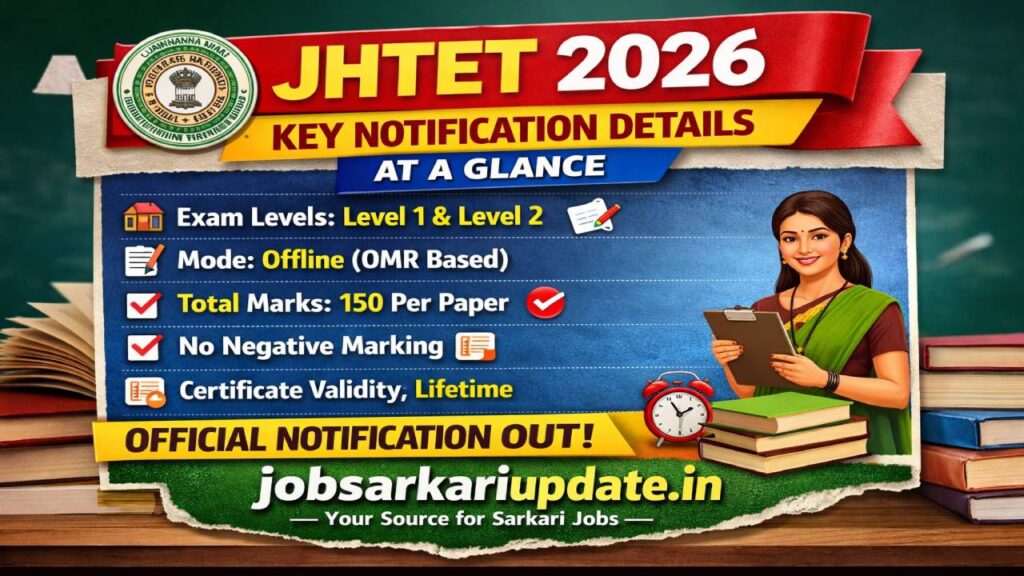
JHTET 2026 – Key Notification Details at a Glance
The table below summarizes the essential facts from the official JHTET 2026 Rules notified on 26 March 2026. This is the foundational reference before reading the detailed eligibility and exam pattern sections below.
| Detail | Information |
|---|---|
| Exam Name | Jharkhand Teacher Eligibility Test (JHTET) 2026 |
| Issuing Authority | School Education & Literacy Department (Directorate of Primary Education), Jharkhand Government |
| Notification Number | 487, dated 26 March 2026 |
| Governing Act | Right of Children to Free and Compulsory Education Act, 2009 (Section 23(1)) |
| Levels of Exam | Level 1 — Primary (Class 1–5); Level 2 — Upper Primary (Class 6–8) |
| Exam Conducting Authority | Jharkhand Academic Council (JAC), Ranchi, or any other competent authority authorized by State Government |
| Exam Mode | Offline (OMR-based MCQ paper) |
| Total Marks per Level | 150 marks (150 questions) |
| Negative Marking | No negative marking |
| Certificate Validity | Lifetime (valid permanently once awarded) |
| Previous Rules Superseded | JHTET Rules 2019, Amendment 2022, Amendment 2024 |
| Notification Date | 26 March 2026 |
| Application Dates | Not mentioned in official notification. Candidates are advised to check the official notice for updates. |
The School Education & Literacy Department (Directorate of Primary Education), Jharkhand is the nodal body responsible for policy formulation for primary education across all 24 districts of the state. The JHTET is not a direct recruitment exam — it is an eligibility certification that must be cleared before a candidate can be considered for appointment as an Assistant Teacher (Sahayak Acharya) in primary or upper primary government schools. Clearing the TET alone does not guarantee appointment; it is a qualifying gateway that establishes minimum teaching competency as required by NCTE norms.
Important Dates – JHTET 2026 Timeline
The JHTET 2026 Rules were officially notified on 26 March 2026. The exam conducting authority (JAC or designated body) will release a separate advertisement with application dates, exam schedule, admit card timeline, and result dates. Candidates must monitor the official portal for updates.
| Event | Date |
|---|---|
| JHTET 2026 Rules Notified | 26 March 2026 |
| Application Start Date | 21 April 2026 |
| Application Last Date | 20 July 2026 (Extended) |
| Exam Date | Not mentioned in official notification. Candidates are advised to check the official notice for updates. |
| Admit Card Date | Not mentioned in official notification. Candidates are advised to check the official notice for updates. |
| Result Date | Not mentioned in official notification. Candidates are advised to check the official notice for updates. |
| Age Limit Reference Date | 01 August of the exam year |
A key point for candidates is that the JHTET 2026 rules mandate that the exam conducting authority is responsible for holding the exam annually or biannually. Given that these rules were notified in March 2026, the first examination under JHTET 2026 rules is expected to be announced in 2026. Candidates who appeared in previous JHTET editions (2013 or 2016) should note that their certificates issued under those examinations also remain valid as per Clause 13 of the new rules, which explicitly extends lifetime validity to older certificates as well.
Important Notice: Exam dates, application schedule, and fee details will be published separately by the exam conducting authority. All dates in this article are subject to change. Always verify from the official notification before taking any action.
Application Fee
The JHTET 2026 Rules specify that the examination fee will be determined by the state government through an authorized exam conducting authority. The exact fee structure has not been detailed in this notification.
| Category | Fee Amount | Payment Mode |
|---|---|---|
| All Categories | Not mentioned in official notification. Candidates are advised to check the official notice for updates. | To be announced by exam authority |
Based on previous JHTET examinations, the fee was typically collected online through the official exam portal. Candidates should watch for the detailed advertisement from JAC (Jharkhand Academic Council) or the designated authority for the 2026 exam cycle, which will specify category-wise fee details and payment modes including online banking, UPI, or debit/credit card options.
Age Limit – JHTET 2026
The age limit is calculated as on 01 August of the exam year. The minimum age is 21 years. The maximum age is as per the Jharkhand government’s service rules — typically governed by the Administrative Reforms and Rajbhasha Department, Ranchi.
| Category | Minimum Age | Maximum Age / Relaxation |
|---|---|---|
| General / EWS | 21 years | As per Jharkhand government service rules |
| Reserved Categories | 21 years | As per Jharkhand government service rules |
| In-service Para Teachers (JEPRC, Ranchi) with 2+ years of continuous service as on notification date and currently employed | 21 years | Age relaxation up to period of service as contract worker, maximum up to 58 years |
| All candidates (gap between previous and current TET) | 21 years | One-time relaxation of one year less than the gap between the last TET and current TET — applicable once (One Time basis). Example: if last JHTET was 2016 and current is 2026, then 9 years minus 1 = 8 years of relaxation on a one-time basis. |
The age relaxation for in-service para teachers (Sahayak Adhyapaks / Para Shikshaks under JEPRC, Ranchi) is a notable provision in the 2026 rules. Candidates who have been continuously serving for at least 2 years as of the notification date and are currently employed as contractual workers can receive age relaxation equivalent to their service period, with an overall cap of 58 years. This is applicable per the Supreme Court direction in Civil Appeal No. 1385/2025 dated 01 September 2025.
Eligibility Criteria – Post-Wise Qualification for JHTET 2026
The educational qualification requirements for JHTET 2026 are detailed and have multiple pathways depending on whether you are applying for the Primary Level (Class 1–5) or Upper Primary Level (Class 6–8) exam. Read each pathway carefully before determining your eligibility.
(i) Primary Level – Class 1 to 5
Any one of the following qualifications is required:
| Option | Qualification Required | Note |
|---|---|---|
| A | +2 (Senior Secondary) or equivalent with minimum 50% marks AND 2-year Diploma in Elementary Education (D.El.Ed.) — by any name | Applicable to those who enrolled in training on or after 09.12.2007 |
| B | +2 (Senior Secondary) or equivalent with minimum 45% marks AND 2-year D.El.Ed. as per NCTE Regulations 2002 | Applicable to those who enrolled before 09.12.2007 |
| C | +2 with minimum 50% marks AND 4-year Bachelor in Elementary Education (B.El.Ed.) | — |
| D | +2 with minimum 50% marks AND 2-year Diploma in Education (Special Education) — D.Ed. Special Education | — |
| E | Graduation AND 2-year D.El.Ed. (by any name) | — |
(ii) Upper Primary Level – Class 6 to 8
Any one of the following qualifications is required:
| Option | Qualification Required | Note |
|---|---|---|
| A | Graduation (or equivalent) AND 2-year D.El.Ed. (by any name) | — |
| B | Graduation (or equivalent) with min. 50% marks AND B.Ed. [enrolled on or after 29.07.2011] | — |
| C | Graduation (or equivalent) with min. 45% marks AND B.Ed. as per NCTE Regulations [enrolled before 29.07.2011] | — |
| D | +2 with min. 50% marks AND 4-year B.El.Ed. | — |
| E | +2 with min. 50% marks AND 4-year BA B.Ed. / B.Sc. B.Ed. / BA.Ed. / BSc.Ed. | — |
| F | Graduation with min. 50% marks AND B.Ed. (Special Education) | — |
| G | Post-graduation with min. 55% marks (or equivalent grade) AND 3-year integrated B.Ed.–M.Ed. | — |
Special Education Teacher (Vishesh Prashiksit Sahayak Acharya) – Class 1 to 5
In addition to the Class 1–5 qualification pathways, candidates must also hold one of the following special education qualifications from RCI-approved institutions: 2-year D.Ed. Special Education / 1-year Diploma in Special Education (DSE) / DCBR / PGDCBR / MRW / Junior Diploma in Teaching the Deaf / Primary Level Teacher Training in Visual Impairment / DVRMR / DVTE-MR / DHLS. A valid RCI CRR number is mandatory.
5% Marks Relaxation: Candidates belonging to SC, ST, OBC, PwD (Divyang), or persons from weak tribal groups (PVTG) are entitled to a 5% relaxation in the minimum qualifying marks in their training/education qualification. This relaxation is as per Rule 9 of the notification.
Most Common Eligibility Mistake: Many candidates assume that simply holding a B.Ed. degree qualifies them for both levels. This is incorrect — B.Ed. qualifies only for Upper Primary (Class 6–8), not Primary (Class 1–5). Primary level requires D.El.Ed. or B.El.Ed. as the teacher training component. Applying for the wrong level based on your qualification will result in your candidature being cancelled at the verification stage.
Subject-Specific Eligibility for Class 6–8 Teachers
For the Upper Primary Level (Class 6–8), the notification specifies additional subject qualification requirements for Maths & Science teachers, Social Science teachers, and Language teachers. These are important details often missed by candidates.
| Subject Area | Additional Graduation Requirement |
|---|---|
| Mathematics & Science Teacher | Must have at least 3-year graduation in Science / Engineering / Technology / Agriculture with Mathematics as one subject AND must have passed 10+2 or higher secondary with at least two subjects from: Physics, Chemistry, Biology, Botany, Zoology, Mathematics |
| Social Science Teacher | Must have at least 3-year graduation in Arts / Humanities / Social Science / Commerce / Management (as per UGC Specification of Degrees, March 2014 and subsequent notifications) |
| Language Teacher | Must have minimum 3-year graduation (or equivalent) in one of the languages listed in Schedule-I of this notification (Hindi, English, Sanskrit, Urdu, or regional/tribal languages) |
From an expert standpoint, the subject-specific requirement for Class 6–8 Math & Science teachers is the most restrictive provision in the entire notification. Candidates who hold a general B.Sc. degree but without Physics, Chemistry, Biology, or Mathematics at the 10+2 level may find themselves ineligible for the Math & Science teacher track specifically, even if they hold a valid B.Ed. This nuance is critical and must be verified against your own academic record before applying for the Class 6–8 paper.
JHTET 2026 Exam Pattern – Level-Wise Structure
The JHTET 2026 exam consists of two separate levels — Level 1 for Primary (Class 1–5) and Level 2 for Upper Primary (Class 6–8). A candidate can appear in both levels simultaneously. Each level has a single integrated question paper of 150 MCQ questions carrying 150 marks, with a duration of 2 hours 30 minutes. There is no negative marking.
Level 1 – Primary (Class 1–5) Exam Pattern
| Section | Subject | Questions | Marks |
|---|---|---|---|
| I | Child Development & Teaching Methodology (Compulsory) | 30 | 30 |
| II | Language-I: Any two from Hindi/Sanskrit/Urdu/English (for Urdu/Special Education Assistants, Urdu must be chosen) | 30 | 30 |
| III | Language-II: Any one Regional/Tribal language from Schedule-I of the notification | 30 | 30 |
| IV | Mathematics | 30 | 30 |
| V | Environmental Studies | 30 | 30 |
| Total | 150 | 150 | |
Level 2 – Upper Primary (Class 6–8) Exam Pattern
| Section | Type | Subject | Questions | Marks |
|---|---|---|---|---|
| I | Compulsory | Child Development & Teaching Methodology | 30 | 30 |
| II | Compulsory | Language-I: Hindi/Sanskrit/Urdu/English — any two (Urdu compulsory for Urdu/Special Education teachers) | 30 | 30 |
| III | Compulsory | Language-II: Any one Regional/Tribal language from Schedule-I | 30 | 30 |
| IV (a) | Optional | Mathematics & Science Teacher: Subject questions (50) + Computer GK (10) | 60 | 60 |
| IV (b) | Optional | Social Science Teacher: Social Studies questions (50) + Computer GK (10) | 60 | 60 |
| IV (c) | Optional | Language Teacher / Other Teacher: Choose either IV(a) or IV(b) | 60 | 60 |
| Total | 150 | 150 | ||
Key Exam Rules
The exam will be bilingual — questions in both Hindi and English. For language subjects, the question paper will be in the relevant language. Visually impaired candidates, Cerebral Palsy candidates, and those disabled in both hands will be given 30 extra minutes and a scribe will be provided. There is no negative marking for incorrect answers. The exam is MCQ-based (multiple choice). Level 1 questions are based on the Class 1–5 syllabus at matriculation/metric difficulty. Level 2 questions are based on Class 6–8 syllabus at +2/Senior Secondary difficulty level.
JHTET 2026 Syllabus Overview
The JHTET 2026 rules provide the following framework for the examination content:
| Section | Level 1 (Class 1–5) | Level 2 (Class 6–8) |
|---|---|---|
| Child Development & Teaching | Based on Class 1–5 state curriculum; Matriculation-level difficulty | Based on Class 6–8 state curriculum; +2 level difficulty |
| Language-I (Hindi/Sanskrit/Urdu/English) | Based on Class 1–5 state curriculum | Based on Class 6–8 state curriculum |
| Language-II (Regional/Tribal) | District-wise tribal/regional language as per Schedule-I | District-wise tribal/regional language as per Schedule-I |
| Mathematics | Class 1–5 syllabus, Matriculation difficulty | Graduation-level Math & Science with Computer GK |
| Environmental Studies / Social Science | Class 1–5 EVS syllabus | Graduation-level Social Studies with Computer GK |
The Schedule-I of the notification lists district-wise tribal and regional languages for the Language-II paper. Each of Jharkhand’s 24 districts has specific assigned tribal languages (such as Santali, Kudukh/Oraon, Mundari/Munda, Ho, Bhumij) and regional languages (such as Nagpuri, Khortha, Kurmali, Panchhpargania, Bangla, Urdu, Odia). Candidates must answer the Language-II paper in the language designated for their district. This is a distinctive feature of JHTET that distinguishes it from national-level TET exams.
Detailed topic-wise syllabus is expected to be published by the exam authority (JAC or designated body) along with the official advertisement. Candidates should not rely on the JHTET 2013 or 2016 syllabus as the base, as the 2026 rules supersede all earlier frameworks.
JHTET 2026 Passing Marks – Category-Wise
The notification specifies the following minimum qualifying marks for the JHTET 2026 examination. Scoring below these thresholds means the candidate does not pass and will not receive a TET certificate.
| Category | Minimum Passing Percentage | Minimum Marks out of 150 |
|---|---|---|
| General / EWS (Economically Weaker Section) | 60% | 90 marks |
| OBC (Backward Class-1 / Backward Class-2) | 55% | 82.5 marks (effectively 83) |
| SC / ST / Special Category / PwD (Divyang) / Weak Tribal Group | 52% | 78 marks |
The JHTET certificate issued to qualifying candidates is valid for lifetime — this was amended from the earlier time-bound validity of 7 years. As per Clause 13 of the notification, this lifetime validity also applies retroactively to certificates issued under the JHTET 2013 and 2016 examinations. Candidates can appear in the exam multiple times to improve their scores, as per Clause 10(Ga) of the notification.
How to Apply for JHTET 2026 – Step-by-Step Guide
The application process for JHTET 2026 will be conducted online through the official exam portal of JAC (Jharkhand Academic Council) or the designated conducting authority. The official advertisement with the application link will be published separately. Below is the general step-by-step process based on the standard JHTET application procedure.
Pre-Application Checklist
- Class 10 and 12 mark sheets and certificates
- Graduation degree certificate / marksheets
- D.El.Ed. / B.Ed. / B.El.Ed. certificate and marksheet
- RCI CRR registration number (for Special Education teachers only)
- Caste certificate (SC/ST/OBC — as per state government format)
- EWS certificate (if applicable — must be valid for current year)
- Recent passport-size photograph and signature scan (JPEG format)
- Valid personal email ID and mobile number
- Online payment method (UPI, Net Banking, or Debit/Credit Card)
- In-service candidates: Service certificate from JEPRC or relevant department
- Visit the official JAC portal (or the designated JHTET 2026 exam authority portal) when the official advertisement is published.
- Register as a new candidate by entering your name, date of birth, mobile number, and email ID. You will receive an OTP for verification.
- Select the exam level — you can choose Level 1 (Class 1–5), Level 2 (Class 6–8), or both. Selecting both levels in the same cycle is permitted as per Rule 11(Ka).
- Fill in the application form with all mandatory details including your qualification details, subject specialization (for Level 2), district/language preference, and category.
- Upload required documents — passport-size photograph, signature, and relevant qualification certificates in the prescribed format and file size.
- Pay the examination fee through the available online modes. Save the payment confirmation receipt.
- Submit and print the application form. Keep a copy of the application number and fee receipt for future reference and the admit card process.
3 Most Common JHTET Application Mistakes:
- Selecting the wrong exam level — many B.Ed. holders apply for Level 1, which requires D.El.Ed. or B.El.Ed. as the teacher training component, not B.Ed.
- Applying for the Math & Science subject track in Level 2 without having Mathematics or Science in Class 12 — this results in disqualification at document verification.
- Not having the Language-II paper district assigned correctly — check Schedule-I of the notification to confirm which tribal/regional language is assigned to your district.
Important Instructions for JHTET 2026 Candidates
- JHTET 2026 is a qualifying exam only — passing it does not guarantee appointment as a teacher. It is merely an eligibility certificate required at the time of recruitment.
- Candidates currently pursuing prescribed training qualifications (D.El.Ed., B.Ed.) can appear in JHTET, but they must submit their final qualifying marks certificate to the exam authority by a specified date after results are declared.
- Any candidate found guilty of malpractice in JHTET will be barred from the next two subsequent TET examinations.
- All exam records must be preserved by the exam authority for a minimum of 7 years.
- The 2026 rules supersede JHTET 2019, Amendment 2022, and Amendment 2024 — check which rules apply to any previously conducted exam or pending recruitment processes carefully.
- This article is for informational purposes only. Always verify from the official JHTET 2026 notification and JAC’s advertisement for final and binding information.
Expert Tips to Clear JHTET 2026
Verify Your Eligibility Level Before Applying
The most critical step before registering for JHTET 2026 is confirming which level — Level 1, Level 2, or both — you are actually eligible for based on your specific training qualification. B.Ed. holders qualify only for Level 2. D.El.Ed. / B.El.Ed. holders qualify for Level 1 and potentially Level 2 as well. Applying for a level you don’t qualify for wastes the exam fee and can result in cancelled candidature — even after you’ve already appeared in the test. Read Rule 6 of the notification carefully or consult the official eligibility chart before registering.
Start Preparation on Child Development & Teaching Methodology First
Section I — Child Development and Teaching Methodology — is compulsory for both levels and carries 30 marks each. This section is also the most scoring because its content is directly linked to your D.El.Ed. or B.Ed. curriculum, which you’ve already studied. Begin revision of this section immediately as it covers topics like learning theories, child psychology, inclusive education, assessment methods, and RTEAct provisions. Scoring 25+ out of 30 here creates a solid buffer before the optional subject sections.
Prepare the Tribal/Regional Language Paper Strategically
Language-II (the regional/tribal language paper) is the section most candidates underestimate. Each of Jharkhand’s 24 districts has specific tribal and regional languages assigned, and the paper will test your knowledge of that language’s grammar, vocabulary, and expression. Check Schedule-I of the notification for your district’s assigned language. If your assigned language is Santali, Kudukh, Mundari, Ho, or another tribal language, ensure you prepare specifically for that language’s grammar structure, as these differ significantly from mainstream languages.
For Level 2 — Know Your Subject Paper Options
Section IV of the Level 2 paper is optional between Math & Science, Social Science, or Language streams. Each option carries 50 subject-specific marks plus 10 marks for Computer General Knowledge (except Language). The Computer GK section is an easy 10 marks that many candidates neglect. Spend at least two weeks specifically on basic computer concepts — hardware, software, MS Office, internet basics — as these 10 marks can make the difference between passing and failing for borderline candidates.
Understand the New Lifetime Certificate Rule
Under JHTET 2026 rules, the TET certificate is valid for a lifetime — there is no longer any time-limited validity. This means candidates who pass JHTET 2026 can use their certificate for any future recruitment in Jharkhand primary or upper primary schools indefinitely. However, this also means the competition for actual teaching posts may remain high, as a large pool of JHTET-qualified candidates will accumulate over the years. Passing the TET as early as possible ensures you enter the qualified pool before it grows further.
In-Service Para Teachers — Apply Without Hesitation
Para teachers (Sahayak Adhyapaks) currently working under JEPRC, Ranchi, who have completed 2 or more years of continuous service as on the notification date (26 March 2026) are specifically included in JHTET 2026 with generous age relaxation provisions. The Supreme Court order has cleared the legal path for their participation. If you are an in-service para teacher who previously could not appear due to age, this 2026 notification opens the door with relaxation up to 58 years of age. Obtain your service certificate from the department promptly and apply when the advertisement is released.
Avoid Waiting for Full Syllabus Before Starting Preparation
The 2026 rules notification gives us the exam structure and subject areas clearly. The detailed topic-wise syllabus will be published with the official exam advertisement, but candidates should not wait for it to start preparation. The broad content areas — Child Development, Language proficiency, Mathematics at Class 1–8 level, EVS/Social Studies, and Computer GK — are consistent with NCTE guidelines and prior JHTET editions. Starting preparation now, even at a broad level, puts you 4–6 weeks ahead of candidates who wait for the official syllabus before opening their books.
Frequently Asked Questions (FAQs) – JHTET 2026
- Q1. What is JHTET 2026 and why was it notified?
- JHTET 2026 (Jharkhand Teacher Eligibility Test 2026) is the updated set of rules governing the teacher eligibility examination for primary (Class 1–5) and upper primary (Class 6–8) school teachers in Jharkhand. It was notified on 26 March 2026 under the RTE Act 2009 and supersedes the 2019 rules, the 2022 amendment, and the 2024 amendment, partly in response to a Supreme Court direction in Civil Appeal No. 1385/2025.
- Q2. Who can apply for JHTET 2026?
- Indian citizens who meet the educational qualification requirements can apply. For Level 1, candidates need at minimum a Senior Secondary (+2) qualification along with a 2-year D.El.Ed. or equivalent. For Level 2, candidates generally need a graduation degree along with a B.Ed. or 2-year D.El.Ed. Specific percentage requirements vary by training pathway and enrollment date. Reserved category candidates get a 5% marks relaxation.
- Q3. Can B.Ed. holders appear for the Level 1 (Class 1–5) paper?
- Not directly. B.Ed. alone qualifies for Level 2 (Class 6–8). For Level 1, the prescribed teacher training qualification is D.El.Ed. (2-year) or B.El.Ed. (4-year). A B.Ed. holder who also holds a D.El.Ed. or B.El.Ed. may appear for Level 1. Check Rule 6(Kha)(i) of the notification for all qualifying pathways.
- Q4. How long is the JHTET 2026 certificate valid?
- The JHTET 2026 certificate is valid for lifetime. This change from the earlier 7-year validity was introduced under the 2026 rules. As per Clause 13, this lifetime validity also applies to certificates issued under JHTET 2013 and 2016.
- Q5. What is the age limit for JHTET 2026?
- The minimum age is 21 years as on 01 August of the exam year. The maximum age is governed by Jharkhand government service rules. In-service para teachers with 2+ years of continuous service as of the notification date can receive age relaxation equivalent to their service period, capped at 58 years maximum. All candidates also receive a one-time relaxation based on the gap between the previous and current TET exam.
- Q6. What is the exam pattern for JHTET 2026?
- Both Level 1 and Level 2 consist of 150 MCQ questions carrying 150 marks each. Duration is 2 hours 30 minutes. There is no negative marking. Level 1 covers Child Development, Language-I, Language-II (tribal/regional), Mathematics, and EVS. Level 2 covers Child Development, Language-I, Language-II, and a subject-specific optional section (Math & Science, Social Science, or Language).
- Q7. What are the passing marks for JHTET 2026?
- General/EWS candidates must score at least 60% (90 out of 150). OBC candidates need 55% (approximately 83 marks). SC/ST/PwD/Special Category candidates need 52% (78 marks). Scoring below these thresholds means the candidate does not qualify.
- Q8. Can candidates appear in both Level 1 and Level 2 in the same year?
- Yes. Rule 11(Ka) explicitly states that a candidate can appear in both levels simultaneously — provided they are eligible for both. Passing either level grants a separate TET certificate for that level.
- Q9. What Language-II paper should I choose?
- The Language-II paper is a regional or tribal language from Schedule-I of the notification, assigned district-wise. The language is determined by the district you are applying from. Each district has specific tribal languages (Santali, Kudukh, Mundari, Ho, Bhumij, etc.) and regional languages (Nagpuri, Khortha, Kurmali, Bangla, Urdu, etc.) assigned. Verify your district’s assigned language in Schedule-I before choosing.
- Q10. What documents are required for JHTET 2026 document verification?
- You will need Class 10 and 12 certificates/marksheets, graduation degree and marksheets, D.El.Ed./B.Ed./B.El.Ed. certificate and marksheets, caste certificate (SC/ST/OBC as applicable in state format), EWS certificate if applicable, RCI CRR registration (for Special Education teachers), and service certificate (for in-service para teachers claiming age relaxation).
- Q11. Does clearing JHTET guarantee a teaching job?
- No. JHTET is a qualifying exam — it certifies that a candidate meets the minimum eligibility to be considered for appointment as a primary or upper primary school teacher. Actual recruitment and appointment happen through separate recruitment notifications issued by the state government or district education authorities. Passing JHTET is a prerequisite but not a guarantee of appointment.
- Q12. Are currently enrolled D.El.Ed./B.Ed. candidates eligible to appear?
- Yes, candidates who are currently enrolled in the prescribed training course but have not yet completed it can appear in JHTET. However, they must submit their final qualifying marks certificate to the exam authority by the date specified in the official advertisement, failing which their candidature will be treated as conditional.
Important Links
| Download Notification | Click Here |
| Official Website | Click Here |
| Exam Syllabus | Click Here |
Recent Jobs
Check out our latest job postings
810 Jobs Available

IAF Agniveervayu Rally 2027 - Quick Summary: Indian Air Force is conducting an Open Recruitment Rally for Agniveervayu (Other Than...
Read Full Details
HAL DT & MT Recruitment 2026 - Quick Summary: HAL has released notification for 120 Design Trainee & Management Trainee...
Read Full Details
MPPSC Assistant Director 2026 - Quick Summary: MPPSC has released notification for Assistant Director posts in Higher Education Department. Graduate...
Read Full Details
MPPSC Assistant Director Fisheries 2026 - Quick Summary: MPPSC has released notification for Assistant Director Fisheries posts. M.Sc Zoology/Fisheries +...
Read Full Details
MPPSC Internal Accounts Examiner 2026 - Quick Summary: MPPSC has released notification for Internal Accounts Examiner Officer post. M.Com OR...
Read Full Details