









HSSC CET OMR Sheet 2026 - Quick Summary: HSSC has released the CET-2025 Group-C OMR Sheet on July 4, 2026....
Read Full DetailsUPCISB Recruitment 2026 – Manager, Clerk & Engineer Vacancy
UPCISB Recruitment 2026 – Over 2,066 Permanent Government Jobs in UP Cooperative Sector
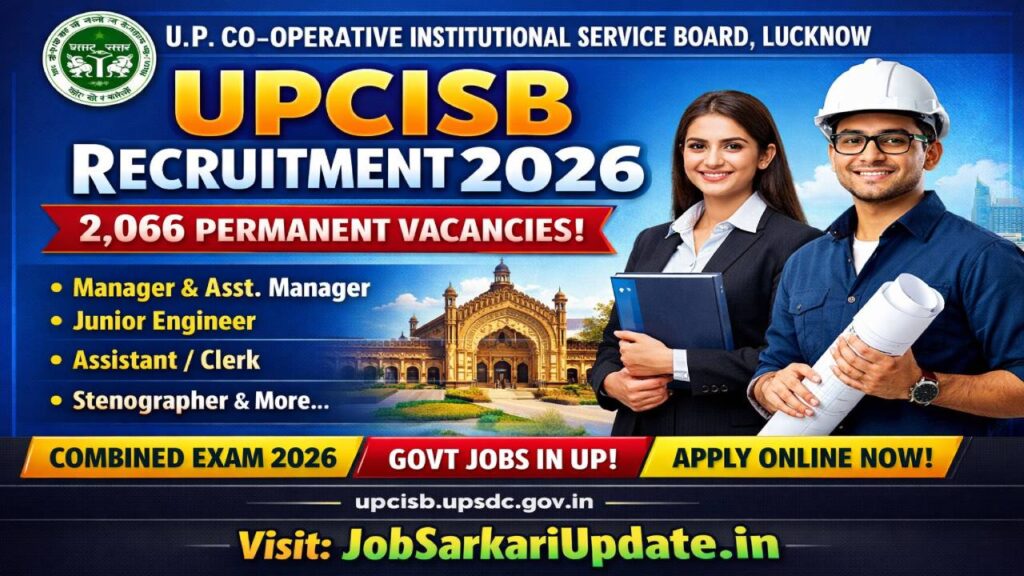
UPCISB Recruitment 2026 is one of the most significant combined hiring drives in Uttar Pradesh’s cooperative banking and technical sector this year. The U. P. Co-operative Institutional Service Board (UPCISB), Lucknow, released Advertisement No. A-2/G.R./2026 in April 2026, inviting online applications from Indian citizens for a total of 2,066 permanent posts spread across 29 distinct designations and multiple cooperative institutions across UP.
This recruitment covers a wide spectrum of roles — from managerial and banking positions such as Manager, Junior Manager, Assistant Manager (General), and Assistant/Cashier, to technical roles including Junior Engineer (Civil & Electrical) and Assistant Engineer (Civil & Electrical), along with clerical and support positions like Junior Assistant, Stenographer, Assistant/Typist, and Accounts Clerk. Posts are distributed across several leading UP cooperative institutions including District Co-operative Bank Limited branches across dozens of districts, U.P. Co-operative Bank Limited, U.P. State Construction Co-operative Federation Limited, and others.
Government jobs in the cooperative banking sector offer strong job security, a defined pay structure with regular increments, National Pension System (NPS) benefits, and the prestige of serving a public institution. For graduates and postgraduates in commerce, science, engineering, and computer science across Uttar Pradesh, this is a rare consolidated hiring opportunity. Given that over 2,000 permanent posts are on offer through a single advertisement, competition is expected to be intense — applicants should begin preparation immediately rather than waiting until closer to the exam date.
Online applications open on 25 April 2026 and close on 15 May 2026. No other mode of application is accepted.
Recruitment Overview
The UPCISB — U. P. Co-operative Institutional Service Board, Lucknow — functions as the nodal recruitment authority for staffing cooperative societies across Uttar Pradesh. Established under state law and headquartered at 21/467, Ring Road, Indira Nagar, Lucknow-226016, the Board has a strong institutional track record of conducting transparent combined examinations for multiple cadres simultaneously. The fact that this recruitment is labelled a “General Recruitment” (as opposed to departmental promotion) signals that it is open to all eligible citizens of India, making it accessible to both fresh graduates and experienced candidates. The Board’s online portal and helpdesk infrastructure add to its credibility as a well-administered recruitment authority.
| Parameter | Details |
|---|---|
| Organization Name | U. P. Co-operative Institutional Service Board (UPCISB), Lucknow |
| Advertisement No. | A-2 / G.R. / 2026 |
| Exam Name | Combined Co-operative Banking, Non-Banking & Technical Services Examination (General Recruitment) – 2026 |
| Total Vacancies | 2,066 (Permanent) |
| Key Post Names | Manager, Junior Manager, Assistant Manager (Computer & General), Assistant/Cashier, Junior Engineer (Civil & Electrical), Assistant Engineer (Civil & Electrical), Stenographer, Junior Assistant, Assistant/Typist, Accountant, Assistant Accountant, Accounts Clerk, Clerk/Typist |
| Job Location | Various districts across Uttar Pradesh |
| Job Type | Permanent Government (Cooperative Sector) |
| Application Mode | Online Only |
| Official Website | upcisb.upsdc.gov.in |
Important Dates
Timing your application wisely is one of the most underrated parts of government job preparation. Candidates who apply in the first week of the application window benefit from fewer server congestion issues, more time to correct mistakes if the portal allows amendments, and the psychological advantage of having the task done. With the last date of 15 May 2026 closing both the fee payment and form submission simultaneously, there is no buffer period — missing this date for any reason means missing this recruitment entirely. Set reminders from today.
| Event | Date |
|---|---|
| Application Start Date | 25 April 2026 |
| Last Date for Online Application & Fee Payment | 15 May 2026 |
| Admit Card Release Date | To be notified on official website |
| Preliminary Examination Date (if conducted) | To be notified on official website |
| Main Examination Date | To be notified on official website |
| Result Date | To be notified on official website |
Note: All dates are subject to change. Always verify from the official notification before taking any action. Exam and result dates will be published on the UPCISB website as the process progresses.
Application Fee
The application fee for UPCISB Recruitment 2026 is straightforward but has one important nuance: if the recruitment process is conducted in two stages (Preliminary + Main), the fee is payable separately for both stages. This means a General category candidate who clears the Preliminary exam will need to pay Rs. 500 again before appearing in the Main exam. Plan your finances accordingly. Payment can be made via debit card (RuPay, Visa, Mastercard, Maestro), credit card, internet banking, UPI, IMPS, or mobile wallet — all standard digital modes are accepted. Always wait for the e-Receipt to generate before closing the browser, and save a printout for your records. One common mistake is pressing the Back or Refresh button during payment processing, which can lead to a failed transaction even when the amount has been deducted from your account.
| Category | Fee Amount | Payment Mode |
|---|---|---|
| Unreserved (UR) / OBC (UP) | Rs. 500/- | Online (UPI, Net Banking, Debit/Credit Card, IMPS, Mobile Wallet) |
| SC / ST (UP) | Rs. 250/- | Online |
| Divyangjan (PwD) of UP | Zero (0) – Exempt | N/A |
| EWS (UP) candidates | Rs. 500/- (same as Unreserved) | Online |
| Candidates not native to UP (all reserved categories) | Rs. 500/- (treated as Unreserved) | Online |
Age Limit
Age is calculated as of 1 January 2026. The general rule: you must have completed 21 years and must not have crossed 40 years on this reference date. In simple terms, your birth date must fall between 2 January 1986 and 1 January 2005 (both dates inclusive) for the general/unreserved category. A helpful way to check: if you were born on 5 March 1987, you were 38 years old on 1 January 2026 — you are eligible. If you were born on 30 December 1985, you were already 40 years and 2 days on that date — you are over-age. Note that for Divyangjan (PwD) candidates, the upper age limit extends to 55 years.
| Category | Minimum Age | Maximum Age | Relaxation Detail |
|---|---|---|---|
| Unreserved (General) | 21 years | 40 years | No relaxation |
| SC / ST / OBC of UP, Outstanding Sports Persons (UP), UP State Govt Employees, UP Basic Education Council employees & aided school teachers/staff | 21 years | 45 years | 5 years relaxation |
| Divyangjan (PwD) of UP | 21 years | 55 years | 15 years relaxation |
| Ex-Servicemen (Emergency / Short-Term Commissioned Officers) | 21 years | 40 years + military service period + 3 years | Relaxation = period of army service + 3 years |
Reservation benefits including age relaxation are available only to UP-domicile candidates in the respective reserved categories. Candidates from reserved categories who are not UP natives will be treated as Unreserved for all purposes including age. Multiple category relaxations cannot be stacked — only the single most beneficial relaxation applies.
Eligibility Criteria
Eligibility requirements vary significantly by post and institution. The most common mistake candidates make is applying for a post based on a general idea of “graduate required” without checking the specific stream, percentage threshold, and computer certificate requirement. For most banking posts, a minimum of 55% marks at graduation is mandatory — not just a pass. Computer certificates (CCC, O-Level, or equivalent from NIELIT) are separately required for nearly all Category-3 posts, and these must be obtained from an officially recognized source. Candidates appearing in their final qualifying examination are explicitly not eligible — you must hold the required qualification by the last date of application.
| Post Name | Key Educational Qualification | Computer Requirement | Experience |
|---|---|---|---|
| Manager (Category-1) – District Co-op Bank | B.Com with 55% OR Graduate with Economics/Maths/Stats (55%) OR B.Tech/BCA/MCA (55%) OR BBA/MBA (Banking/Finance/HR) OR Full-time PG in Banking Finance/HR | Minimum O-Level or equivalent (NIELIT) | Not specified |
| Junior Manager (Category-2) – District Co-op Bank | B.Com with 55% OR Graduate with Economics/Maths/Stats (55%) OR B.Tech/BCA/MCA (55%) OR BBA/MBA (Banking/Finance/HR) OR Full-time PGDM in Banking Finance/HR | Minimum O-Level or equivalent | Not specified |
| Assistant/Cashier (Category-3) – District Co-op Bank | Graduate with 55% marks from a recognized University | CCC Certificate (NIELIT) – mandatory | Not specified |
| Assistant Manager (Computer) – UP Co-op Bank | B.E./B.Tech (Computer Science / Electronics & Communication) OR BCA with 55% | Inherent in qualification | Not specified |
| Assistant Manager (General) – UP Co-op Bank | PG in Commerce/Economics/Maths/Statistics with 55% + CCC or higher OR MBA/PGDM (Banking/Finance) from UGC/AICTE institution OR CA | CCC or higher (NIELIT) | Not specified |
| Assistant/Cashier (Category-3) – UP Co-op Bank | Bachelor’s degree with 55% from a recognized University | CCC or higher (NIELIT) | Not specified |
| Assistant Manager (General) – UP Co-op Federation | Graduate/B.Tech (Computer/Electronics) in any trade; MBA preferred | Not specifically mentioned | Preferably 3 years as Superintendent or equivalent in a top co-op society |
| Accountant (Category-3) – UP State Construction Co-op Federation | B.Com from a recognized university OR PG Diploma in Accountancy | O-Level Diploma in Computer Operation (Govt recognized) | Not specified |
| Assistant Accountant – UP Co-op Union / UP Upbhokta Sahkari Sangh | B.Com with 50% from a recognized University | CCC / O-Level / BCA or equivalent (NIELIT) | Not specified |
| Junior Engineer (Civil) – Category-3 | Diploma in Civil Engineering OR Bachelor’s degree in Civil Engineering from a recognized University | Not specified | Not specified |
| Junior Engineer (Electrical) – Category-3 | Diploma in Electrical Engineering OR Bachelor’s degree in Electrical Engineering from a recognized University | Not specified | Not specified |
| Assistant Engineer (Civil) – Category-2 | Bachelor’s degree in Civil Engineering from a recognized University | Not specified | Not specified |
| Assistant Engineer (Electrical) – Category-2 | Bachelor’s degree in Electrical Engineering from a recognized University | Not specified | Not specified |
| Stenographer / Assistant Stenographer | Graduate from a recognized University + Hindi shorthand 80 wpm / English shorthand 80 wpm + Hindi typing 30 wpm / English typing 40 wpm (computer) | CCC or higher (NIELIT) | Not specified |
| Junior Assistant / Assistant/Typist / Clerk/Typist | Graduate from a recognized University + Hindi typing 30 wpm / English typing 40 wpm (computer) | CCC / O-Level (NIELIT) | Not specified |
| Accounts Clerk – UP Co-op Jute & Agricultural Development | B.Com from a recognized University with minimum 50% marks + General Knowledge of Computer | General computer knowledge required | Not specified |
Vacancy Details
The 2,066 total vacancies in this recruitment are spread across three broad categories. Category-1 (Manager) accounts for 65 posts, Category-2 (Junior Manager, Assistant Manager, Assistant Engineer) accounts for 486+52 posts, and Category-3 (clerical, cashier, technical, steno, typist, accountant) makes up the bulk with over 1,463 posts. The Assistant/Cashier (Banking Assistant / Clerical Staff) group alone across District Co-op Banks is 887 strong, making it the single largest pool of opportunity in this advertisement. Engineers should note that Junior Engineer (Civil) alone has 211 posts across two organizations — an exceptionally high number by cooperative sector standards. Compared to typical UP government banking recruitments that see 200–400 vacancies, 2,066 posts represent a generational hiring event in the cooperative sector, likely driven by years of deferred vacancies finally being consolidated.
| Post Name | Category | Total Vacancies | Posting Organization(s) |
|---|---|---|---|
| Manager | Category-1 | 65 | District Co-operative Bank Limited (Multiple Districts) |
| Junior Manager | Category-2 | 486 | District Co-operative Bank Limited (Multiple Districts) |
| Assistant / Cashier (Banking Assistant / Clerical Staff) | Category-3 | 887 | District Co-operative Bank Limited (Multiple Districts) |
| Assistant Manager (Computer) | Category-2 | 10 | U.P. Co-operative Bank Limited, Lucknow |
| Assistant Manager (General) | Category-2 | 42 | U.P. Co-operative Bank Limited, Lucknow |
| Assistant / Cashier (Category-3) | Category-3 | 66 | U.P. Co-operative Bank Limited, Lucknow |
| Assistant Manager (General) | Category-3 | 78 | U.P. Cooperative Federation Limited, Lucknow |
| Accountant | Category-3 | 24 | U.P. State Construction Co-operative Federation Limited |
| Assistant Accountant | Category-3 | 34 (8+16+2+8) | UP State Construction, UP State Construction & Labour Dev., UP Co-op Union, UP Upbhokta Sahkari Sangh |
| Accounts Clerk | Category-3 | 2 | U.P. Co-operative Jute & Agricultural Development Association Limited |
| Assistant / Stenographer | Category-3 | 18 (4+14) | District Co-op Bank Limited & U.P. Co-operative Bank Limited |
| Stenographer | Category-3 | 5 (4+1) | UP State Construction Co-op Federation & UP Co-op Union |
| Junior Assistant | Category-3 | 45 (12+17+16) | UP State Construction, UP Co-op Union, UP State Construction & Labour Dev. |
| Assistant / Typist | Category-3 | 51 (20+31) | District Co-op Bank Limited & U.P. Co-operative Bank Limited |
| Clerk / Typist | Category-3 | 20 | U.P. Upbhokta Sahkari Sangh Limited, Lucknow |
| Assistant Engineer (Civil) | Category-2 | 32 (20+12) | UP State Construction Co-op Federation & UP State Construction & Labour Dev. |
| Assistant Engineer (Electrical) | Category-2 | 2 | U.P. State Construction Co-operative Federation Limited |
| Junior Engineer (Civil) | Category-3 | 211 (131+80) | UP State Construction Co-op Federation & UP State Construction & Labour Dev. |
| Junior Engineer (Electrical) | Category-3 | 7 | U.P. State Construction Co-operative Federation Limited |
| TOTAL | — | 2,066 (Approx.) | — |
Important: Reservation-wise (vertical and horizontal) vacancy details are provided in Appendix-4 of the official notification. The numbers above reflect total posts. The actual category-wise split (UR, SC, ST, OBC, EWS) and horizontal categories (Women, Ex-servicemen, Divyangjan, etc.) are subject to change as per the latest Government of Uttar Pradesh orders.
Selection Process
The UPCISB selection process is multi-staged and differs by category. For Category-1 and Category-2 posts, merit is determined by the Main Examination score combined with an Interview (Personality Test). For Category-3 posts, merit is based on the Main Examination score and, where applicable, a Proficiency/Skill Test (e.g., typing speed test for typists, shorthand test for stenographers). The Preliminary Examination is a screening stage only — its marks are NOT added to the final merit list.
Stage 1: Preliminary Examination (if required)
The Prelims is a 100-question, 100-mark, 90-minute online objective exam. It is held only if the number of applicants for a post crosses a specified threshold set by the Board. Based on Prelims results, candidates up to 15 times the number of vacancies are shortlisted for the Main Exam. Prep tip: Focus on Numerical Ability, Reasoning, and Hindi/English Language sections — these four sections constitute all 100 marks in the Prelims. Even if you are confident about the Mains subject paper, poor performance in aptitude sections can eliminate you at this stage.
Stage 2: Main Examination
The Main Exam is 120 questions, 200 marks, and 2 hours in duration. Unlike the Prelims, it includes a subject-specific section (Civil/Electrical Engineering, Computer Science, Commerce, Banking/Management) carrying 40 questions worth 120 marks — making the subject section the single most decisive component. Based on Mains results, candidates up to 3 times the vacancy count are called for Interview (Category-1 and 2) or Proficiency Test (Category-3). Prep tip: The subject paper for banking posts is “Managerial Skills” covering Banking (30 Qs) and Computer Knowledge (10 Qs) — study both with equal seriousness since Computer Knowledge is often neglected.
Stage 3: Interview / Personality Test (Category-1 & Category-2 Only)
Candidates shortlisted from the Main Exam are called for Interview. The final merit list is prepared by combining Main Exam marks and Interview marks. Prep tip: Prepare for questions on cooperative banking structure in UP, RBI policy, and your own educational background — interviewers often probe domain knowledge specific to the post.
Stage 4: Proficiency / Skill Test (Category-3 Applicable Posts)
For posts like Stenographer, Assistant/Typist, Junior Assistant, and Clerk/Typist, a Proficiency Test (typing and/or shorthand speed test) is conducted where it is an essential qualification. Candidates up to 5 times the vacancy count are called for this test. Prep tip: Practice daily typing tests using free online tools to hit the required speeds — 30 wpm Hindi and 40 wpm English — well before the exam date. Speed drills two months in advance are far more effective than last-minute cramming.
Stage 5: Document Verification & Medical Examination
Candidates in the final shortlist undergo original document verification. Failure to produce required documents on the scheduled date results in automatic rejection of candidature. A medical examination as prescribed in the service rules is also conducted before final appointment. Prep tip: Prepare a complete document folder in advance — see the Expert Tips section for a full checklist.
Every stage of this recruitment demands consistent preparation — not just for the exam, but also for document readiness, physical fitness, and interview confidence. Candidates who treat this as a single-step exam are often caught off-guard at later stages.
Exam Syllabus & Pattern
The official syllabus and exam pattern for both the Preliminary and Main Examinations are provided in full in Appendix-2 and Appendix-3 of the official notification. The patterns below are reproduced directly from the notification.
Preliminary Examination Pattern (All Categories — if conducted)
| S.No. | Section | No. of Questions | Max. Marks |
|---|---|---|---|
| 1 | Numerical Ability / Quantitative Aptitude | 35 | 35 |
| 2 | Reasoning Ability / Mental Ability | 35 | 35 |
| 3 | Hindi Language & General English | 20 | 20 |
| 4 | Cooperative | 10 | 10 |
| Total | 100 | 100 | |
Negative Marking: 1/4 (25%) per wrong answer Duration: 90 Minutes
Main Examination Pattern – Category-1 & Category-2 Posts (Manager, Junior Manager, Assistant Manager, Assistant Engineer)
| S.No. | Section | Questions | Marks/Q | Max. Marks |
|---|---|---|---|---|
| 1 | Reasoning Ability / Mental Ability | 20 | 1 | 20 |
| 2 | Numerical Ability / Quantitative Aptitude | 20 | 1 | 20 |
| 3 | General Awareness | 15 | 1 | 15 |
| 4 | Cooperative | 15 | 1 | 15 |
| 5 | Language (Hindi & English) | 10 | 1 | 10 |
| 6 | Subject Paper (Civil / Electrical / Computer Science / Managerial Skills & Banking) | 40 | 3 | 120 |
| Total | 120 | — | 200 | |
Negative Marking: 1/4 (25%) Duration: 120 Minutes
Main Examination Pattern – Category-3 Posts (Banking/Clerical: Assistant/Cashier, Typist, Steno, Junior Assistant, Clerk)
| S.No. | Section | Questions | Marks/Q | Max. Marks |
|---|---|---|---|---|
| 1 | Reasoning Ability / Mental Ability | 20 | 2 | 40 |
| 2 | Numerical Ability / Quantitative Aptitude | 20 | 2 | 40 |
| 3 | Computer Language / Computer Knowledge | 20 | 2 | 40 |
| 4 | Language (Hindi & English) | 20 | 2 | 40 |
| 5 | General Awareness | 20 | 1 | 20 |
| 6 | Cooperative | 20 | 1 | 20 |
| Total | 120 | — | 200 | |
Negative Marking: 1/4 (25%) Duration: 120 Minutes
Main Examination Pattern – Category-3 Technical Posts (Junior Engineer Civil/Electrical, Accountant, Assistant Accountant, Accounts Clerk)
| S.No. | Section | Questions | Marks/Q | Max. Marks |
|---|---|---|---|---|
| 1 | Reasoning Ability / Mental Ability | 20 | 1 | 20 |
| 2 | Numerical Ability / Quantitative Aptitude | 20 | 1 | 20 |
| 3 | General Awareness | 15 | 1 | 15 |
| 4 | Cooperative | 15 | 1 | 15 |
| 5 | Language (Hindi & English) | 10 | 1 | 10 |
| 6 | Subject Paper (Civil Engineering / Electrical Engineering / Commerce) | 40 | 3 | 120 |
| Total | 120 | — | 200 | |
Minimum Efficiency Standard (Qualifying Marks)
| Category | Minimum Qualifying Marks in Main Exam |
|---|---|
| SC / ST | 35% |
| All Other Categories (UR, OBC, EWS, etc.) | 40% |
Syllabus Highlights
The complete subject-wise syllabus is given in Appendix-3 of the official notification. Key topics per section include:
- Reasoning: Coding-Decoding, Blood Relations, Puzzles, Syllogism, Data Inequality, Statement & Assumption, Direction & Distance, Input-Output, Figure Series, Non-Verbal Reasoning
- Quantitative Aptitude: Simplification, Number Series, Profit & Loss, SI & CI, Time & Work, Speed-Time-Distance, Data Interpretation (Bar Graph, Pie Chart, Table), Quadratic Equations, Mensuration, Probability
- Hindi Language: Apathit Bodh, Vakya Shuddhi, Muhavre, Paryayvachi, Vilom Shabd, Sandhi, Upsarg, Pratyay, Alankar, Ras
- English Language: Vocabulary, Tenses, Grammar, Idioms & Phrases, Reading Comprehension, Cloze Test, Spotting Errors, Synonyms, Antonyms, Para Jumbles
- General Awareness: UP Co-operative Bank structure, RBI & Monetary Policy, NPA & Basel Standards, Indian Money & Capital Markets, Financial Planning, Current Affairs, Indian History, Polity & Constitution, General Science, Geography of India, UP-specific information
- Cooperative: Origin & Development of Co-operatives, National-level co-operatives (Amul, IFFCO, KRIBHCO), Co-operative societies in UP, Innovations in Co-operatives, Ministry of Cooperation
- Computer Knowledge (Category-3 Banking posts): Hardware & Software basics, Operating Systems, MS Office (Word/Excel/PowerPoint), Internet, Computer Networking, Database basics, Cyber Security basics
- Civil Engineering (AE/JE): Structural Analysis, RCC Design, Building Materials, Soil Mechanics, Hydraulics, Transportation Engineering, Environmental Engineering, Surveying, Hydrology, Irrigation, Estimation & Costing
- Electrical Engineering (AE/JE): Networks & Systems, Electrical Machines, Power System Analysis, Control Systems, Measurement, Power Electronics, Digital Electronics, Microprocessors
- Accountancy (Accountant/Asst. Accountant): Trading & P&L Accounts, Bills of Exchange, Depreciation, Branch Accounts, Bank Reconciliation Statement, Rectification of Errors, Auditing & Income Tax basics
Preparation Tips (Based on Official Syllabus)
- The Cooperative section is unique to this exam — most coaching materials skip it. Dedicate 1 week specifically to UP cooperative banking structure, IFFCO, KRIBHCO, Amul, and the formation of the Ministry of Cooperation.
- For Category-3 banking/clerical posts, Reasoning and Quant each carry 40 marks (2 marks/question) — more than any other section. These two sections will determine your selection, not General Awareness.
- Engineers applying for AE/JE roles should note that the Subject Paper (Civil/Electrical) carries 120 out of 200 marks. Securing 100+ in this section alone can place you comfortably above cutoff even with average scores elsewhere.
Salary & Pay Scale
Salary in this recruitment varies significantly by post and institution, reflecting the financial capacity of different cooperative organizations. The highest pay scale offered — Rs. 43,890 to Rs. 89,285 per month — applies to Assistant Manager (Computer) and Assistant Manager (General) posts at UP Co-operative Bank Limited. By contrast, some posts in smaller cooperative banks operate on older pay commission scales. The figures below represent the pay band; actual gross salary includes Dearness Allowance (DA), House Rent Allowance (HRA), Transport Allowance (TA), and other applicable allowances. In-hand salary after deductions (NPS contribution, income tax if applicable) is typically 15–20% lower than the gross figure. As a rough estimate, a Manager at a District Co-op Bank with Pay Scale Rs. 34,000–88,000 would have a gross in-hand starting salary of approximately Rs. 45,000–55,000 per month depending on the specific bank’s DA rate and posting location.
| Post Name | Pay Scale (Min – Max) | Approximate Starting Basic Pay | Estimated Gross Salary (Approx.) |
|---|---|---|---|
| Manager (Category-1) – Large Banks | Rs. 34,000 – 88,000 | Rs. 34,000 | Rs. 48,000 – 58,000/month (approx.) |
| Manager (Category-1) – Medium Banks | Rs. 20,310 – 52,610 | Rs. 20,310 | Rs. 28,000 – 35,000/month (approx.) |
| Junior Manager (Category-2) – Large Banks | Rs. 29,600 – 82,100 | Rs. 29,600 | Rs. 42,000 – 50,000/month (approx.) |
| Junior Manager (Category-2) – Medium Banks | Rs. 17,670 – 49,170 | Rs. 17,670 | Rs. 25,000 – 32,000/month (approx.) |
| Assistant Manager (Computer & General) – UP Co-op Bank | Rs. 43,890 – 89,285 | Rs. 43,890 | Rs. 60,000 – 75,000/month (approx.) |
| Assistant/Cashier (Banking Assistant) – Large Banks | Rs. 25,620 – 64,670 | Rs. 25,620 | Rs. 35,000 – 45,000/month (approx.) |
| Assistant/Cashier – UP Co-op Bank | Rs. 24,050 – 64,480 | Rs. 24,050 | Rs. 33,000 – 42,000/month (approx.) |
| Assistant Manager (General) – UP Co-op Federation | Rs. 9,300 – 34,800 (Grade Pay Rs. 4,200) | Rs. 9,300 + Grade Pay | Rs. 18,000 – 24,000/month (approx.) |
| Accountant – UP State Construction Co-op | Level-6: Rs. 35,400 – 1,12,400 | Rs. 35,400 | Rs. 50,000 – 60,000/month (approx.) |
| Junior Engineer (Civil) – UP State Construction | Level-6: Rs. 35,400 – 1,12,400 | Rs. 35,400 | Rs. 50,000 – 60,000/month (approx.) |
| Assistant Engineer (Civil) – UP State Construction | Level-10: Rs. 56,100 – 1,77,500 | Rs. 56,100 | Rs. 75,000 – 90,000/month (approx.) |
| Junior Assistant – UP Co-op Union | Level-3: Rs. 21,700 – 69,100 | Rs. 21,700 | Rs. 30,000 – 38,000/month (approx.) |
Career progression in the cooperative sector typically follows a structured promotion path. A candidate joining as Assistant/Cashier can reasonably expect promotion to Junior Manager level within 5–8 years based on seniority and performance-based internal exams. The cooperative sector also offers NPS-based retirement benefits, medical benefits for self and family, and district-based posting that allows candidates to remain close to their home districts — a significant quality-of-life advantage compared to central government posts requiring all-India transfers.
How to Apply Online – Step by Step
Pre-Application Checklist
- Passport-size color photo (4.5 cm × 3.5 cm, white background, 20–50 KB, JPG)
- Signature in black ink on white paper (140×60 pixels, 10–20 KB, JPG)
- Left-hand thumb impression in black or blue ink on white paper (240×240 pixels, 20–50 KB, JPG)
- Handwritten declaration in English in your own handwriting (800×400 pixels, 50–100 KB, JPG)
- Valid personal email ID and active mobile number
- Debit/Credit card, UPI ID, or Net Banking details for fee payment
- Educational certificates, age proof (High School certificate), category certificate (if applicable)
- Visit the Official Portal: Go to the UPCISB official website at upcisb.upsdc.gov.in and look for the “APPLY ONLINE” link under the General Recruitment 2026 section.
- New Registration: Click on “Click here for New Registration.” Enter your name, contact details, and email ID. Note down the Temporary Registration Number and Password sent to your email and SMS.
- Fill the Application Form: Log in with your credentials. Fill all personal, educational, and category details carefully. Use the “SAVE AND NEXT” feature to save your progress. Do not click “COMPLETE REGISTRATION” until all details are verified.
- Upload Documents: Upload your photo, signature, left-hand thumb impression, and handwritten declaration in the specified dimensions and file sizes. Ensure all uploads are clear — blurry uploads lead to rejection.
- Select Post and Preference: Select the specific post and institution, and fill in your order of preference as required. This preference cannot be changed after submission.
- Preview and Final Submission: Click “Preview” to review your entire form. Make any corrections. Once satisfied, click “COMPLETE REGISTRATION.” No changes are possible after this step.
- Pay Application Fee: Click the “Payment” tab. Select your payment mode (UPI, Debit/Credit Card, Net Banking, etc.). Wait for the e-Receipt to generate. Do not press BACK or REFRESH during payment. Save and print the e-Receipt and application printout.
Most Common Application Mistakes to Avoid
- Uploading oversized or blurry documents: The portal strictly enforces file size limits. Test your image files before starting the form.
- Signing in capital letters: Signatures in all CAPS are explicitly rejected. Your signature must be in your regular cursive style.
- Writing the handwritten declaration in someone else’s handwriting or in Hindi: The declaration must be written by you, in English, in your own handwriting. Typed declarations are allowed only for visually impaired candidates with a left thumb impression.
- Pressing Back/Refresh during payment: This is the most common cause of fee payment failures. Always wait on the payment processing screen until the e-Receipt appears.
Important Instructions for Candidates
- ✔ Double-check every detail entered in the form before clicking the final submission button — no corrections are accepted post-submission.
- ✔ Keep all scanned documents ready in the specified format and size before opening the application form. Starting without them often leads to incomplete or rushed uploads.
- ✔ All dates are subject to change — always verify from the official notification before taking any action.
- ✔ Use only your own valid email ID and mobile number — all future communications (admit card download intimation, result alerts) will be sent to these details.
- ✔ Candidates currently serving in Central or State Government must obtain a No Objection Certificate (NOC) from their employer to participate.
- ✔ This content is for informational purposes only. Candidates are advised to read the official notification thoroughly before applying.
Expert Tips to Crack UPCISB Recruitment 2026
Apply in the First Week
The application window runs from 25 April to 15 May 2026. Applying in the first few days gives you the advantage of resolving any technical errors with the portal’s helpdesk (0522-7118317 or helpdesk@upcisb.org) before the last date rush. Government portals frequently experience server slowdowns and payment gateway issues in the final 48 hours. Candidates who wait until 13–15 May often find themselves unable to complete the process in time. Apply by 30 April if possible — treat May 15 as an emergency backup date, not the planned submission date.
Read the Full Notification Before Filling the Form
This 106-page notification contains crucial details that are easy to miss — particularly the Appendix-4 vacancy data (category-wise distribution), the Appendix-3 syllabus, and the Appendix-5 service rules. Many candidates apply without confirming that their specific district’s institution has vacancies in their preferred post. For example, the post of Assistant/Cashier at District Co-operative Bank, Bareilly has only 1 vacancy — a very different competition scenario from the 78 vacancies at Lakhimpur Kheri. This kind of data-driven choice can significantly improve your chances of selection.
Prepare All Documents Before Starting the Application
Create a dedicated folder (physical or digital) containing: High School certificate for DOB proof, graduation marksheets and degree, CCC/O-Level computer certificate, category certificate (SC/ST/OBC/EWS/Divyang/etc.) in the format specified in Appendix-1 of the notification, passport photographs, signature scans, left thumb impression scan, and handwritten declaration image. Having all these ready before even opening the portal eliminates the risk of scrambling mid-application, which often leads to rushed uploads and errors.
Begin Exam Preparation from Day One
With the application window closing on 15 May 2026, and the exam date yet to be announced, you have a preparation runway that is typically 2–4 months for competitive exams of this scale. Begin immediately — specifically the Cooperative section, which is unique to UPCISB and has no standard coaching material. Study UP’s cooperative sector through official UPCISB and NABARD publications. For engineering candidates, start with your core subject paper (Civil/Electrical) since it carries 120 out of 200 Mains marks. For banking/clerical posts, daily practice of 50 Reasoning and 30 Quant questions is the most reliable preparation strategy.
Avoid the Most Common Rejection Reasons
Based on standard cooperative recruitment patterns in UP, the most frequent causes of candidature rejection are: applying without the mandatory computer certificate (CCC/O-Level), claiming category benefits without UP domicile, submitting applications where the educational qualification was not completed by the last date, not having the required percentage (55% or 50% depending on post), and discrepancies between the name on the application and the name on the High School certificate. Verify each of these five points for the specific post you are targeting before submitting. A candidature once rejected cannot be reinstated.
Stay Updated on Admit Card, Result, and Cut-off Dates
The UPCISB does not conduct personal correspondence with candidates — all updates including exam dates, admit card links, and result announcements are published exclusively on the official website upcisb.upsdc.gov.in. Bookmark this URL and check it at least once a week after submitting your application. Additionally, register on 2–3 reliable Sarkari job update platforms to receive notifications as a backup. Missing the admit card download window is a surprisingly common issue — candidates who rely on email alone sometimes find the email in their spam folder after the window closes.
Frequently Asked Questions (FAQs)
- 1. How many total vacancies are there in UPCISB Recruitment 2026?
- A total of approximately 2,066 permanent posts are advertised under Advertisement No. A-2/G.R./2026. These posts span 29 designations across multiple cooperative institutions in Uttar Pradesh.
- 2. What is the educational qualification required for the Assistant/Cashier (Banking Assistant) post?
- For Assistant/Cashier at District Co-operative Bank Limited, you need a graduation degree with a minimum of 55% marks from a recognized university. Additionally, a CCC certificate in computer operation from NIELIT or its affiliated institution is mandatory.
- 3. What is the age limit for UPCISB 2026 General Recruitment?
- The general age limit is 21 to 40 years, calculated as of 1 January 2026. SC/ST/OBC of UP and state government employees get 5 years relaxation (up to 45 years). Divyangjan of UP can apply up to 55 years. Ex-Servicemen get relaxation equal to their military service period plus 3 years.
- 4. How much is the application fee, and is there any exemption?
- The fee is Rs. 500 for Unreserved and OBC (UP) candidates and Rs. 250 for SC/ST (UP) candidates. Divyangjan (PwD) of UP are fully exempt. Note that if the exam is conducted in two stages (Prelims and Mains), the fee is payable separately for each stage.
- 5. What is the last date to apply for UPCISB Recruitment 2026?
- The last date for both online fee payment and form submission is 15 May 2026. No extension has been announced as of the date of this notification.
- 6. How many stages are there in the UPCISB 2026 selection process?
- For Category-1 and Category-2 posts, the process includes Preliminary Exam (if required), Main Exam, and Interview. For Category-3 posts, it involves Preliminary Exam (if required), Main Exam, and Proficiency/Skill Test (where applicable). Document verification and medical examination follow final shortlisting.
- 7. What is the salary for Junior Engineer (Civil) in UPCISB 2026?
- Junior Engineer (Civil) at UP State Construction Co-operative Federation is placed at Pay Level-6 with a pay scale of Rs. 35,400 to Rs. 1,12,400. The estimated gross starting salary including DA, HRA, and TA is approximately Rs. 50,000–60,000 per month, depending on posting location.
- 8. Is there negative marking in the UPCISB exam?
- Yes. For both the Preliminary and Main Examinations, 1/4 (25%) of the marks allotted to a question will be deducted for each wrong answer. No marks are deducted for unattempted questions. Marking more than one answer for a question is treated as a wrong answer.
- 9. Can final-year students apply for UPCISB 2026?
- No. The official notification explicitly states that candidates appearing in the qualifying examination are not eligible to apply. All required educational qualifications must be held by the last date of application, i.e., 15 May 2026.
- 10. What documents are needed for UPCISB document verification?
- You will typically need originals and self-attested copies of: High School certificate (for DOB), graduation marksheets and degree, CCC/O-Level computer certificate, category certificate (SC/ST/OBC/EWS/Divyang) in the format specified in Appendix-1 of the notification, domicile certificate, and one valid photo identity proof (Aadhaar, PAN, Passport, Voter ID, etc.).
- 11. Is age relaxation available for OBC candidates outside Uttar Pradesh?
- No. Reservation and age relaxation benefits — including for OBC, SC, ST, EWS, Divyangjan, Ex-Servicemen, Freedom Fighter dependants, and Outstanding Sports Persons — are available only to candidates who are domiciles (natives) of Uttar Pradesh. Candidates from the same categories but not native to UP will be treated as Unreserved (General) for all purposes.
- 12. Where can I download the admit card for the UPCISB 2026 exam?
- Admit cards will be made available for download on the official UPCISB website at upcisb.upsdc.gov.in. Intimation will also be sent via email and SMS to the registered contact details. You will need your Registration Number/Roll Number and Password/Date of Birth to download it.
Important Links
| Apply Online | Apply Now |
| Download Notification | Click Here |
| Official Website | Click Here |
Recent Jobs
Check out our latest job postings
815 Jobs Available
Delhi Police Physical Admit Card 2026 - Quick Summary: Delhi Police has released new dates for Physical Endurance & Measurement...
Read Full Details
TMB Specialist Officer 2026 - Quick Summary: Tamilnad Mercantile Bank has released notification for Specialist Officer (IT) vacancies in Chennai....
Read Full Details
BPSC Bihar TRE-4 2026 - Quick Summary: BPSC has announced Bihar TRE-4 Recruitment 2026 for 32,388 Teacher vacancies across Primary,...
Read Full Details
Punjab PTI Recruitment 2026 - Quick Summary: Education Recruitment Directorate (ERD), Punjab has released notification for 2,000 Physical Training Instructor...
Read Full Details
SSB Physical Date 2026 - Quick Summary: SSB has announced PET/PST commencement for Constable to Sub Inspector (Non-GD) Recruitment 2025....
Read Full Details